THIS.
It's not that I can't comprehend a foreign language. My masters degree is in Semitic Languages. I worked with Northwest Semitic languages (Canaanite, proto-Canaanite, Tyrian/Bibylian Phoenician, Moabite, Amorite, taught koine Greek for a year to college students, and Hebrew (biblical, rabbinic and modern) for years. I can tell if a dialect is Moabite or Hebrew by the use of a verb. I can navigate the proto-Canaanite A to O shift and fully decline pretty much anything I want from any binyan or shoresh, but I cannot read music. Languages aren't the same for me as music; languages draw easily from one part of my brain, whereas music, art, poetry come from an entirely different an unrelated part of my brain. The two parts don't communicate with each other very well, in fact, they're not even on speaking terms anymore.
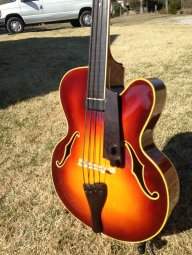
This is exacerbated by the fact that I was entirely self-taught on bass. I learned it by ear based on patterns on the fingerboard, so when I think of a song, I think of sets of polygonic patterns that make up the song. I learned the Intro to 2112's Overture as: A to D string - straight vertical line (E -A), Pause. Go to G string then D and make a scalene triangle (C - G - D). When I play Dream Theater's "Dance of Eternity" I subconsciously think "Oh, here's that oven shaped pattern" or "Here's that sawtooth pattern that drops into that gun-shaped pattern." I screw up when I can't recall the pattern. So I have my patterns from basic shapes (boxes - D - E - G - A, triangles) to more advanced ones (sawtooth - F - B - E / D - Ab -Db, ), to completely crazy ones (sailboats, guns, etc.) It all depends. Of course I can take the pattern and break it (the square of D - E - G -A might be played with open strings, or on one string, or whatever. But the patterns never go away, unless I forget them. But these are real notes on the real fingerboard. They make sound when I invoke them - it's very physical, non analytical, and immediate.
Now, take my way of thinking (polygons) and throw a sheet of music in front of me. Sure, I know that all cows eat grass - but the note patterns on the staff are completely different. Alien. Not bass-like. I now have to deal with another language, a language that is instrument agnostic, completely UNLIKE everything on my fingerboard and translate them, on the fly, deciphering rests, stops, dotted notes, bars, etc. and take this data to the fingerboard, an environment that looks nothing like the staff. For me, this takes away from any direct "ear to emotions" pleasure because now I've got to activate the analytical part of my brain to a very high degree to decipher squiggles, bars, dots, lines, etc. - all abstractions - and play them. This is so different from my goofy way that doesn't utilize abstractions, but uses patterns that really exist on the fingerboard itself.
I think that's it for me.
Now, is this a problem? It can be. For certain, as mentioned earlier in this thread, my inability to read has cost me numerous opportunities, and I regret that. I wish I could read. People ask me to teach them bass, and I won't because I don't want to pass along my bad habits. I tell people to find a good teacher with a solid knowledge of theory and who can read music and do it right from the start - that way, they might be able to say "Yes, I'll be there" for a studio session opportunity instead of "Sorry, I've I learned my own idiosyncratic method for bass playing that is no one else knows and I'll be practicing at home that day" as I've done.
But it isn't ALL a problem. Yes, there are tabs (of variable quality), which is almost what I am doing in my own polygonic style, but some of my most interesting stuff has resulted from my INability to read and be influenced by what I see - and having to rely SOLELY upon what I hear. For instance, in an original piece, there's a section our keyboardist wrote out. The band played it and recorded it for me to learn, so I'm listening to it and hear a melody in my head.
Hit one a string E note. Now hit an open E. Next, hit a harmonic of G-C-F on the D -G -C strings (I've a six string), let it sustain and hit a C on the A string then B then C quickly. Next line. Repeat the Intro with the E's, hit the harmonic chord but don't sustain it, mute it) go to E string and hit B - A - B then repeat. Much to my surprise I later learned the section was written in Am. The knowledge that it was in Am might have influenced me to have done something chained to an Am instead of what I, in my ignorance, came up with, which doesn't make use of A except as a single quick 8th note for contrast. This happens quite a bit. I write my lines purely by ear, and my ear doesn't care what key it's in - it hears what it hears and is blind to what is written - then I play it and it becomes a pattern, followed by more patterns, until it's finished. This doesn't always work, but it's served me pretty well and (I think) has caused me to think in ways that are not bound so tightly.
This whole "one part of the brain" thing really seems to sum up my failure to be able to read music. For me it's a personal deficiency. I can either analyze, break down and study (languages for instance), or I can hear it, see the pattern, the color (of course patterns have colors - right? lol) and feel it emotively, immediately and fully without consciously thinking about it. I can't combine analysis (data decipherment) and emotion (art) to any high degree. I know a lot of people can, or they see the analysis as emotive, I'm not one of them. I play music for the emotion of it - right at the moment it's happening, I read Ahiram for the non-emotive mental challenge of it.