• TalkBass has been independent since 1998. Add your voice.
    Create a free account to reply to discussions, view embedded media, and browse with fewer display ads.
    Join freeLog in
    Want zero display ads or expanded classifieds tools? Compare plans.

Dummy load. Can you use ceramic cement resistors.

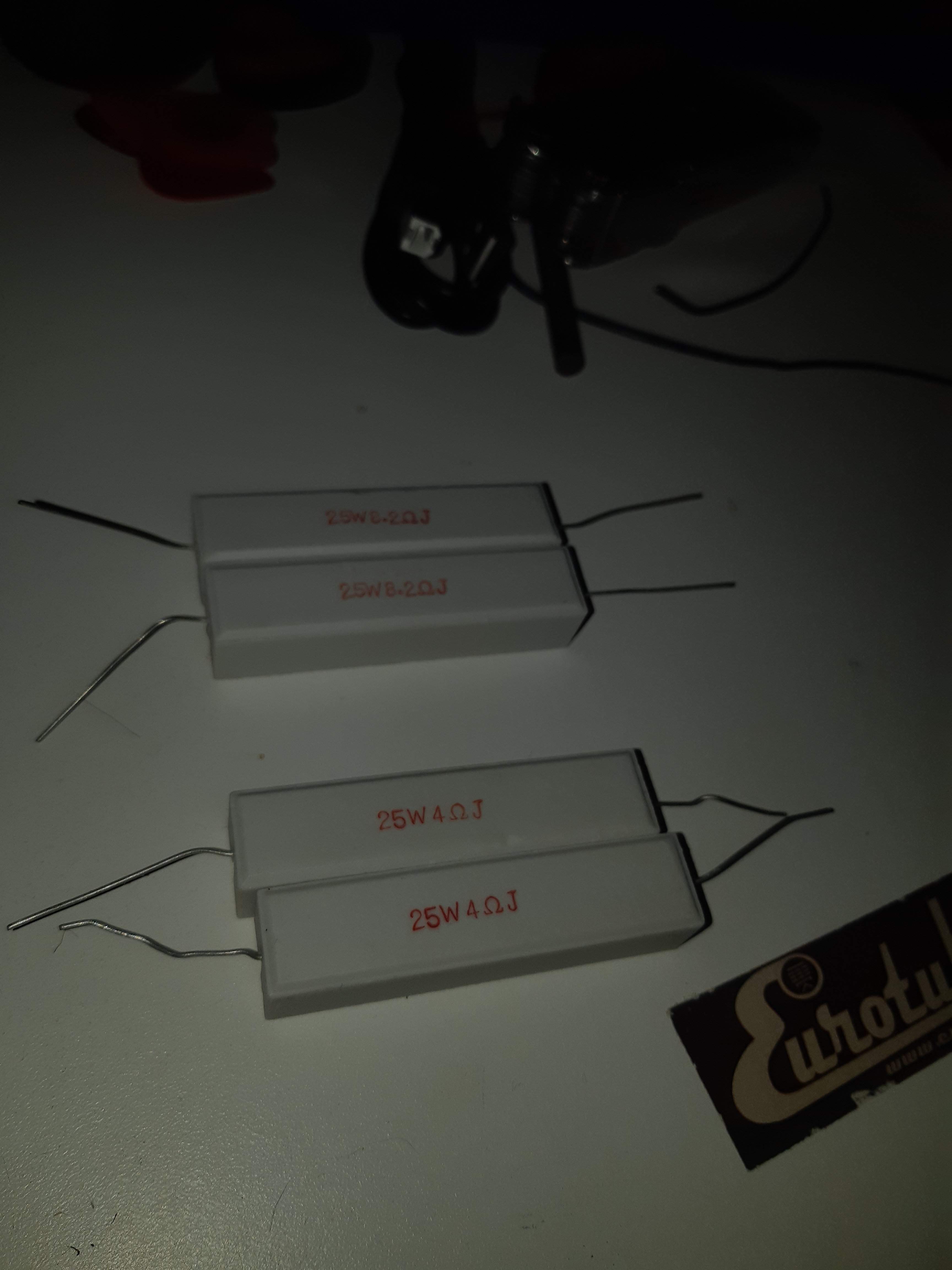
Went to the local electronics store today and they did not have any Metal Heat Sink Power Resistors in the values I needed. I ordered some in but I also have a 90 watt tube amp I wanted to do some signal tracing on. I have a bunch of ceramic cement resistors in my stash is there anything I could whip up with them that would work as a sufficient dummy load?
20200214_164806.jpg
 
Connect four of the 4Ω 25W resistors, two pairs in parallel and the pairs in series will give you a 100W 4Ω load. If you are going to apply some power blow a small fan on them.

I go some 500w resistors via Ebay. Bolted to an aluminium plate they work well.

I only have two 8 ohm 25 watt and two four ohm 25 watt on hand right now. Could I wire the two 8ohms in parallel for a 4 ohm 50watt load.? Would that be enough or the two 4 ohm in series for a 8 ohm load.
 
Last edited:
I only have two 8 ohm 25 watt and two four ohm 25 watt on hand right now. Could I wire the two 8ohms in parallel for a 4 ohm 50watt load.? Would that be enough or the two 4 ohm in series for a 8 ohm load.
for a 90w tube amp?

i wouldn't, even if i had four of the same to make a 100w dummy load. there's no safety margin, some "90w" tube amps can put out a lot more if pushed into clipping. if one of those resistors opens up and all of a sudden your tube amp is going full-blast into an open circuit that could be the end of your output transformer.

i'd be more comfortable with two or even four of these bad boys at 100w each:
2021009388.jpg
 
you can get water heater elements from home depot
for about 10 to 25 dollars.

the elements range from about 14 to 16 ohms.
so most guys will run 2 for a 8 ohm load.
you just mount them in a paint can and suspend them in water like usual.

in English this means you get a dummy load up to 1600 to 2000 watts
resistance stays stable within .001 ohms usually up to 1000 to 1200 watt loads

do a search for heater element dummy load, plenty of youtube videos as well

you can use ceramic resistors
you just need to run enough in series or parallel to be able to handle the wattage. and to get whatever impedance you like.

keep in mind a " 25" watt resistor can handle way more power then 25 watts
its rated at 25 watts because that is the temperature the resistance stays stable within its tolerance rating. 1% 10% 20 % etc etc

so if you apply more power than its rated value
resistance will not be within the rated tolerance if the temperature gets high.
likewise if the resistance wire was bare you could apply way more power
but of course its suspended in the ceramic form. so it cannot dissipate heat as well
this is why a " 25" watt resistor is rated for 25 watts cause that is the power it can handle before the value is out of tolerance. otherwise they wire can handle anywhere from 200 to 300 watts. it just gets hot and does not remain accurate cause its in a ceramic form. hence why the rate them so low.

anyways blah blah. point is you just run a fan on them to keep down the heat.
likewise setup your test. get the measurements quickly and dont run the load for extended periods

otherwise you add more resistors and run a fan if you want longer test time.

or like i said you buy a heater element for 10 bucks and it stays very very stable for a long long time and can handle 1000 plus watts
 
Last edited:
Went to the local electronics store today and they did not have any Metal Heat Sink Power Resistors in the values I needed. I ordered some in but I also have a 90 watt tube amp I wanted to do some signal tracing on. I have a bunch of ceramic cement resistors in my stash is there anything I could whip up with them that would work as a sufficient dummy load?

What could go wrong?
Yel_wink.gif


Toaster3.JPG
 
Note that water heater elements don't remain stable to .001 ohm under any conditions.
Are wire-wound resistors that consistent under load? I've long been aware of resistance varying in a water-heater element, but I always figured wire-wound resistors would also begin to drift when things start to warm up, just not as much. Accuracy to .001 ohm would be considerably more than I would have thought. And of course, considerably more than needed for the sort of stuff that I'm capable of doing. EDIT: Now that I've re-read the post from @BogeyBass, I see where that .001 number accuracy number came from; I thought Andy was asserting that about wire-wound resistors. So, uhmm… never mind, I guess. :D

Also...if you're going to immerse your resistors to dissipate the heat, use mineral oil, not water.
 
Last edited:
I really wish I knew what this was about. Anyone care to elaborate?
Amps in general and tube amps specifically need a load to operate correctly (and safely in the case of a tube amp) when troubleshooting on a test bench for signal tracing.

Using a speaker is both inconvenient (due to the noise generated) and unsafe to the speaker, especially in amp fault conditions.
 
Are wire-wound resistors that consistent under load? I've long been aware of resistance varying in a water-heater element, but I always figured wire-wound resistors would also begin to drift when things start to warm up, just not as much. Accuracy to .001 ohm would be considerably more than I would have thought. And of course, considerably more than needed for the sort of stuff that I'm capable of doing. EDIT: Now that I've re-read the post from @BogeyBass, I see where that .001 number accuracy number came from; I thought Andy was asserting that about wire-wound resistors. So, uhmm… never mind, I guess. :D

Also...if you're going to immerse your resistors to dissipate the heat, use mineral oil, not water.
All resistors drift, wire wound resistors do drift, generally (a lot) more than .001 ohms for an 8 watt resistor.
 
  • Like
Reactions: Redbrangus
Speakers are terrible loads. Their impedance jumps all over the place. Speakers are reactive loads and the current and voltage are out of phase.

Amplifiers are rated into resistor loads. It's just easier to measure. And it's easier to do basic troubleshooting with a known stable load.

Using a speaker for a test is just one part of troubleshooting.
 
Amps in general and tube amps specifically need a load to operate correctly (and safely in the case of a tube amp) when troubleshooting on a test bench for signal tracing.

Using a speaker is both inconvenient (due to the noise generated) and unsafe to the speaker, especially in amp fault conditions.
Thanks, that sheds a little light, but I'm still lost. Carry on sorry for the derail.
 
Went to the local electronics store today and they did not have any Metal Heat Sink Power Resistors in the values I needed. I ordered some in but I also have a 90 watt tube amp I wanted to do some signal tracing on. I have a bunch of ceramic cement resistors in my stash is there anything I could whip up with them that would work as a sufficient dummy load?
View attachment 3707685


Thise look like what are in my Scholz Power Soak.........which has 30 years of use with a Fender BandMaster Reverb.
 
I don't know of any resistor that doesn't vary somewhat with large temperature changes, although maintaining resistance of a dummy speaker load to within .001 of an ohm is chasing rainbows.

I made a set of load resistors 30 years ago from ceramic kiln shelf pedestals, a triangular shaped hollow rod made of high temperature clay, and wound it with #18 nichrome wire to 4 ohms. It's stood up to as high as 1800W RMS for short periods of time, although it's glowing bright yellow. These are just strictly air cooled, and I haven't ever had them burn open.

If impedance isn't critical, an ordinary incandescent light bulb matched close to the maximum power of the amp will work.