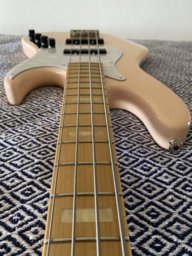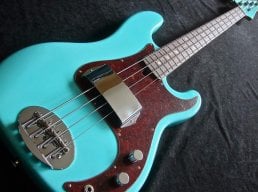
I think raw roasted maple is more stable than raw maple. I'm not sure raw roasted maple is more stable than finished regular maple.

TalkBass has been independent since 1998. Add your voice.
Create a free account to reply to discussions, view embedded media, and browse with fewer display ads.
Join free Log in
Want zero display ads or expanded classifieds tools? Compare plans.


Not aesthetically no but possibly for the other benefits of roasted maple?With a painted headstock and painted neck....no real need for using roasted maple?
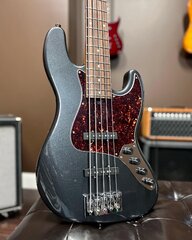
If one maintains an oiled-and-waxed neck properly, is it not finished?
Not aesthetically no but possibly for the other benefits of roasted maple?

Photoshop.How are those guitars standing up?

Woah! When'd they get that in?! I almost stopped by tonight.N'Stuff Music here in Pittsburgh already has one of the Dargies. I have refused to go in order to protect my savings account.

Classic.I try to avoid outlandish initial reactions, but I’m very pleased. It weighs in at 8 lbs, 14 oz on my kitchen scale. First impressions are that it feels and sounds really good! I’m glad I got the Plek job on it, whether it needed it or not.
View attachment 3314502

Yessir. I love the size and feel of my Sterling 5 but it is very forward sounding. Wish they would've changed the pickup/preamp for 2019. Wonder what neo-pickups would sound like in it.I was a bit iffy of it being too harsh like my Sterling 5 is because of the ceramic pickup.


He did ask if anyone thought we needed one. I thought it was a pretty good ideaGotta say, "Thanks RichSnyder for starting this thread!"
101 pages and going strong!
But what I was getting at is that EBMM necks — roasted or not — are not unfinished (raw, as you call it). They are finished with oil and wax. They only become unfinished if one does not maintain them.Yes and that is sort of my point. The non-aesthetic benefits of roasted maple are the feel (for some players) and stability (for all players). A finished and cared for non-roasted neck is just as stable as a roasted maple neck for all intents and purposes.
It seems to me by painting the headstock and neck you lose the marketing aspect of what roasted maple represents for these new Specials. In other words, I'm not sure there is a definite advantage to having your maple neck roasted if you are going to paint it and the headstock. None of the roasted color shows, you don't get the "raw wood" feel, and any added stability is largely negligible.
Don't get me wrong, it's a beautiful bass. I just feel that it defeats the purpose of having a "roasted maple" neck as a feature.
I try to avoid outlandish initial reactions, but I’m very pleased. It weighs in at 8 lbs, 14 oz on my kitchen scale. First impressions are that it feels and sounds really good! I’m glad I got the Plek job on it, whether it needed it or not.
View attachment 3314502

But what I was getting at is that EBMM necks — roasted or not — are not unfinished (raw, as you call it). They are finished with oil and wax. They only become unfinished if one does not maintain them.

In regards to roasted, non-roasted I’d like to make a few observations here taken from real life, long term experience.
It is a fact that the drier wood becomes the more stable it becomes as well, both in its dimensions and straightness. Let me qualify that statement by saying I’ve been a player for 45 years and one bass in my quiver I’ve owned for forty of those years. When that bass was new I felt like it was reasonably stable but the older (drier) it gets, the better it becomes and is pretty much impervious to any kind of climate change within reason.
It is my belief that painting a maple neck will not make it more stable. Only proper curing and drying will do that. Having said that, I think it’s possible that the trend in roasted wood is really only a means of speeding up that process. Economics maybe?
I’m also a gunsmith specializing in the crafting of hand made 18th century flintlock replicas most of which are stocked in sugar maple (very stable) and some with red maple (not so stable).
When I buy this wood it is kiln dried and then aged in a humidity controlled warehouse in PA to a moisture content of around 12% for at least four years. When it is shipped to me it then is exposed to the Florida humidity of between 60% on the dry end, to maybe 85% or even higher and will undergo all kinds of drastic warping and twisting. I then have to start the aging and re-acclimating process all over again. I’m sure that building guitars, especially necks, requires a similar process.
Sorry about the rant, but I couldn’t contain it any longer. I have an opinion about PLEK’ed necks, but I’m gonna bite my tongue for now.
Thanks, KW
Regardless of neck finish, I find that Dargie Special extremely handsome. Glad I just got a five string so no temptation. But wow...lure of the Siren for sure.