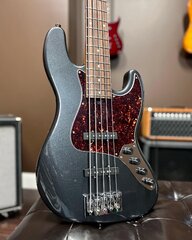
The strings follow the radius of the fretboard. I’ve personally never seen a properly setup bass that didn’t have the strings following the radius of the fretboard. YMMVThe simple solution is don’t curve the strings

TalkBass has been independent since 1998. Add your voice.
Create a free account to reply to discussions, view embedded media, and browse with fewer display ads.
Join free Log in
Want zero display ads or expanded classifieds tools? Compare plans.
The strings follow the radius of the fretboard. I’ve personally never seen a properly setup bass that didn’t have the strings following the radius of the fretboard. YMMVThe simple solution is don’t curve the strings

The strings follow the radius of the fretboard. I’ve personally never seen a properly setup bass that didn’t have the strings following the radius of the fretboard. YMMV
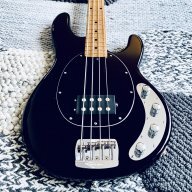
The strings follow the radius of the fretboard. I’ve personally never seen a properly setup bass that didn’t have the strings following the radius of the fretboard. YMMV

I have a Special and a couple pre-Special StingRays — all 5-strings — and I do not experience what you describe. (Or maybe I do, and I subconsciously adjust my technique to compensate.)I’ve primarily been a P bass player for years, but I’m enjoying this new Stingray Special 5. One observation for which I’d like to find a solution: on my P basses, I can adjust the pickup heights so that they generally arch higher in the middle, following the curvature of the fingerboard, thereby making each string the same distance from the pickup. On my Stingray, I’m noticing the outside strings (B & G) sound louder than the inner strings (especially the A string). I’m assuming this is because the pickup is flat, and the pole pieces don’t follow the curvature of the strings, so the inner strings are further away from the pickup. Is there a simple solution to this? Is it possible to raise the pole pieces in the middle, to account for the curvature of the strings? I know jazz basses typically face the same problem, although I have seen some jazz pickups with raised pole pieces in the middle.
This would provide an unplayably giant string height for the B and G strings. String height should follow the fingerboard radius.The simple solution is don’t curve the strings
Unplayably giant is a bit of a stretch. The curve isn’t all that exaggerated. You can set up a bass the way that works best for you and for the instrument. If you like it one way then that’s the best way for you but sometimes that isn’t the best for everyone. Again there are lots of ways to skin a cat. The argument seems to be “it has to be this way, even if it doesn’t work for me because this is the right way even if it’s wrong”. That doesn’t make much sense to me. I set up saddle height differently on a p bass then I do on a Stingray. That’s what makes sense to me.This would provide an unplayably giant string height for the B and G strings. String height should follow the fingerboard radius.
GHS Bass Boomers: 45-65-85-105-130The other variable and possibly the biggest variable that we aren't discussing as it relates to Killens issue is the strings. What kind of strings are you experiencing this issue with?

I just put 45-100 Boomers on mine a couple of days ago. I haven't noticed any drop. If I were you, I would definitely experiment with the pickup heights. Best of luck!GHS Bass Boomers: 45-65-85-105-130
Gonna try various others as well.
This is interesting I’ve always adjusted the pole pieces of my older Stingrays to be almost flat, because my low action setup doesn’t have much of a curve. So I was pleased to see the special had flat pole pieces to start with. I find it gives a much more even volume across the strings.

EBMM are damned if they do, and damned if they don't :
The pickup poles used to follow the radius of the fretboard, and some people complained it caused a "weak" G string.
They make the Specials with all the pole pieces level, and now there's a "weak" A string



At this price point I’d insist on getting what you want. Bring it back and get a lighter one without obvious dead spotsHallo everybody - i’ve been reading pages 1 to 15 and then 95 to 100
But here I go to join the Club with my 5hh
View attachment 3317855
I am really happy with this beauty and with the sound it produces.
I have something though I would like to hear your opinions.
Beside the fact that the instrument weighs almost 10.5lbs - which seems to be slightly more than advertised - I have found dead spots
It’s not the g though - its the b string from say 12th fret all the way up that sounds dull. the notes sound quite dead unamplified. But - its the b string, and one would hardly use it up that register except maybe for some arpeggios pearling down.
Any thoughts?
Zsolt

I'm just ridiculously happy with the stock strings that came on it