• TalkBass has been independent since 1998. Add your voice.
    Create a free account to reply to discussions, view embedded media, and browse with fewer display ads.
    Join freeLog in
    Want zero display ads or expanded classifieds tools? Compare plans.

EBMM StingRay Special Club

I've owned rosewood and maple Precision and Jazz basses, and even though they were all quite different, I prefer rosewood, but I've never tried roasted maple.
Im just asking whether the process of roasting maple has any effect on tone.
For me it's more about the way the wood looks and the way it feels underneath my fingertips . I've always preferred ebony because of this.


Yep, what do you like staring at? Lol
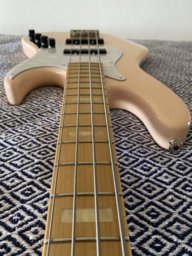
I prefer a maple board but found the roasted maple boards to be too dark on the specials, so now both my specials have Ebony. EBMM puts a generous chunk of wood on there too, looks and feels real nice. If they ever make one in their lighter vintage satin tint with a maple board I will be all over it.
 
Ok. If three identical basses has the same 'flat' eq setting, but different fingerboards, how would the tonal characteristics differ?

It's the sum of all parts that ends up defining the tone. Changing one variable to another is not a surefire way to anticipate the difference in the outcome. Every piece of wood is different, and you can't generalize how a certain type of wood sounds, I'm sorry but no one has ever been able to prove otherwise. I'm not a wood fanatic, and most of the tonal difference that the new Stingray Specials have to their older counterparts is due to the redesigned electronics and pickups. So chose the bass that you end up liking the most, or - choose the fretboard that looks better to you.
 
Ok. If three identical basses has the same 'flat' eq setting, but different fingerboards, how would the tonal characteristics differ? Sadowsky say the fingerboard has a bigger influence than the body wood on tone. How does roasting the neck change the tone, if at all?

Hi
Although the test below has been done for guitars but I think it might answer to your question

At the end, it's all a matter of personal preference.

 
Not wanting to debate tonewood at all. Just asking people's experience with these new roasted necks. Good morning to you.

As I said earlier, it's all about personal preference! Whatever combo makes you happy and willing to grab the bass every time you see it, go for it!
Personally I prefer rosewood, but their maple is sensational.

For me, this one has been ordered.
upload_2019-5-7_13-32-36.png

And that after I'm constantly playing this one
upload_2019-5-7_13-36-35.png
 
Hi
Although the test below has been done for guitars but I think it might answer to your question

At the end, it's all a matter of personal preference.


Interesting demonstration. Thanks for sharing. I suggest that, while informative, the body-wood demonstration does not address the fingerboard- and neck-wood question.

The tone added or subtracted through the resonance of a wood body is different than how the supporting structure — the nut or fret secured in a maple or roasted-maple fingerboard glued to a maple or roasted-maple neck material bolted or glued to a body material to which a bridge is attached — affects string vibrations, and therefore the tone sensed by the magnetic pickup. In this demonstration, the supporting structure is constant. The question asked in the thread is whether a components of the supporting structure — a roasted-maple fingerboard and neck — affects the tone. It either does or it doesn't, but the resonance qualities of body woods, or body-wing woods, neither proves or disproves whether the supporting structure affects tone.

For the record, my opinion is that there is little difference tone-wise between roasted-and non-roasted-maple fingerboards and necks.
 
Interesting demonstration. Thanks for sharing. I suggest that, while informative, the body-wood demonstration does not address the fingerboard- and neck-wood question.

The tone added or subtracted through the resonance of a wood body is different than how the supporting structure — the nut or fret secured in a maple or roasted-maple fingerboard glued to a maple or roasted-maple neck material bolted or glued to a body material to which a bridge is attached — affects string vibrations, and therefore the tone sensed by the magnetic pickup. In this demonstration, the supporting structure is constant. The question asked in the thread is whether a components of the supporting structure — a roasted-maple fingerboard and neck — affects the tone. It either does or it doesn't, but the resonance qualities of body woods, or body-wing woods, neither proves or disproves whether the supporting structure affects tone.

For the record, my opinion is that there is little difference tone-wise between roasted-and non-roasted-maple fingerboards and necks.

Thanks for that excellent reply.
 
  • Like
Reactions: Stevorebob
I've owned rosewood and maple Precision and Jazz basses, and even though they were all quite different, I prefer rosewood, but I've never tried roasted maple.
Im just asking whether the process of roasting maple has any effect on tone.

Every bass I have ever owned except for my SRS (4 HH) has had a rosewood neck.... my fretboard of choice.

I don't know how/if the roasted maple effects the tone (would need two basses to compare), but I can tell you that the bass sounds great. I love the way the neck looks and plays as well. Go try one out if you can!
 
  • Like
Reactions: Mark Ambler