• TalkBass has been independent since 1998. Add your voice.
    Create a free account to reply to discussions, view embedded media, and browse with fewer display ads.
    Join freeLog in
    Want zero display ads or expanded classifieds tools? Compare plans.

EBMM StingRay Special Club

It has an Ebony fingerboard your Favorite:) Yes as with most EBMM Finishes; Nice
also we may now know Specials new pricing for 4H when newer finishes come out

My GC exclusive [Burnt Apple] and Pastels came out at $2699 up from $2599[2499 for non-sparkle]
$100 more for 5H and/or for HH
Beautiful finish but yes, the ebony board and black hardware are a no go for me.
 
  • Like
Reactions: Nebadon2000
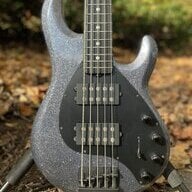
You can see it in this pic. The color flips between a deep royal purple/ emerald green/ and sapphire blue .

Ernie Ball has some amazing finishes.

Ernie Ball Music Man StingRay Special 4H Bass Guitar - Sapphire Iris, Sweetwater Exclusive


These finishes are so trippy lol, the only downside i see to them is that typically outside the "cool factor" you usually just want one of the colors to be the actual color since usually they use really nice ones lol. I was at a music store locally that sells really high end guitars and Suhr guitars... i saw a jazzmaster style with the nicest color of sparkling green ive ever seen in my life... its was a slightly bluer forest green with a great depth of sparkle.

Go on the website (they post all their stock and specs) to show my friend this insane color... i don't see it anywhere nor its T style twin... im like why wouldn't they post this its such a nice color... the photo from head on is purple haha. When i was in the store i guess because of the lighting or the way they angled them on the stand it didnt flip flop.
 
  • Like
Reactions: LadyLoveStingRay5
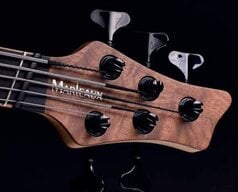
Love that color, especially with the matching headstock!

I'm a tool for matching headstocks. I wanted this (2012 SLO Special that was seen on TB sales and Reverb before) so bad but was unable to find the person who owns it:

image.jpg
 
Could someone chime in about the dead spots on the 5-string Special?

I bought a 4-string Special in 2021 online and the dead spots on the G string (5th to 7th frets) were so bad I returned it. I tried another since then and same thing.

I assume the 5-string might be better in that regards given the extra headstock weight?

There's a store about a three hour drive from my place that has three in stock. I don't want to make the drive if the dead spots are as bad.

Thanks!
 
  • Like
Reactions: PrimitiveMan
Could someone chime in about the dead spots on the 5-string Special?

I bought a 4-string Special in 2021 online and the dead spots on the G string (5th to 7th frets) were so bad I returned it. I tried another since then and same thing.

I assume the 5-string might be better in that regards given the extra headstock weight?

There's a store about a three hour drive from my place that has three in stock. I don't want to make the drive if the dead spots are as bad.

Thanks!
I have NO dead spots on 4HH or 5H whatsoever
 
Could someone chime in about the dead spots on the 5-string Special?

I bought a 4-string Special in 2021 online and the dead spots on the G string (5th to 7th frets) were so bad I returned it. I tried another since then and same thing.

I assume the 5-string might be better in that regards given the extra headstock weight?

There's a store about a three hour drive from my place that has three in stock. I don't want to make the drive if the dead spots are as bad.

Thanks!
My 2018 StingRay5 Special (swamp ash body/maple neck/fretboard) has a bad one on the G string/7th fret (D). I added a Fender FatFinger just in front of the G tuner that killed it - actually moved it to C (like normal, haha).
FWIW, most basses have dead spots in that area. You know, physics, n'at.
The EBMM 5ers I've played at my LMS are about the same. From what I remember, I think the ebony boards suffer a bit less from it.
 
Emerald iris looks pretty boring but
Could someone chime in about the dead spots on the 5-string Special?

I bought a 4-string Special in 2021 online and the dead spots on the G string (5th to 7th frets) were so bad I returned it. I tried another since then and same thing.

I assume the 5-string might be better in that regards given the extra headstock weight?

There's a store about a three hour drive from my place that has three in stock. I don't want to make the drive if the dead spots are as bad.

Thanks!

My 5H has none, very very even playing. But a little bit luck of the draw, I have played some EBMM basses with dead spots but most were pretty minor
 
Emerald iris looks pretty boring but


My 5H has none, very very even playing. But a little bit luck of the draw, I have played some EBMM basses with dead spots but most were pretty minor

The 7/8 G string area on my 4H doesn't sustain as long as others and I can feel it a little in neck but I wouldn't call them 'Dead Spots' never a problem with playing; note's are clear on attack and have at least 2/3 seconds of sustain.

If for some reason I need longer sustain on a Song for those high notes I would use D string 12-14:)
 
Last edited:
FWIW, most basses have dead spots in that area. You know, physics, n'at.

Usually "dead spots" are about vibrations feeding back and canceling the vibration of the string at certain frequencies (frets). Instruments will always have them. It's a matter of whether or not it's noticeable; sustain isn't going to be consistent across the fretboard because of this effect and things like where you are playing in the scale/string gauge.

When I see something about the 5th to 7th frets it makes me wonder if a slight truss rod adjustment may help. Are they really "dead spots" or does that neck need a little relief to keep the string from coming into contact slightly with higher frets? If you don't have enough relief in your neck that range is where you'll have a lot of issues.
 
  • Like
Reactions: walking_line
Usually "dead spots" are about vibrations feeding back and canceling the vibration of the string at certain frequencies (frets). Instruments will always have them. It's a matter of whether or not it's noticeable; sustain isn't going to be consistent across the fretboard because of this effect and things like where you are playing in the scale/string gauge.

When I see something about the 5th to 7th frets it makes me wonder if a slight truss rod adjustment may help. Are they really "dead spots" or does that neck need a little relief to keep the string from coming into contact slightly with higher frets? If you don't have enough relief in your neck that range is where you'll have a lot of issues.

I've never played a bass that didn't have any dead spots. Like you said, it's just a matter of how noticeable they are, and they were unbearable on the 4-string Special. It's unfortunate because everything else about the bass was top notch, which is why I'm willing to give it another try.

I did try different strings and setup on the 4-string I had and it didn't really help.
 
In a huge amount of posts in talkbass over the years, people mistake a dead spot for a resonant fret (wolf tone). Or they just label a wolf tone , a deadnote. Well, is the fret dead (no sound or just a metallic plunk), or does the sustain disappear and is replaced with an octave harmonic (wolf tone)?

Wolf tones have been on string instruments for hundreds of years. The modern bass guitar is no exception. The location of it can change with the mass of the instrument. It's the frequency where the bass mass resonates to a frequency equal to or near the note played/pressed/fretted. This does not retract from the great workmanship or quality of basses, from either Fender, Music Man or others. It's just physics. We all deal with them. Ignorance can be bliss though. Beginners don't worry about them i guess.

You can get lucky and the resonating frequency of the bass lies between two note frequencies, so that it is almost unaudible. In this instance some will say, "My bass does not have them, because it's a superior instrument" but it's just less noticable, a stroke of luck, not of craftsmanship quality. Normally you get one really weak note, and the notes on each side of it is often marginally weaker han a normal note. Those surrounding frets are also harmonically resonant and their sound will move to the octave harmonic too, but over longer time so to speak, and with lower volume.

If you have a dead note aka "plunk plunk clack" and no tone rings at all, it's a fret issue. See your luthier.

Hope this helps someone :)
 
In a huge amount of posts in talkbass over the years, people mistake a dead spot for a resonant fret (wolf tone). Or they just label a wolf tone , a deadnote. Well, is the fret dead (no sound or just a metallic plunk), or does the sustain disappear and is replaced with an octave harmonic (wolf tone)?

Wolf tones have been on string instruments for hundreds of years. The modern bass guitar is no exception. The location of it can change with the mass of the instrument. It's the frequency where the bass mass resonates to a frequency equal to or near the note played/pressed/fretted. This does not retract from the great workmanship or quality of basses, from either Fender, Music Man or others. It's just physics. We all deal with them. Ignorance can be bliss though. Beginners don't worry about them i guess.

You can get lucky and the resonating frequency of the bass lies between two note frequencies, so that it is almost unaudible. In this instance some will say, "My bass does not have them, because it's a superior instrument" but it's just less noticable, a stroke of luck, not of craftsmanship quality. Normally you get one really weak note, and the notes on each side of it is often marginally weaker han a normal note. Those surrounding frets are also harmonically resonant and their sound will move to the octave harmonic too, but over longer time so to speak, and with lower volume.

If you have a dead note aka "plunk plunk clack" and no tone rings at all, it's a fret issue. See your luthier.

Hope this helps someone :)

That being the case, I should've said wolf tone and not dead note above. I wonder though if the Special I had did not have an actual dead note.

Either way, I tried a... Sterling by Music Man Stingray Ray.... I don't know... today and the wolf tones were acceptable!
 
That being the case, I should've said wolf tone and not dead note above. I wonder though if the Special I had did not have an actual dead note.

Either way, I tried a... Sterling by Music Man Stingray Ray.... I don't know... today and the wolf tones were acceptable!
Keep trying as many as you can until you find one you like. Most dealers have a generous return policy .