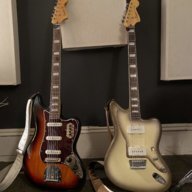
I'm digging this so much! My Squier Bass VI is definitely getting a TRS jack and will absolutely slay through my SB300/100T Ric-O-Sound rig
Nice. Do you use a LPF or HPF for either channel or are they both full-range?
View attachment 4143605

Enjoy the benefits of a premium membership!
Upgrade Account
-
TalkBass has been independent since 1998. Add your voice.
Create a free account to reply to discussions, view embedded media, and browse with fewer display ads.
Join free Log in
Want zero display ads or expanded classifieds tools? Compare plans.
You are using an out of date browser. It may not display this or other websites correctly.
You should upgrade or use an alternative browser.
You should upgrade or use an alternative browser.
Educate me on bi-amping
- Thread starter tleeitsme
- Start date
More options
Who Replied?
In my experience I tend to prefer multi-amping to bi-amping though it may be due to the equipment available to me.
Around 15 years ago I acquired a modest Peavey collection as most folks were practically giving away 70's & 80's amps and cabs for pennies on the dollar in my area. Among these scores is a Combo 300 that besides being loaded with a 15" Black Widow driver has some pretty progressive features including a variable crossover. In the spirit of sonic exploration I sent the crossover low signal to the "pwr amp in" on the Combo 300 and the high signal to a Peavey Deuce, which is a 212 hybrid guitar amp with a SS preamp and four 6L6 tube power section. The result was quite impressive but the Combo 300 being an extreme PITA to move about, this true bi-amp setup is for basement use only.
A few years down the road I fell head over heals for the Fender Bassman Pro tube amps and neo cabs and before long I had a Super Bassman 300, Bassman 100T and a pair of 410neo cabs. Shortly there after I got a Ric 4003 and of course had to check out the Ric-O-Sound. I have found this full range muti-amp rig to be absolutely amazing. With the Ric I send the neck pup to the SB300/410 and the bridge pup to the 100T/410. For those not familiar with these all tube heads, they have identical preamps with separate Vintage & Overdrive foot switchable channels. I run the neck/SB300 in the Vintage channel for a clean, big round tube tone and the bridge/100T in the Overdrive channel in 25 watt mode pushing the power tubes pretty hard. For me the advantage of this multi vs bi-amp setup is that I can easily switch between a clean and dirty tone via the footswitch with the 100T Vintage & Overdrive channels that have independent volume controls so there is no change in volume when doing so. I should also note that this multi-amp setup works equally well with an ABY pedal and mono output instruments.
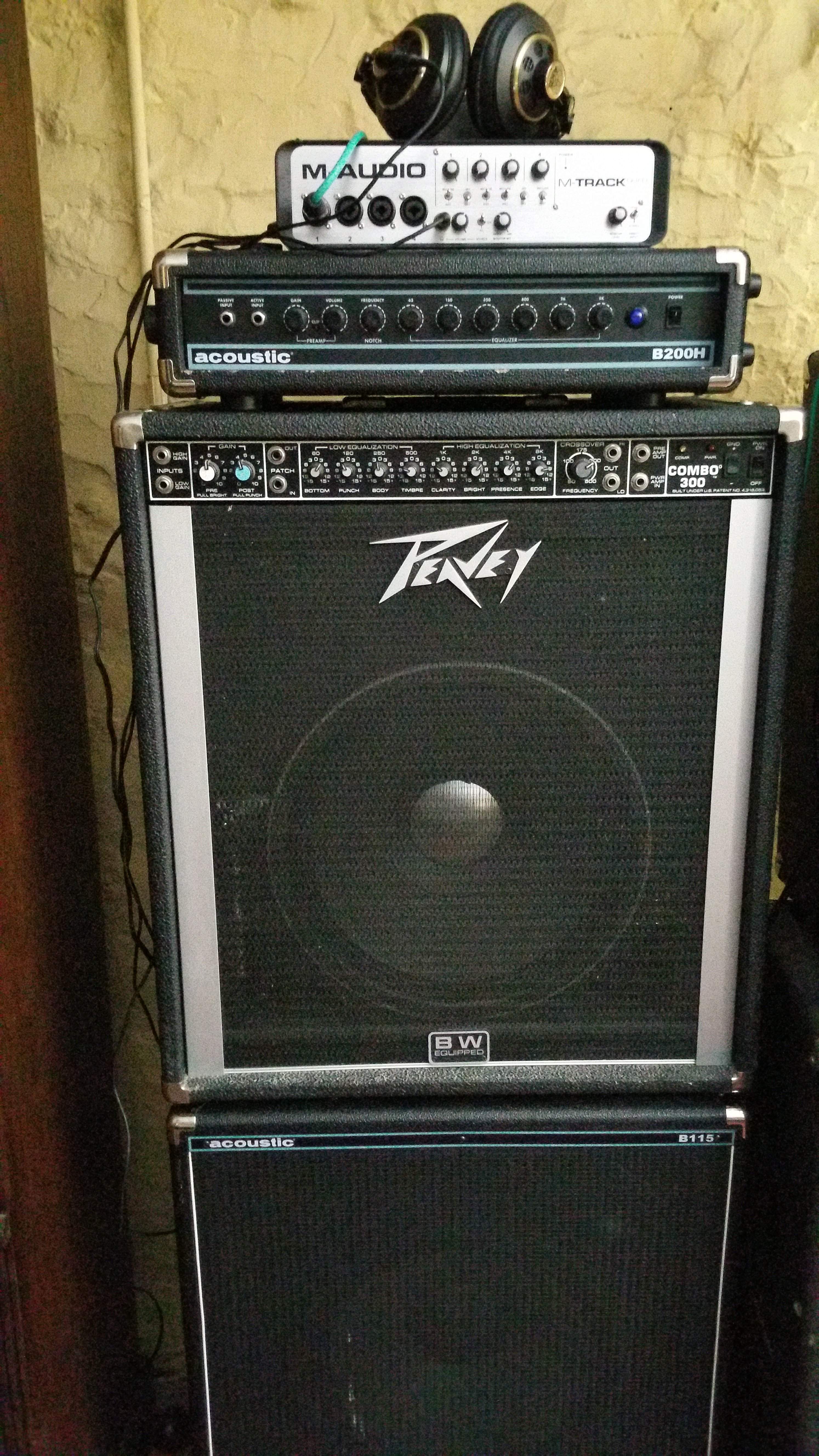
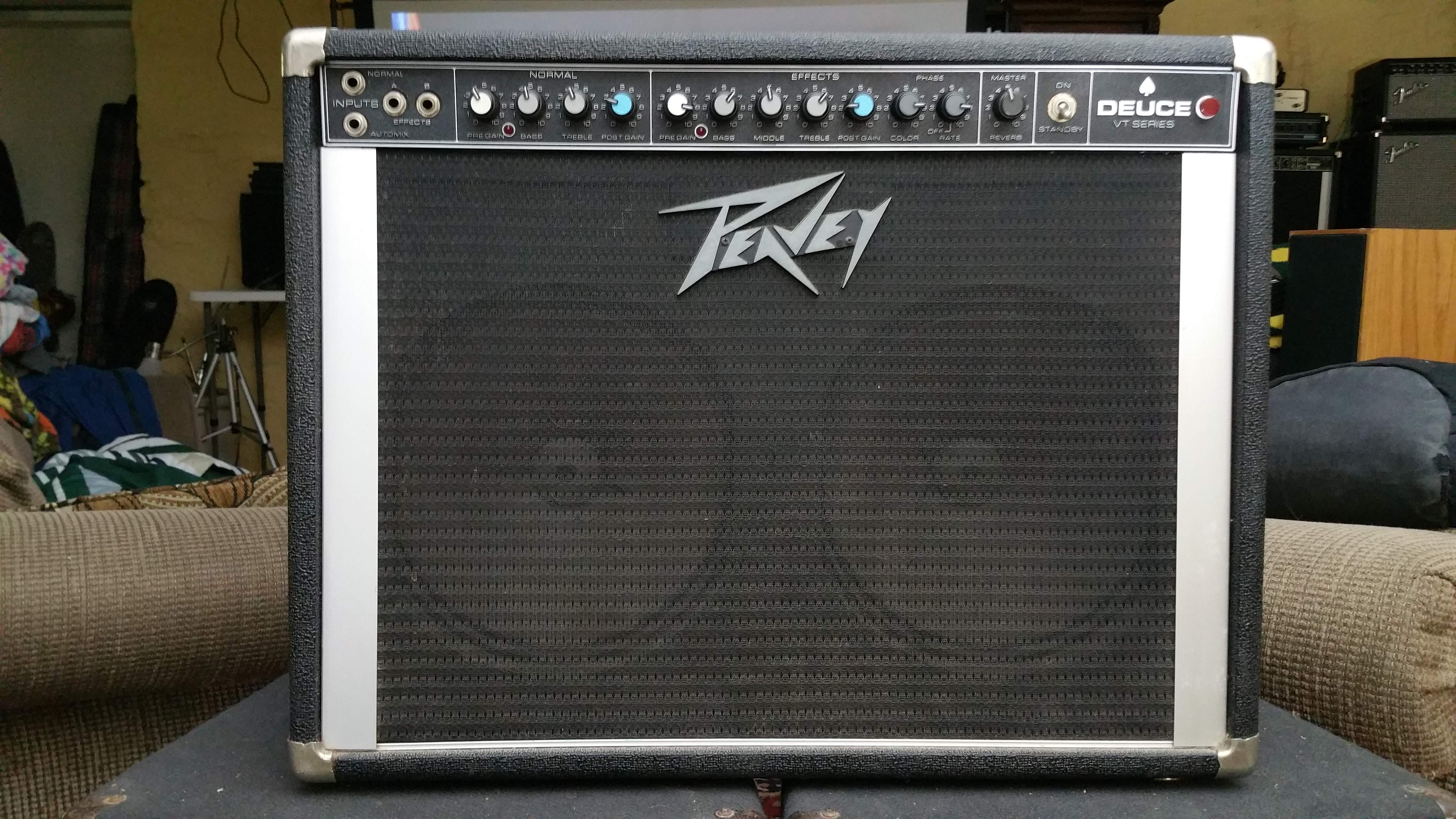
Around 15 years ago I acquired a modest Peavey collection as most folks were practically giving away 70's & 80's amps and cabs for pennies on the dollar in my area. Among these scores is a Combo 300 that besides being loaded with a 15" Black Widow driver has some pretty progressive features including a variable crossover. In the spirit of sonic exploration I sent the crossover low signal to the "pwr amp in" on the Combo 300 and the high signal to a Peavey Deuce, which is a 212 hybrid guitar amp with a SS preamp and four 6L6 tube power section. The result was quite impressive but the Combo 300 being an extreme PITA to move about, this true bi-amp setup is for basement use only.
A few years down the road I fell head over heals for the Fender Bassman Pro tube amps and neo cabs and before long I had a Super Bassman 300, Bassman 100T and a pair of 410neo cabs. Shortly there after I got a Ric 4003 and of course had to check out the Ric-O-Sound. I have found this full range muti-amp rig to be absolutely amazing. With the Ric I send the neck pup to the SB300/410 and the bridge pup to the 100T/410. For those not familiar with these all tube heads, they have identical preamps with separate Vintage & Overdrive foot switchable channels. I run the neck/SB300 in the Vintage channel for a clean, big round tube tone and the bridge/100T in the Overdrive channel in 25 watt mode pushing the power tubes pretty hard. For me the advantage of this multi vs bi-amp setup is that I can easily switch between a clean and dirty tone via the footswitch with the 100T Vintage & Overdrive channels that have independent volume controls so there is no change in volume when doing so. I should also note that this multi-amp setup works equally well with an ABY pedal and mono output instruments.
Couldn't possibly read all of this, but...
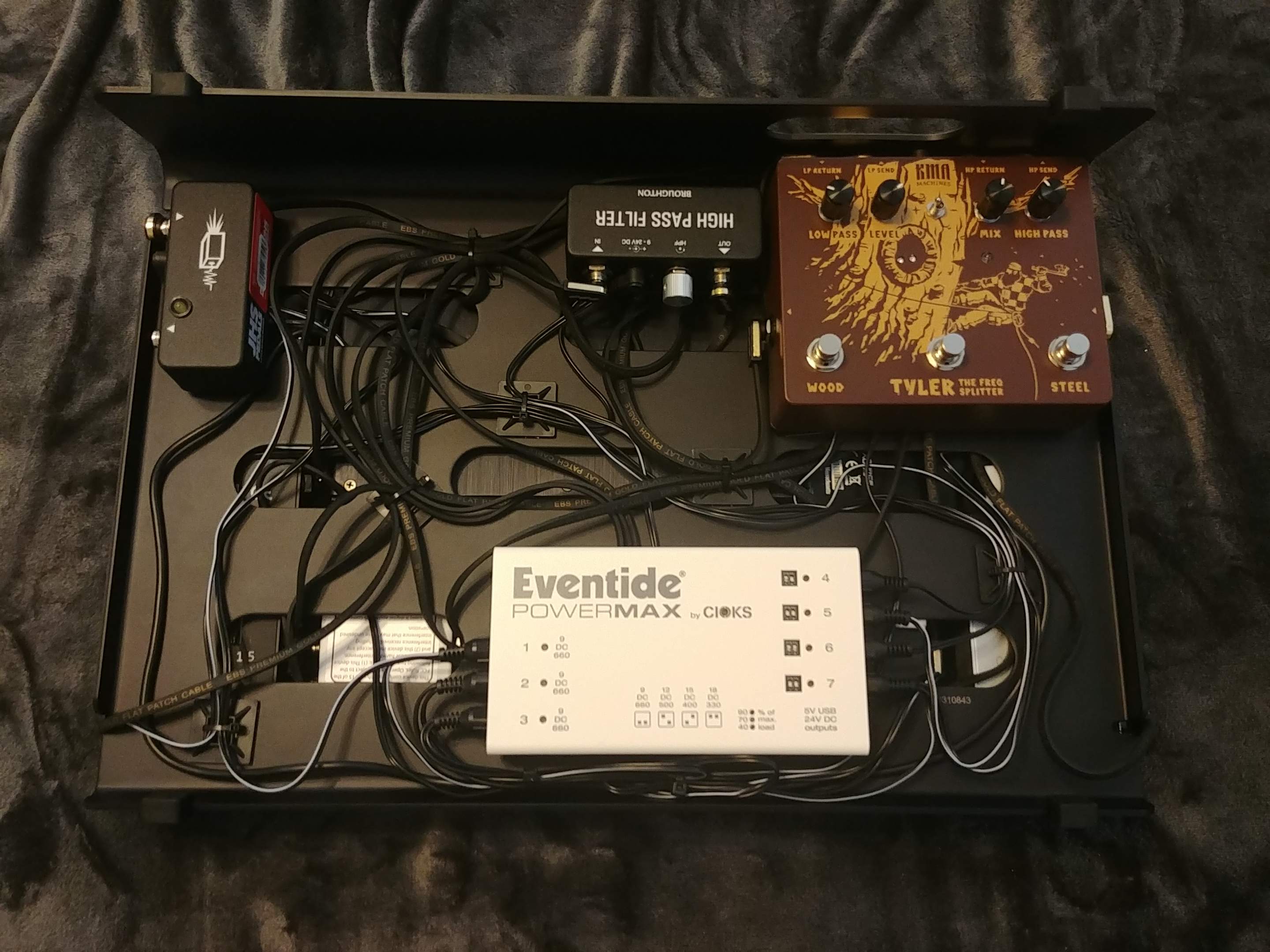
...you may get some mileage with the KMA Tyler Frequency Splitter to process and mix your Highs and Low's independently and run full-range as I do.
I compress low end and run the HPF. Then process highs through the dirt and one channel of the SA EQ2 with a gate set and mix. Then to an octave and then to the preamp input.
I process modulation/Delay-Reverb-Looper through the preamp effects loop with the modulation pedal cutting effects below 100Hz and then to delay-Rev-looper the second channel of the SA EQ2 w/o Gate.
Sounds Amazing!
...you may get some mileage with the KMA Tyler Frequency Splitter to process and mix your Highs and Low's independently and run full-range as I do.
I compress low end and run the HPF. Then process highs through the dirt and one channel of the SA EQ2 with a gate set and mix. Then to an octave and then to the preamp input.
I process modulation/Delay-Reverb-Looper through the preamp effects loop with the modulation pedal cutting effects below 100Hz and then to delay-Rev-looper the second channel of the SA EQ2 w/o Gate.
Sounds Amazing!
Last edited:
Full range, though I do enjoy using a Darkglass X7 that is a parallel process pedal that employs a lpf with compression and a hpf with distortion

- Feb 12, 2006
- 60,961
- 5
- 220,636
- Disclosures
- Development Engineer-Mesa Boogie, Development Engineer-Genzler (pedals), Product Support-Genz Benz
I appreciate the desire to clarify terms, although sometimes bi-amping and parallel mono start blending into each other. In my rig, I use dual output guitars. I do send high and low frequencies to their respective amps, however I don’t use a crossover. I use a HPF and a LPF. This way, I can have control over the overlapping frequency band so I can boost mids/lows where a crossover would be set.
I also treat each signal differently with effects, so while it could be mistaken for simply a parallel mono rig, the incorporation of HPF and LPF achieve what traditional bi-amp rigs attempt to do, albeit with MORE control over frequency band for each amp.
What do you think a crossover is?
A 2 way crossover (bi-amp) is a LPF for the low output and a HPF for the high output, they can be either synchronous (one control sets both simultaneously) or they can be asynchronous (one control for each function). In DSP, generally you have access to asynchronous parameters.

I didn’t know DSP crossovers had asynchronous functions. What DSP product are you referring to?
Most hardware crossovers I’ve seen only allow for synchronous crossover settings. I’ve used a DBX 223 stereo crossover (2 channels) to achieve asynchronous settings on my pedal board, but I don’t believe it was intended to be used that way.
Most hardware crossovers I’ve seen only allow for synchronous crossover settings. I’ve used a DBX 223 stereo crossover (2 channels) to achieve asynchronous settings on my pedal board, but I don’t believe it was intended to be used that way.
What do you think a crossover is?
A 2 way crossover (bi-amp) is a LPF for the low output and a HPF for the high output, they can be either synchronous (one control sets both simultaneously) or they can be asynchronous (one control for each function). In DSP, generally you have access to asynchronous parameters.
What do you think a crossover is?
A 2 way crossover (bi-amp) is a LPF for the low output and a HPF for the high output, they can be either synchronous (one control sets both simultaneously) or they can be asynchronous (one control for each function). In DSP, generally you have access to asynchronous parameters.

I didn’t know DSP crossovers had asynchronous functions. What DSP product are you referring to?
Most hardware crossovers I’ve seen only allow for synchronous crossover settings. I’ve used a DBX 223 stereo crossover (2 channels) to achieve asynchronous settings on my pedal board, but I don’t believe it was intended to be used that way.
Most speaker processors have totally independent filter sections. Take a look at the Klark Teknik DN9848E for example. You can select different filter types for each output. You can also apply time delay, all pass filters for phase correction, compression, limiting, and EQ.
OM attached for your convenience.
Attachments
I did consider the Tyler at one point. However, I don’t have a need for blending the 2 channels back together because I like my 2-amp rig. I DO use the Broughton HPF as pictured. It is a lovely piece of gear. I wish he also made an “always on” LPF...
The Tyler could be used to set your frequency points on each of the loop outs and send the highs one way and the lows in another. (The mix would not be in line and the level wouldn't be either.)
I run it under the board "always on" like the HPF. The nice thing is, it's not exactly the same as a crossover where you would set the split point. You may want to have different points for Hi & Low signals overlap going to different amps!
Wow. Thanks
Now, because my guitars are dual output, the signal is already split, so I don't need a Tyler to do the splitting. I just run the Broughton HPF on the the 'high' channel, and I use the Iron Ether Xerograph as a LPF on the Bass channel, into an MXR M81.
What's the reason for using the Broughton HPF in conjunction with the Tyler??
Yeah, that's a great feature of the Tyler. My 1st Gen rig was just using a Rolls SX21 crossover, and I quickly became aware of the lack of control over your set points for the low and high signals, due to the fact it just has a traditional crossover set point for both channels.The Tyler could be used to set your frequency points on each of the loop outs and send the highs one way and the lows in another. (The mix would not be in line and the level wouldn't be either.)
I run it under the board "always on" like the HPF. The nice thing is, it's not exactly the same as a crossover where you would set the split point. You may want to have different points for Hi & Low signals overlap going to different amps!
Now, because my guitars are dual output, the signal is already split, so I don't need a Tyler to do the splitting. I just run the Broughton HPF on the the 'high' channel, and I use the Iron Ether Xerograph as a LPF on the Bass channel, into an MXR M81.
What's the reason for using the Broughton HPF in conjunction with the Tyler??
- Feb 12, 2006
- 60,961
- 5
- 220,636
- Disclosures
- Development Engineer-Mesa Boogie, Development Engineer-Genzler (pedals), Product Support-Genz Benz
I didn’t know DSP crossovers had asynchronous functions. What DSP product are you referring to?
Most hardware crossovers I’ve seen only allow for synchronous crossover settings. I’ve used a DBX 223 stereo crossover (2 channels) to achieve asynchronous settings on my pedal board, but I don’t believe it was intended to be used that way.
Most DSP based speaker processors include such independent filters. The DriveRack 260 and 480 do for example.
Wow. Thanks
Yeah, that's a great feature of the Tyler. My 1st Gen rig was just using a Rolls SX21 crossover, and I quickly became aware of the lack of control over your set points for the low and high signals, due to the fact it just has a traditional crossover set point for both channels.
Now, because my guitars are dual output, the signal is already split, so I don't need a Tyler to do the splitting. I just run the Broughton HPF on the the 'high' channel, and I use the Iron Ether Xerograph as a LPF on the Bass channel, into an MXR M81.
What's the reason for using the Broughton HPF in conjunction with the Tyler??
If you have say 180Hz and below being compressed, then cutting the bottom off around 35 (AEAD tuning) that gets mixed back into the highs going from 150 and above through the Fuzzz/OD and mixing that in keeps a tight low end and a nice feeling distortion, too.
I wouldn't think of the Tyler as a way to cut off the bottom like a HPF. Think of it as a way to split and mix hi & Low signals back into one mono signal. But, you can pass on the mix function, too. There is also a phase switch to get best results.
Last edited:
- Feb 12, 2006
- 60,961
- 5
- 220,636
- Disclosures
- Development Engineer-Mesa Boogie, Development Engineer-Genzler (pedals), Product Support-Genz Benz
Many filters do not sum a signal that's been split back together very well, the phase response of the filters themselves as well as both parallel paths can result in some serious comb filtering or unexpected deep null
artifacts.
artifacts.
Currently Im playing biamped with a Marshall 100w guitar head into a Randall 412 guitar cab and run dirt through it.
For clean I use a 810 or a 610 cab paired with an 200w bass tube amp.
I split the signal with an ABY box from radial. And it sounds awesome. But should I put a HPF infront of the guitar rig? Dont know if I really need a crossover.
For clean I use a 810 or a 610 cab paired with an 200w bass tube amp.
I split the signal with an ABY box from radial. And it sounds awesome. But should I put a HPF infront of the guitar rig? Dont know if I really need a crossover.
Currently Im playing biamped with a Marshall 100w guitar head into a Randall 412 guitar cab and run dirt through it.
For clean I use a 810 or a 610 cab paired with an 200w bass tube amp.
I split the signal with an ABY box from radial. And it sounds awesome. But should I put a HPF infront of the guitar rig? Dont know if I really need a crossover.
I would call what you are doing multi-amping. It's more common to apply the term biamping when a full active crossover is used.
It is a good idea to run an HPF to protect the guitar cab. It's likely the HPF will clear up the lows a bit.
Given that you are using one amp for clean and one amp for distortion, you probably do not need a crossover. But it can depend somewhat on your gear and goals.
I used to biamp an SVT with an 810 and a Fender Twin Reverb loaded with JBL E120s. I used an Orban 672A for processing the signals, so the lowest I could set the crossover was 200hz. I did experiments with the 672A's HPF section, where I ran the filter down towards 100hz. From what I remember, running the filter very much below 150hz started degrading clarity and focus in the low end.
I would call what you are doing multi-amping. It's more common to apply the term biamping when a full active crossover is used.
It is a good idea to run an HPF to protect the guitar cab. It's likely the HPF will clear up the lows a bit.
Given that you are using one amp for clean and one amp for distortion, you probably do not need a crossover. But it can depend somewhat on your gear and goals.
I used to biamp an SVT with an 810 and a Fender Twin Reverb loaded with JBL E120s. I used an Orban 672A for processing the signals, so the lowest I could set the crossover was 200hz. I did experiments with the 672A's HPF section, where I ran the filter down towards 100hz. From what I remember, running the filter very much below 150hz started degrading clarity and focus in the low end.
So I should use two bass rigs instead?
I have a 610 bass cab and a 810 for my disposal with bass heads where we practice.
Since the guitar rigs are not mine atm, and it will take some time to get a HPF pedal, do you recommend that option?
Dont want to blow speakers thats not mine.
I were thinking a 412 guitar cab with a guitar head was fine.
What about a guitar head into a bass cab?
Im gonna look into the Broughton HPF!
Last edited:
So I should use two bass rigs instead?
I have a 610 bass cab and a 810 for my disposal with bass heads where we practice.
Since the guitar rigs are not mine atm, and it will take some time to get a HPF pedal, do you recommend that option?
Dont want to blow speakers thats not mine.
I were thinking a 412 guitar cab with a guitar head was fine.
What about a guitar head into a bass cab?
Im gonna look into the Broughton HPF!
Yes, the guitar cab is probably at risk if you are pushing significant power. You could run the guitar amp into a bass cab. Depending on how well the two bass cabs interact, it may still sound better with an HPF.
I can't really say which combination of amps and cabs will give you the best sound. Choosing the ideal tone is subjective, so you will need to experiment, to figure out what sounds best to you
Yes, the guitar cab is probably at risk if you are pushing significant power. You could run the guitar amp into a bass cab. Depending on how well the two bass cabs interact, it may still sound better with an HPF.
Yeah, I will. I found the sound is so good with a guitar cab, but will try to use the guitar head on a bass cab. Last time I did it, it did not go so low, which maby is a good thing in this setup.
Thanks !
I can't really say which combination of amps and cabs will give you the best sound. Choosing the ideal tone is subjective, so you will need to experiment, to figure out what sounds best to you
This is surprisingly true.Barely 24, I have another 24 years ahead of me before I get jaded and switch to a micro-rig and a multi-fx


