
Enjoy the benefits of a premium membership!
Upgrade Account
-
TalkBass has been independent since 1998. Add your voice.
Create a free account to reply to discussions, view embedded media, and browse with fewer display ads.
Join free Log in
Want zero display ads or expanded classifieds tools? Compare plans.
You are using an out of date browser. It may not display this or other websites correctly.
You should upgrade or use an alternative browser.
You should upgrade or use an alternative browser.
Educate me on bi-amping
- Thread starter tleeitsme
- Start date
More options
Who Replied?



Great minds think alike,I was going to post mine but you got here first.It sure gets the b- amp thing without the hassle of lugging gear.Good luck with yout journey, OP. In the meanwhile you can try one of these:
View attachment 4035717

One reality is that ampless gigs are working their way down into the clubbing circuit; courtesy of Behringer producing affordable boards, and lead singers being tired of being drowned out by unaware musicians. And, in those cases, most PA’s are biamped.
So, most of us one way or another are going to play through biamp systems at some point down the road.
Going back to the 80’s and 90’s, I was playing an Alembic Series I bass at the time; so, I had the low and high outputs referred to in previous posts. But, I never played through any system, including absurdly expensive Macintosh power amps / subs / 10’s, where the sound was even close to the quality of the full range output into a well designed bass amp.
Breaking the bass up into two channels, one high and one low, looks interesting on paper; but, I have NEVER heard an implementation that surpasses what a single well designed full range bass amplifier will put out. Not one. And, believe me, I’ve tried.
So, you can look at that as good or bad depending on what you are trying to accomplish. It is “good” because a straightforward bass amp can def get a great backline tone. It is “bad” because our main projection systems going forward are 100% going to be biamped; and as I stated, I’ve never heard bass through such systems, which was remotely satisfying. I actually think this is a massive challenge, which needs more attention. But, I admit I’m probably the lone voice in forest on this point; and most sound engineers, who own the PA systems, will tell me I’m deaf, daft, ignorant, and just shut up. So, there you go.
In any case, I’m pretty sure consensus is that there is no issue, and bass sounds “great” through the PA systems. So, no one is working to address an issue that doesn’t exist. I will simply point out that if biamp systems were superior, bass players would put them on the backline instead of their 810. I just wish the bass playing community and the sound engineer community would listen to each other rather than being tribal.
Lastly, the best you can do IME to get the bass to sound decent in the FOH, is to put the bass pretty much full range into the mains, with sensible HPF to protect the drivers, and then to bring up the bass just enough in the subs to fill in the low end. But, that approach is not popular, nearly never happens, and takes diligent interaction to get it. Anyhow, that’s the direction I try to go; FWIW.
So, most of us one way or another are going to play through biamp systems at some point down the road.
Going back to the 80’s and 90’s, I was playing an Alembic Series I bass at the time; so, I had the low and high outputs referred to in previous posts. But, I never played through any system, including absurdly expensive Macintosh power amps / subs / 10’s, where the sound was even close to the quality of the full range output into a well designed bass amp.
Breaking the bass up into two channels, one high and one low, looks interesting on paper; but, I have NEVER heard an implementation that surpasses what a single well designed full range bass amplifier will put out. Not one. And, believe me, I’ve tried.
So, you can look at that as good or bad depending on what you are trying to accomplish. It is “good” because a straightforward bass amp can def get a great backline tone. It is “bad” because our main projection systems going forward are 100% going to be biamped; and as I stated, I’ve never heard bass through such systems, which was remotely satisfying. I actually think this is a massive challenge, which needs more attention. But, I admit I’m probably the lone voice in forest on this point; and most sound engineers, who own the PA systems, will tell me I’m deaf, daft, ignorant, and just shut up. So, there you go.
In any case, I’m pretty sure consensus is that there is no issue, and bass sounds “great” through the PA systems. So, no one is working to address an issue that doesn’t exist. I will simply point out that if biamp systems were superior, bass players would put them on the backline instead of their 810. I just wish the bass playing community and the sound engineer community would listen to each other rather than being tribal.
Lastly, the best you can do IME to get the bass to sound decent in the FOH, is to put the bass pretty much full range into the mains, with sensible HPF to protect the drivers, and then to bring up the bass just enough in the subs to fill in the low end. But, that approach is not popular, nearly never happens, and takes diligent interaction to get it. Anyhow, that’s the direction I try to go; FWIW.

One reality is that ampless gigs are working their way down into the clubbing circuit; courtesy of Behringer producing affordable boards, and lead singers being tired of being drowned out by unaware musicians. And, in those cases, most PA’s are biamped.
So, most of us one way or another are going to play through biamp systems at some point down the road.
Going back to the 80’s and 90’s, I was playing an Alembic Series I bass at the time; so, I had the low and high outputs referred to in previous posts. But, I never played through any system, including absurdly expensive Macintosh power amps / subs / 10’s, where the sound was even close to the quality of the full range output into a well designed bass amp.
Breaking the bass up into two channels, one high and one low, looks interesting on paper; but, I have NEVER heard an implementation that surpasses what a single well designed full range bass amplifier will put out. Not one. And, believe me, I’ve tried.
So, you can look at that as good or bad depending on what you are trying to accomplish. It is “good” because a straightforward bass amp can def get a great backline tone. It is “bad” because our main projection systems going forward are 100% going to be biamped; and as I stated, I’ve never heard bass through such systems, which was remotely satisfying. I actually think this is a massive challenge, which needs more attention. But, I admit I’m probably the lone voice in forest on this point; and most sound engineers, who own the PA systems, will tell me I’m deaf, daft, ignorant, and just shut up. So, there you go.
In any case, I’m pretty sure consensus is that there is no issue, and bass sounds “great” through the PA systems. So, no one is working to address an issue that doesn’t exist. I will simply point out that if biamp systems were superior, bass players would put them on the backline instead of their 810. I just wish the bass playing community and the sound engineer community would listen to each other rather than being tribal.
Lastly, the best you can do IME to get the bass to sound decent in the FOH, is to put the bass pretty much full range into the mains, with sensible HPF to protect the drivers, and then to bring up the bass just enough in the subs to fill in the low end. But, that approach is not popular, nearly never happens, and takes diligent interaction to get it. Anyhow, that’s the direction I try to go; FWIW.
I have played through several biamp rigs over the years and gotten pretty decent results. But something to consider is a lot of engineering goes into a modern bass speaker to make sure it sounds good. In contrast, there never was any significant engineering put into off the shelf biamp solutions for bass players. You basically have a bass amp with two power amps and a very basic built-in crossover.
If you want biamping to work well, you at least need the ability to use a bit of time delay to line up the acoustic centers of your drivers so they integrate well.
The next issue is people typically selected random speakers for the lows and highs rather than using cabs and drivers that were painstakingly selected and designed to work well together.
The last problem is operator error. Most people don't have a deep enough understanding to really benefit from biamping. Often you wind up with a system that sounds great up close, but sounds awful in the distance. FYI, This is the result you get when you hype the sub output. Up close you have this incredible sense of power and dynamics, but in the distance it sounds like mud!
There are some very respected bass players using top-of-line PA gear who have apparently fallen into this trap...done it myself as well
 . It's hard to resist the temptation because the sound a few feet in front of the rig is very satisfying
  . Unfortunately we need to be more focused on what the audience hears
  .
.
+1I have played through several biamp rigs over the years and gotten pretty decent results. But something to consider is a lot of engineering goes into a modern bass speaker to make sure it sounds good. In contrast, there never was any significant engineering put into off the shelf biamp solutions for bass players. You basically have a bass amp with two power amps and a very basic built-in crossover.
If you want biamping to work well, you at least need the ability to use a bit of time delay to line up the acoustic centers of your drivers so they integrate well.
The next issue is people typically selected random speakers for the lows and highs rather than using cabs and drivers that were painstakingly selected and designed to work well together.
The last problem is operator error. Most people don't have a deep enough understanding to really benefit from biamping. Often you wind up with a system that sounds great up close, but sounds awful in the distance. FYI, This is the result you get when you hype the sub output. Up close you have this incredible sense of power and dynamics, but in the distance it sounds like mud!
There are some very respected bass players using top-of-line PA gear who have apparently fallen into this trap...done it myself as well
The technology certainly can work. We just need to first recognize that it needs further development and start working together between design and sound engineers, and players; rather than rowing in different directions and being tribal about it.

- Feb 12, 2006
- 60,953
- 5
- 220,612
- Disclosures
- Development Engineer-Mesa Boogie, Development Engineer-Genzler (pedals), Product Support-Genz Benz
One major challenge with biamped rigs is that you can lose much of the desired texture when driving the speaker harder because when the LF driver is low passed by the crossover, you lose the often desired harmonics that are generated by the LF speaker cone.
Biamped rigs tend to sound fairly sterile, BUT there is an exception where the biamping is to an 18" sub section for the low frequencies (typically crossed over around 100-125 hz) and the top cabinet's low frequency driver is allowed to run full range (with or without passively highpassed tweeter).
Biamped rigs tend to sound fairly sterile, BUT there is an exception where the biamping is to an 18" sub section for the low frequencies (typically crossed over around 100-125 hz) and the top cabinet's low frequency driver is allowed to run full range (with or without passively highpassed tweeter).

How about a bi-amping DI?
Kickass sound.
Definitely.Great minds think alike,I was going to post mine but you got here first.It sure gets the b- amp thing without the hassle of lugging gear.

Definitely.Kickass sound.
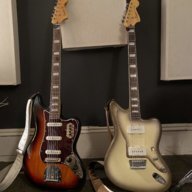
After a lot of experimentation, I wired a few Bass VIs and other 27”-30” scale guitars to be dual output. I swapped in TRS jacks to do this. The neck pickup is the “bass” pickup (wired to the ring) and the bridge and middle pups are switchable and wired to the tip.
The “tip” signal is the hi-end signal chain, run through a OD, Fuzz, and THEN a HPF. This chain goes to a ‘72 Twin.
The “ring” signal is the low-end, and goes to a LPF. This goes to a bass rig. (SWR350 / EDEN 2x10)
The result is a sound that has all the dirt/fuzz/sizzle on top, and a clean, ridiculously dub-like deep bass. We are a 2piece, and this allows us to sound much bigger than we are. Anyone out there that’s curious about this rig, HMU.
The “tip” signal is the hi-end signal chain, run through a OD, Fuzz, and THEN a HPF. This chain goes to a ‘72 Twin.
The “ring” signal is the low-end, and goes to a LPF. This goes to a bass rig. (SWR350 / EDEN 2x10)
The result is a sound that has all the dirt/fuzz/sizzle on top, and a clean, ridiculously dub-like deep bass. We are a 2piece, and this allows us to sound much bigger than we are. Anyone out there that’s curious about this rig, HMU.

I'm digging this so much! My Squier Bass VI is definitely getting a TRS jack and will absolutely slay through my SB300/100T Ric-O-Sound rigAfter a lot of experimentation, I wired a few Bass VIs and other 27”-30” scale guitars to be dual output. I swapped in TRS jacks to do this. The neck pickup is the “bass” pickup (wired to the ring) and the bridge and middle pups are switchable and wired to the tip.
The “tip” signal is the hi-end signal chain, run through a OD, Fuzz, and THEN a HPF. This chain goes to a ‘72 Twin.
The “ring” signal is the low-end, and goes to a LPF. This goes to a bass rig. (SWR350 / EDEN 2x10)
The result is a sound that has all the dirt/fuzz/sizzle on top, and a clean, ridiculously dub-like deep bass. We are a 2piece, and this allows us to sound much bigger than we are. Anyone out there that’s curious about this rig, HMU.

- Feb 12, 2006
- 60,953
- 5
- 220,612
- Disclosures
- Development Engineer-Mesa Boogie, Development Engineer-Genzler (pedals), Product Support-Genz Benz
Or simply do not understand the terminology and call something “biamped” when in fact that’s not what it is.It seems to me that people here who bash the setup either never set it up correctly or just had the wrong equipment. Haters gonna hate
Dual amped with parallel processed signal paths (with either the same signal source or 2 signal sources like the dual pickup example) is different, which is what oldskoolskatedad is actually doing.
There’s no hating going on unless you are looking for a fight from someone.
Yeah, I feel like it depends on the goal. If bi amping is just used to achieve a better frequency response by sending highs and lows to their corresponding speakers, that’s one thing. Arguably, full range setups can do this nearly as well. However, if you’re looking for tonal separation, bi amping is a blue ocean. And I suggest, in order to take full advantage, dual output is a must. I spent way too much energy trying to split the mono signal using everything from buffered splitters, unbuffered splitters, DIs back to reAmp boxes, chorus pedals with stereo out, crossover pedals, crossover rack gear, you name it, I probably tried it. In the end, to avoid signal degradation, dual output is the only way to go for me. We can discuss the unique characteristics of germanium and silicon fuzz pedals, and why direct talk between pups and pedal is important as well, and why this allows for unique fuzz bass that can’t be achieved elsewhere.It seems to me that people here who bash the setup either never set it up correctly or just had the wrong equipment. Haters gonna hate

Any information would be greatly appreciated. Please steer me in the right direction. Especially when it comes to old sunns and guitar amps. I. Know. Nothing. Im sure that is evident already.
Bi Amping:
Step one: Set a tonal goal you would like to achieve.
Step two: Verify that bi amping is the only way of doing that.
Step three: Ask around for alternatives until you find a way to do what you like without biamping.
Sometimes, splitting your signal is the way to go. Split the clean signal off, then wreck tonal mayhem on the remaining signal. Fuzz, Overdrive, whatever you like. now, when you're done with it, you join them back together, blend to taste and run them into a single amp.
Bi-Amping has a few drawbacks:
1. You'll have to carry a buttload of stuff because you will bring two full amps instead of one.
2. When you want to make it work, it's expensive. You need to split your signal at some point and feed two amps. That need to be carefully matched. This is not a 'I have two cheap combo amps which are too small on their own, but If I work some bi amp magic, It'll be good enogh' thing.
3. Setting up is a hassle. Setting volumes is a hassle.
- Feb 12, 2006
- 60,953
- 5
- 220,612
- Disclosures
- Development Engineer-Mesa Boogie, Development Engineer-Genzler (pedals), Product Support-Genz Benz
If you are REALLY bi-amping, you will also be crossing the signal over into 2 different frequency bands. Otherwise isn’t NOT bi-amping but is a dual amp system.
I think the disagreement here is the incorrect use of terminology, not the value or use of the techniques.
I think the disagreement here is the incorrect use of terminology, not the value or use of the techniques.

None of these drawbacks needs to be considered true In this day and age, you can get a fairly cheap Class-D, 2-channel amp with built-in DSP that includes crossover functions, all in a light, 2-space rack package -- just add preamp to taste. And in a true bi-amped rig, one is specifically NOT trying to carefully match components, but to use specialized components suited to their respective tasks.Bi-Amping has a few drawbacks:
1. You'll have to carry a buttload of stuff because you will bring two full amps instead of one.
2. When you want to make it work, it's expensive. You need to split your signal at some point and feed two amps. That need to be carefully matched. This is not a 'I have two cheap combo amps which are too small on their own, but If I work some bi amp magic, It'll be good enogh' thing.
3. Setting up is a hassle. Setting volumes is a hassle.
Once again, or rather still, we seem to be conflating bi-amping with parallel mono, full-range signals.
There’s no hating going on unless you are looking for a fight from someone.
I certainly didn't mean it that way, but thanks for the enlightenment.
I appreciate the desire to clarify terms, although sometimes bi-amping and parallel mono start blending into each other. In my rig, I use dual output guitars. I do send high and low frequencies to their respective amps, however I don’t use a crossover. I use a HPF and a LPF. This way, I can have control over the overlapping frequency band so I can boost mids/lows where a crossover would be set.
I also treat each signal differently with effects, so while it could be mistaken for simply a parallel mono rig, the incorporation of HPF and LPF achieve what traditional bi-amp rigs attempt to do, albeit with MORE control over frequency band for each amp.
I also treat each signal differently with effects, so while it could be mistaken for simply a parallel mono rig, the incorporation of HPF and LPF achieve what traditional bi-amp rigs attempt to do, albeit with MORE control over frequency band for each amp.


