• TalkBass has been independent since 1998. Add your voice.
    Create a free account to reply to discussions, view embedded media, and browse with fewer display ads.
    Join freeLog in
    Want zero display ads or expanded classifieds tools? Compare plans.

effect of underpowering a cab?

By definition, a square wave has components of a DC signal.

The flatted peaks on both sides of the null-point are at a voltage that are held for x/moments and that effectively is a partial square wave.

One can see that any repeating, non-sinusoidal waveform can be equated to a combination of DC voltage, sine waves, and/or cosine waves (sine waves with a 90 degree phase shift) at various amplitudes and frequencies. This is true no matter how strange or convoluted the waveform in question may be. So long as it repeats itself regularly over time, it is reducible to this series of sinusoidal waves. In particular, it has been found that square waves are mathematically equivalent to the sum of a sine wave at that same frequency, plus an infinite series of odd-multiple frequency sine waves at diminishing amplitude:

Then ::: As noted step by step from here - it's rather obvious what it is we're creating in musical wave form.

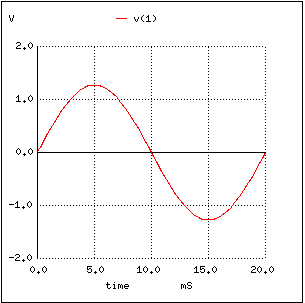
In this first plot, one can see the fundamental-frequency sine-wave of 50 Hz (an slightly sharp-tuned G1) by itself. It is nothing but a pure sine shape, with no additional harmonic content. This is the kind of waveform produced by an ideal and perfect musical note, although for purposes of argument, the 50 Hz is not normally a tuned note :
22013.png

Pure 50 Hz sinewave.

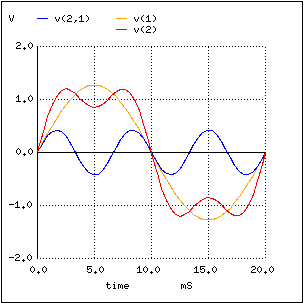
Next, we see what happens when this clean and simple waveform is combined with the third harmonic (three times 50 Hz, or 150 Hz - all very common in a stringed instrument). Suddenly, it doesn't look like a clean sine wave any more:
22014.png


The sum of the 1st (50 Hz) and 3rd (150 Hz) harmonics approximates a 50 Hz square wave.

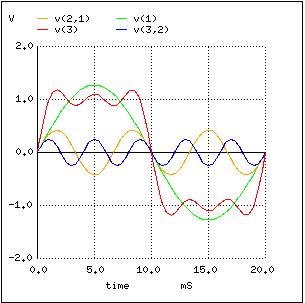
The rise and fall times between positive and negative cycles are much steeper now, and the crests of the wave are closer to becoming flat like a squarewave. Notice what happens as we add the next odd sinusoidal harmonic frequency:
22015.png


The most noticeable change here is how the crests of the wave have flattened even more. There are several more dips and crests at each end of the wave, but those dips and crests are smaller in amplitude than they were before. Watch again as we add the next odd harmonic waveform to the mix:
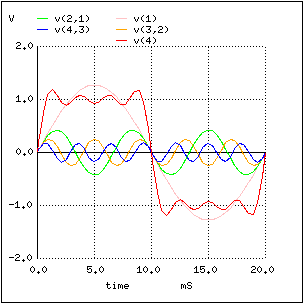
22016.png


The sum of 1st, 3rd, 5th, and 7th harmonics more aptly approximate a square wave.

Here we can see the wave becoming flatter at each peak. Finally, adding the 9th harmonic, the fifth sine wave voltage source in our circuit, we obtain this result:
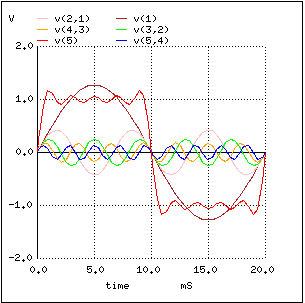
22017.png


The sum of 1st, 3rd, 5th, 7th and 9th harmonics approximates a true square wave.

We can get into the Squarewave for SPICE/Fourier analysis, but you can see that at almost any time a note is struck on a string, it generates a certain quality that approximates a square wave with all the primary, secondary, tertiary harmonics, etc.

You are almost always attacking the speaker(s) with these semi-square wave or their equivalent in form by mass acceleration/magnetic hysteresis/field collapse, subtrahention and reversal and REMF anyway.

I too once agonized over the causative damage (via distortion boxes and stomp pedals) to the speaker cones and voice coil windings, but with ample heat radiation/conduction/convection and the resulting damage induced into the delicate micro windings in the coil and the fact that paper burns at Fahrenheit 451, I can see that there might be some concern about square waves.

Just don't hold a note for more than 1.4 seconds and you'll be alright! <sarcastic smiley>

A square wave still isn't DC and shouldn't be confused with DC.
 
And since under powering is a myth, as long as no fat signal spike is fed into your cab, it lasts forever and it is actually physically impossible to blow a speaker cone? I'm just trying to go one more step in my understanding. If you had a 4 ohm cab you would've gotten all 500 watts from the lm into an 800 watt cab, you're still gravy, but feed an amp with a lot of headroom into a low wattage cab, and maybe add a nice signal spike, then possibly bye bye speaker cone? But the speakers can typically handle double what we throw at them...volume to me is a pressure gauge. It's a little hard for me to find true understanding in a single search.
 
Is anyone here up for some (potentially) destructive testing?
We have destructive testing going on all the time in this rehearsal facility. So far with only 200 rms clean tube watts driving a 1400 watt eight by ten, we had one idiot that managed to blow the tweeter fuse bulb with a dime'd fuzz face and a graphic eq pedal.
I asked him to demonstrate his clean dirty balance and he said he never played clean so I asked him how he knew what distortion or clipping came from which part of the signal chain. So he would be sure that his distorted sound did not get much louder than the amp could deliver at its safe rated output. I enforced a cleanish dirty balance on his pedal set and one of his band mates said it was the best sound he ever got.
You may only have 200 watts clean available but how many watts does that get too if the power amp is miles into clipping.
It will depend on the design and the power supply!:hiding:
 
And since under powering is a myth, as long as no fat signal spike is fed into your cab, it lasts forever and it is actually physically impossible to blow a speaker cone?
well everything has a chance of breaking eventually, but that is correct that your speaker won't break because it was blown.

I'm just trying to go one more step in my understanding. If you had a 4 ohm cab you would've gotten all 500 watts from the lm into an 800 watt cab, you're still gravy
not necessarily. the power handling rating of a cab is what the voice coil melts at. but the vast majority of cabs won't let you go anywhere near that number before the speaker reaches the point to where it has no more excursion, and once it reaches that point, all you're doing is damaging it, and it will eventually blow. it varies from manufacturer to manufacturer, but generally you can count on only being able to put about half its rated power handling into it before it starts to rebel.

but feed an amp with a lot of headroom into a low wattage cab, and maybe add a nice signal spike, then possibly bye bye speaker cone?
don't even have to have a spike. if the wattage is greater than the speakers can handle, it's bye bye speaker.

But the speakers can typically handle double what we throw at them...
where did you get that idea? that's false.

volume to me is a pressure gauge. It's a little hard for me to find true understanding in a single search.
it takes a little while for everything to soak in, yes. but here's something everyone can understand:

if you don't try to push your gear to its absolute limits, you have nothing to worry about.
 
By definition, a square wave has components of a DC signal.

That's a lot of pretty graphs but the premise is wrong.

You seem to have the tools right in front of you, multiply a square wave function by cos(0)(ie.1, ie DC) and integrate over one period. You will find the result is 0.

Where you can get some amount of DC offset is if the signal is clipping asymmetrically. I can't imagine it mattering.

The real issue is this: most transistor amplifiers don't like being run way past the power they are designed to be run at. If you really need 500 watts and are trying to get it by running a 200 watt amp all the way in to grotesque distortion you are inviting potential trouble. Don't do that.

If you really only need 200 watts you will be fine, regardless of the power handling of the speaker box.
 
TB myths and urban legends. And my false understanding. I do follow the law about not pushing my gear though, in the end that is the bottom line. And Jimmy my logic was completely flipflopped backwards, thanks man.
dude, i have had longtime professional soundmen try to tell me the same thing, and you'll even find manufacturers try to tell you that. but i liken it to a glass of water. does 32 ounces of water fit in a 16 oz cup? ;)

so don't feel bad...there are a lot of stupid myths about sound that have been busted now that we have ways to measure it and prove it scientifically.
 
Hi.

WOW, an underpowering topic again, what a surprise :(.

If the tone of a bass rig changes drastically when going from one end of the operating range to the other (or from low power output/power handling of the speaker to high power output/power handling of the speaker), either the speaker is defective or the amplifier or the amplifiers power supply is uncapable of delivering the required power. IME only as always of course.

Regards
Sam
 
In the square wave scenario, although the speakers are still moving, they are not moving smoothly and are subject to sudden movements and sudden stops, which is not good for them.

As to ohmage and cranks speakers i totally agree. Impedance (to a reasonable extent) is nature's attenuator. No need to blow big bucks on fancy Hot Plates.
 
In the square wave scenario, although the speakers are still moving, they are not moving smoothly and are subject to sudden movements and sudden stops, which is not good for them.
where did you hear that one?

As to ohmage and cranks speakers i totally agree. Impedance (to a reasonable extent) is nature's attenuator. No need to blow big bucks on fancy Hot Plates.
what if you use a tube amp, where wattage is unaffected by impedance?

i think you might want to read up a bit more on the subject.
 
Second time I've seen this, once from Sundogue, this time from SurferJoe. If the note you are playing has a frequency response of 50 Hz, the first harmonic will be 100 Hz. The SECOND harmonic will be twice that...200 Hz., NOT 150 Hz. So now I have to wonder how accurate the rest of the graph story is, as I don't know whether it is based on accurate information or not.
 
In the square wave scenario, although the speakers are still moving, they are not moving smoothly and are subject to sudden movements and sudden stops, which is not good for them.

Loudspeakers move and stop suddenly. That's what they're supposed to do. Square waves have nothing to do with it.
 
Second time I've seen this, once from Sundogue, this time from SurferJoe. If the note you are playing has a frequency response of 50 Hz, the first harmonic will be 100 Hz. The SECOND harmonic will be twice that...200 Hz., NOT 150 Hz. So now I have to wonder how accurate the rest of the graph story is, as I don't know whether it is based on accurate information or not.

If the fundamental is 50 Hz, the first harmonic in the Fourier Series is 50 Hz. The second is 100 Hz, the third is 150 Hz, the fourth is 200 Hz, the fifth is 250 Hz, and so on.
 
In the square wave scenario, although the speakers are still moving, they are not moving smoothly and are subject to sudden movements and sudden stops, which is not good for them.
No, they don't. No offense intended, but that's pure piffel. Read the FAQ, this dead horse has been beat so many times it's verging on the ridiculous.

Why is this subject here again? Where's a Mod when you need a topic shut down! :confused:
 

Latest posts