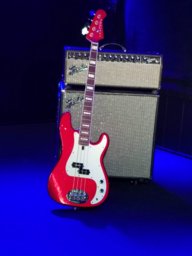
What are y’all’s opinions on an electric bass setup for bluegrass? I’ve never played a bluegrass gig, but I’ve been thinking my Fender Am. Performer Jazz Bass w/ tone rolled halfway down would work, but that’s just me. What are y’all’s ideas?
This is a fair question, and there are a number of long-time bluegrassers here that have responded. I'll gently add my "opinion" to the mix...
My answer is a big "It depends..."
There are a number of "recent" (avoiding the word modern) bluegrass bands, and even a few of the original foundational bands/players, who at least used an EB for a while. On both ends of that spectrum, Bluegrass Etc., The Krugers, and one of Don Reno's later bluegrass bands comes to mind.
But, the big names that everyone thinks of with bluegrass -- Monroe, Scruggs & Flatt, Stanley, etc. -- didn't use EBs at least during the formative bluegrass years, because they weren't widely available or popular among the bands, or among the folks that played bass for bluegrass, or among the audiences that listened.
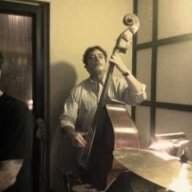
Soooo, if you're going for that original formative bluegrass sound, or if the people you're playing with, or if the audiences that you're playing for, want that original formative bluegrass sound, you want a double bass. Even a if it's double bass with electronics on it for on-stage use, a double bass still sounds like a double bass.
But, if you're playing with a "recent" bluegrass band, or more, with a truly modern bluegrass band, or if you're playing for a more modern bluegrass compatible audience, you may be able to get away with an EB, or for that matter, even a fretless uBass.
The long and the short of it is that whether we like it or not, us old timers, many which do prefer that original formative bluegrass sound, are going to be off the bluegrass music scene sometime soon, and the new fold is going to bring with it a mix of their musical tastes and the musical tastes of their peers. My money is on bluegrass changing at least subtly in the next 50 years; from a practical sense it really has to. I'm sure there will always be a place for that original formative bluegrass sound, but it may be a special niche, similar to how the various "recent" generations of jazz look at old-jazz and even ragtime.
Transparency: This is coming from a 50-year bluegrass and Gospel banjo, mandolin and Dobro player, who two years ago bought an Alcoa Aluminum double bass that was setup for rockabilly, and with only a few modifications has been using it for bluegrass and Gospel -- plugged in on stage and acoustically in jams -- pretty much without complaints, in the Pacific-western states of the USA.
Btw, geography may also make a difference. It depends...