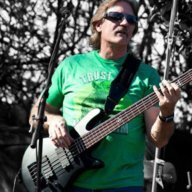
If anyone tells you that you can't play an electric bass in Bluegrass music, tell 'em to tell that to John Hartford.

TalkBass has been independent since 1998. Add your voice.
Create a free account to reply to discussions, view embedded media, and browse with fewer display ads.
Join free Log in
Want zero display ads or expanded classifieds tools? Compare plans.
I played for many years with a classical violinist who branched out and did everything. He used a boss reverb and some rack compression through a Polytone. The sound he acquired sounded just like his violin unamplified. The line out of the amp sounded like poo. Him straight into the amp, more poo. He had tweaked that gear to get his sound coming out of the speaker of the Polytone.Good question.
I was at a yearly hotel-based bluegrass jam-festival in a city in California that is known oil and for the "California Country sound" (look it up) 3 years ago and heard what sounded like the nicest DB, and some pretty good other instruments being played in one of the rooms from down the hall. Out of curiosity my wife and I walked by to see what and who was playing. It was actually a band jamming together, but it was no group that we recognized. Interestingly, there didn't seem to be a bassist there, just bluegrass instruments and a uke player.
We stopped to see and hear more. They sounded great. Of course with careful watching it turned out that the uke player was the bassist, playing a fretless uBass. He sounded great and if I hadn't been watching I would have sworn it was a DB. We talked after the jam song ended, the bassist commented that it's all in the amp and how it is set, and that voicing makes a huge difference. He was using a big old Ampeg amp of some kind. He had come into town on the train and while he couldn't bring his DB, he could bring the uBass in a gig bag and a big old amp.
Ironically at this event, the hotel power went out later that day, for a few hours. That particular bass player was silent during that period.
So anyway, here was a true DB player who had figured out how to make a uBass sound right. I've also since then met and talked and jammed with another bluegrass band bass player, for a national traveling band, who now routinely plays uBass. I have a fretless uBass for my backup bass now, along with a battery-powered light-weight amp.
As I mentioned in my earlier post though, it all depends. The uBass for bluegrass may be acceptable for some bassists and for some some bands / jams and it may be acceptable for some audiences in some geographic areas.
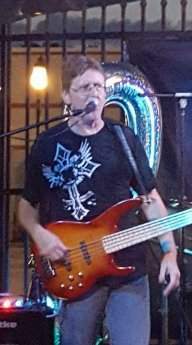
I've been a bluegrass music radio DJ and MC'd bluegrass festival for decades. Lots of bluegrass bass players play electric basses. Some include Steve Bryant (in the 70s with JD Crowe), John Cowan (NGR), Darrin Vincent (Dailey and Vincent), Mike Angling (Larry Cordle, Lonesome River Band, David Parmley/Continental Divide). Mike played a really nice Haze bass. I remember back years ago Cowan played a Kubicki, and another guy I saw at a festival had a six string bass. Most ones I see are P bass Fender or clones.
BnB

It says: "There's music here!"I am always amazed that people are so impressed with an acoustic upright bass... It comes down the the overall size of the thing. People dig it before you ever play a note.
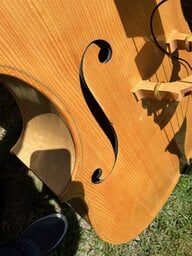
It says: "There's music here!"
Yes you are.And I'm not a beeeg violin

I'm sure it has become more acceptable over the last couple of decades. In 2002 (around...) I was at Merlefest and got booed the minute I stepped on stage with a resonator bass (not that I cared...).
It was also humorous to see booths selling instructional media that had signs up that said "why stand on the sidelines... You can play bass!". Lol.
I (somewhat) play upright as well. I am always amazed that people are so impressed with an acoustic upright bass... It comes down the the overall size of the thing. People dig it before you ever play a note.
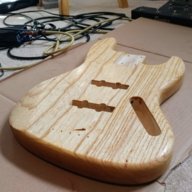
What are y’all’s opinions on an electric bass setup for bluegrass? I’ve never played a bluegrass gig, but I’ve been thinking my Fender Am. Performer Jazz Bass w/ tone rolled halfway down would work, but that’s just me. What are y’all’s ideas?

But I recall an article in the magazine Bluegrass Unlimited that had a section about a respected band (maybe Hot Rize, I know it wasn't New Grass Revival) using electric bass. He used a Precision with GHS Brite-Flats (GHS' version of modified rounds like D'Addario HalfRounds). That was a L O N G time ago, can. 1985.

Just going through my record collection;
Jim & Jesie
The Osborne Bros
The Country Gentelmen
Doc Watson
Mac Wiseman
Earl Scruggs Review
Third Tyme Out
Newgrass Revival
Hot Rize
Doyle Lawson & Quicksilver
Knoxville Grass
Somebody help me out, I'm sure I've missed a few others.
B.
But would hardcore traditionalists be less opposed to it than they'd be to other bass guitars?But, if you're looking for a electric bass for bluegrass (besides a P bass), consider the Ibanez Artcore AGBV200A. It looks the part and sounds the part. To me, it sounds a lot like an upright in short scale bass body.