So basically I'm just looking to make an alternative for the few $200 and up systems on the market.
The problem to solve is fairly easy, talking about the body side only,
when the 1st fret side is: adapter (string holes), tightened to a C shape brass bar with 2 holes, connected to the neck, and a nut to set the strings right.
So the main 2 options to tune a string:
1. roll it on a screw \ rod, like a normal tuning post.
2. take it back to step up in tension, like the regular "drawers"
Obviously a drawer looking part is a hard one to manufacture, so I went with the following idea, currently using a normal bass bridge for saddles, but that might be solved in the future as well.
1. Fluted angle aluminum bar, drilled for mounting holes, also drilled for tuning screws. (electrostatic powder coated in black)
2. 4 Socket cap M4 screws, tuned by allen wrench.
3. 4 springs
4. 4 locking nuts, coming from the front.
5. 4 barrel nut (flat surface = constrained rotation) + drilled for strings, when the ball
end is held by the barrel nut body.
I believe this should work pretty good, but what can you say about the tuning precision and movement?
The progression of the screw threads should be close enough right?
I mean, ABM surley use these kind of screws for their systems, maybe M2\M3 to be more accurate.
Any thoughts?

The problem to solve is fairly easy, talking about the body side only,
when the 1st fret side is: adapter (string holes), tightened to a C shape brass bar with 2 holes, connected to the neck, and a nut to set the strings right.
So the main 2 options to tune a string:
1. roll it on a screw \ rod, like a normal tuning post.
2. take it back to step up in tension, like the regular "drawers"
Obviously a drawer looking part is a hard one to manufacture, so I went with the following idea, currently using a normal bass bridge for saddles, but that might be solved in the future as well.
1. Fluted angle aluminum bar, drilled for mounting holes, also drilled for tuning screws. (electrostatic powder coated in black)
2. 4 Socket cap M4 screws, tuned by allen wrench.
3. 4 springs
4. 4 locking nuts, coming from the front.
5. 4 barrel nut (flat surface = constrained rotation) + drilled for strings, when the ball
end is held by the barrel nut body.
I believe this should work pretty good, but what can you say about the tuning precision and movement?
The progression of the screw threads should be close enough right?
I mean, ABM surley use these kind of screws for their systems, maybe M2\M3 to be more accurate.
Any thoughts?
Last edited:





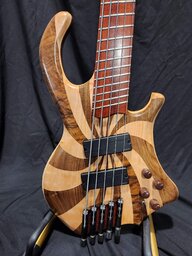



 Just some food for thought.