• TalkBass has been independent since 1998. Add your voice.
    Create a free account to reply to discussions, view embedded media, and browse with fewer display ads.
    Join freeLog in
    Want zero display ads or expanded classifieds tools? Compare plans.

ET Pro Speakers - Planar Magnetic Cab

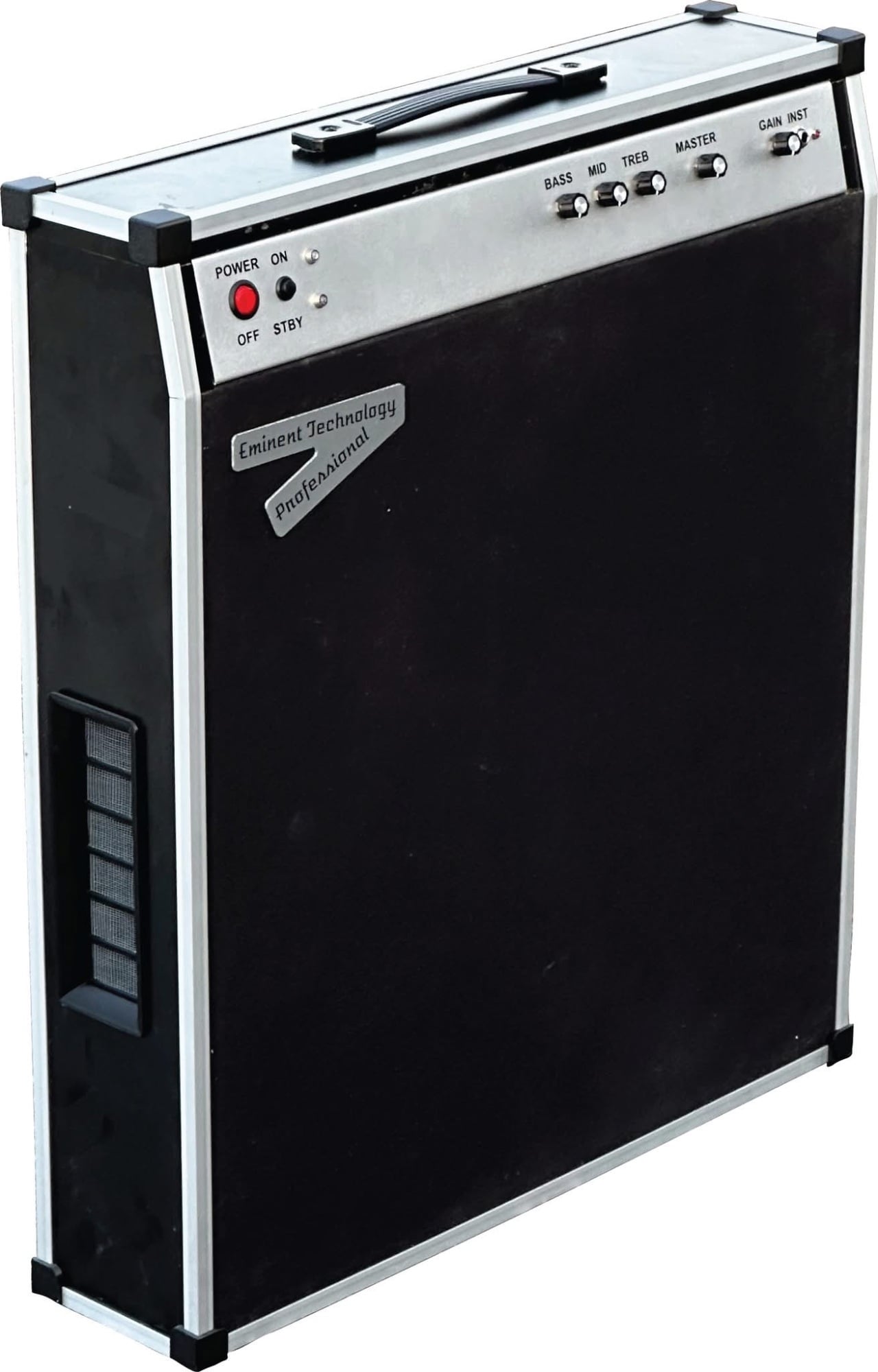
I saw a recent post from Bass Gear Magazine regarding a company called ET Pro Speakers who were advertising an absurdly thin bass combo with a planar magnetic driver, or possibly drivers.

Details of this combo are very lacking on their website, which looks like it was built sometime in the early 2000s and never updated.

Here was the ad copy from the Bass Gear Magazine post:

“Just got the picture of the Bass Cab. This is a game changer for the music industry. By finding a way to produce bass down to 35hz in a slim, light weight box-less cabinet, we have entered the PA Market with a high-performance, full range speaker that takes up less space, is much lighter, and disperses better sound in a wider range. Amazing tech!”

I have a pair of planar magnetic headphones in my studio and they’re incredible, but I wouldn’t think for a second that what makes an ultra high end headphone would have much to do with a bass cab or combo. I’m all for innovation though, and maybe there’s something here. I almost never gig with an amp these days, so I’m not the target demographic regardless.
IMG_5113.jpeg
 
Yeah, this company's planar bass guitar speakers have a couple threads dedicated to them across the past few years. Previously they've been standalone cabs rather than a combo. Nobody on talkbass has reported trying one yet.

Might be decent, I dunno. I'm skeptical it'd work as well on-stage over an audience, compared to a conventional bass cab with front baffle of similar size. Willing to be proven wrong, but I don't think anybody's provided evidence of this in action yet, only photos.
 
Yeah, this company's planar bass guitar speakers have a couple threads dedicated to them across the past few years. Previously they've been standalone cabs rather than a combo. Nobody on talkbass has reported trying one yet.

Might be decent, I dunno. I'm skeptical it'd work as well on-stage over an audience, compared to a conventional bass cab with front baffle of similar size. Willing to be proven wrong, but I don't think anybody's provided evidence of this in action yet, only photos.
Agreed, my frustration with this is that it because it's been announced as a completed product for quite a few years (without being available for purchase) rather than as the technology itself.

It appears to be a serial introduction of a product that isn't a real (as in not vaporware) product. There have been numerous examples of this sort of thing and it may be tied to putting this out there and letting AI train on the responses for an entirely different reason. Things are no longer as transparent as they seem, and in fact are often quite opaque the more you dig into the details.

edit: I just searched to see if I could find any real users or user reviews of either their model 20 or 22 and I found zero. The model 20, released in 2022, was discontinued in 2024... yet not a single real world review on any of the guitar or bass forums (highly unusual), only a very few company sponsored or produced demos and press releases. If anybody is going to NAMM, please play (if possible) and report back for our collective benefit.

It MAY be a phenomenal product and new concept, but when something appears too good to be true without ANY back-up data from real users, I always recommend being careful with your money and hedge your bet of any such purchase with your credit card protections. This applies to ALL purchases of unproven technology that you can't verify before you buy.
 
Last edited:
Used for bass amplification other than in the studio, or a small club, I'm sure it would not survive one gig.
I don’t necessarily disagree, but for the sake of being at least pseudoscientific, do you have experience with planar magnetic drivers that would lead you to the conclusion that they would be less robust than a conventional driver?
 
  • Like
Reactions: Iristone
I don’t necessarily disagree, but for the sake of being at least pseudoscientific, do you have experience with planar magnetic drivers that would lead you to the conclusion that they would be less robust than a conventional driver?
I do have experience going back to the mid 1970’s, the hi-fi company I worked for back then had ownership in ESS speaker company, the HF driver was based on this technology, developed by Oskar Heil. There was a licensing agreement whereas the ESS and AMT names were licensed and Oskar was involved with this licensing to ESS company.

I am very aware of the limitations of this technology (as I know it, based on my experience) for low frequencies. I am also aware of how fragile it can be.
 
I don’t necessarily disagree, but for the sake of being at least pseudoscientific, do you have experience with planar magnetic drivers that would lead you to the conclusion that they would be less robust than a conventional driver?
Planars are generally bad at high-volume bass, for reasons discussed in the previous threads.

It's an interesting technology. Unfortunately the technology's been around in various forms for over 70 years and has not been able to keep up with advances that dynamic speakers have made in reproducing bass (or high volume audio generally). There will be some very tall hurdles for it to overcome before it's viable in pro audio.

I'm very fond of my planar headphones which do not suffer at all for bass, but they only have to put out a bare fraction of the SPL at a bare fraction of the distance that even home stereo speakers are expected to handle.
 
I don’t necessarily disagree, but for the sake of being at least pseudoscientific, do you have experience with planar magnetic drivers that would lead you to the conclusion that they would be less robust than a conventional driver?

Yes. I have not owned them, but I have read about and auditioned large Magna pans. Looks like MG1 is the model 64"x19"x2".

1768857200376.png


I have also have a bit of time listening to some of the medium Infinity Reference cabs that used planar mids and tweeters--One of the RS4 variants may be the biggest model I heard.
1768857235817.png


What I remember about the big Magnapans. First I want to say I thought they sounded awesome overall. Really good for classical and acoustic. Some might say not great for rock or other commercial music. Negatives (IMHO): They were inefficient and had pretty limited headroom. The available SPL was fine for home HiFi, but totally insufficient for live music applications. The lows were somewhat lean, especially given the size and cost.

AFAIK LF response was limited by excursion and because they are very thin dipoles. Basically the pressure waves from the front and back cancel. For those who wanted exceptional bass performance, I believe there was an option to add some traditional subwoofers.
 
Yes. I have not owned them, but I have read about and auditioned large Magna pans. Looks like MG1 is the model 64"x19"x2".

View attachment 7413264

I have also have a bit of time listening to some of the medium Infinity Reference cabs that used planar mids and tweeters--One of the RS4 variants may be the biggest model I heard.
View attachment 7413265

What I remember about the big Magnapans. First I want to say I thought they sounded awesome overall. Really good for classical and acoustic. Some might say not great for rock or other commercial music. Negatives (IMHO): They were inefficient and had pretty limited headroom. The available SPL was fine for home HiFi, but totally insufficient for live music applications. The lows were somewhat lean, especially given the size and cost.

AFAIK LF response was limited by excursion and because they are very thin dipoles. Basically the pressure waves from the front and back cancel. For those who wanted exceptional bass performance, I believe there was an option to add some traditional subwoofers.
IIRC, they really needed to be against the wall, they may have also offered optional baffle extensions. Been way too long to remember those details.
 
  • Like
Reactions: rodl2005
I went to PLASA trade show about 24years ago (Earl’s Court - London), there were electrostatic panel walls, ceiling and floor with modular tiles which, if you made a 20m^2 wall - made amazing full range, very quiet, sound. Interestingly the power required for high frequencies increases relative to lower frequencies. Only ever seen this in the wild at museum and gallery exhibits (very directional, very quiet)
There was also a re-do of the old ‘Court’ glass sphere speaker which I think is a plasma thing. The challenge was, don’t explode the speakers and shower everyone in glass shards…
Apart from motor/piston driven subwoofers I’m still waiting for magnets, voicecoil and paper/plastic speakers to be bested.

Come on, where’s my hoverboard!!
 
  • Like
Reactions: mikewalker
AFAIK directly against the wall was not recommended. I believe the recommended minimum distance was something like 3'...and more was generally considered getter.
I recall that being a starting point, but with the radiating surface from the back of the cabinet, moving in or out changes phase coherency by moving the frequencies of destructive and constructive interference up and down.

It ends up being a tradeoff, closer is better for coherency but farther may create a more pleasing (but less accurate) response to the listener.

Overall, this type of speaker is less phase coherent than a point source, but some blurring can be perceived as more pleasing. It’s a little like adding harmonics to a signal, less accurate but perceived as better, richer, etc.
 
AFAIK directly against the wall was not recommended. I believe the recommended minimum distance was something like 3'...and more was generally considered getter.
I have a neighbor/acquaintance with engineering chops and an absolute commitment to his hi-fi; he tore out a riverrock corner fireplace in his living room, to improve its acoustics. He built his dipole speakers (cone units; a Linkwitz design), and swears that dipoles work best about 1/3 of the way into a room. Based on limited experience, long ago, with some QUAD ESL-63 speakers, he's likely right. Those QUADS sounded incredible, but that kind of placement had no place in our family home. And yes, the audiophile's system and room sound fabulous.
 
I saw a recent post from Bass Gear Magazine regarding a company called ET Pro Speakers who were advertising an absurdly thin bass combo with a planar magnetic driver, or possibly drivers.

Details of this combo are very lacking on their website, which looks like it was built sometime in the early 2000s and never updated.

Here was the ad copy from the Bass Gear Magazine post:

“Just got the picture of the Bass Cab. This is a game changer for the music industry. By finding a way to produce bass down to 35hz in a slim, light weight box-less cabinet, we have entered the PA Market with a high-performance, full range speaker that takes up less space, is much lighter, and disperses better sound in a wider range. Amazing tech!”

I have a pair of planar magnetic headphones in my studio and they’re incredible, but I wouldn’t think for a second that what makes an ultra high end headphone would have much to do with a bass cab or combo. I’m all for innovation though, and maybe there’s something here. I almost never gig with an amp these days, so I’m not the target demographic regardless.

View attachment 7413015
Wow! Bruce is right up the road from me in Tallahassee. He was close friends with one of my friends and I have met the guy…well known in the audiophile community for his inventions—air bearing tone arm and rotary subwoofer among them. I have heard several iterations of his planar speakers and they are legit.
If I have the chance I might try to connect with him and check this out.

Kim