• TalkBass has been independent since 1998. Add your voice.
    Create a free account to reply to discussions, view embedded media, and browse with fewer display ads.
    Join freeLog in
    Want zero display ads or expanded classifieds tools? Compare plans.

Ever maxed out your bridge saddles?...

Let me preface this by saying that I've been doing my own setups for years and overall been happy with the results but I came across an issue that I've never dealt with before. Maybe you guys have experienced something similar.
My G&L SB-2 had been strung with Labella Copper White Tapewounds and although I liked the sound and feel, the noise from the lack of string ground was annoying me so I decided to put on Pressurewounds.
There is a big difference in tension between these two strings (or so it seems), the tapes feeling like rubber bands and the GHS noticeably tighter. Making the transition required repeated incremental neck adjustments and of course, adjusting the bridge saddles and intonation.
My setup is pretty standard... I always have a .012mm gap around the 7th-8th frets with the 1st and 15th fretted and I run my E at 2.5mm and the G string at just under 2.0mm.
After I got the neck relief bowed correctly with no buzzing anywhere, I could not get the G string lower than 2.25mm because the saddle was bottomed out, sitting on the bridge. There was no more room for adjustment. The other saddles have had to be lowered since the string change but are still raised off the bridge.
So basically, I cannot get my G as low as I would like it with these particular strings. :bored: Has this ever happened to you? Are Pressurewounds' tension so far outside the realm of what G&L thought you'd be stringing it with that the bridge doesn't accommodate them? Does anyone out there have an SB-2 with Pressurewounds that managed to get low action on all the strings? Regardless, let me know your thoughts.
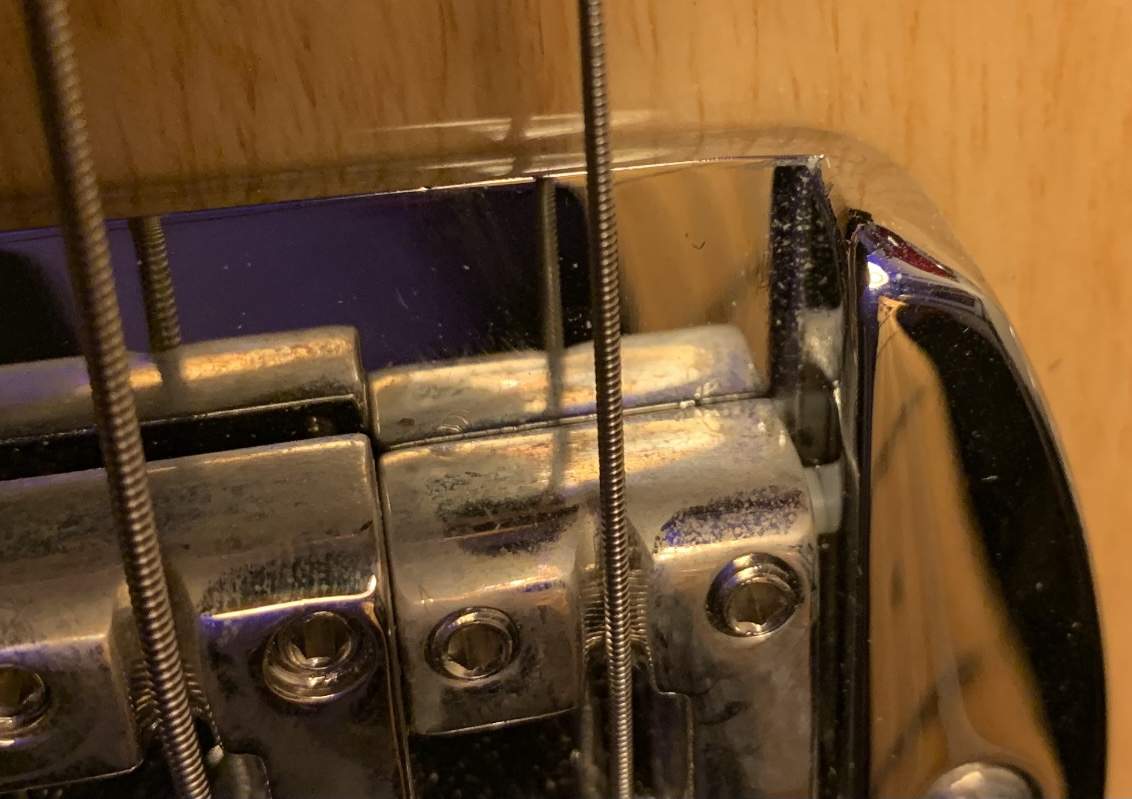
C680ACC4-0F63-4A66-A56A-BBF559431A13.jpeg
 
So basically, I cannot get my G as low as I would like it with these particular strings. :bored: Has this ever happened to you?

I have just run into this problem myself. On my Epiphone Thunderbird Pro IV, I cannot get the G-string saddle lower than 2mm of action at the 12th fret. The strings, E to G, have action like this now: 2 - 1,75 - 1,75 - 2 millimeters. Usually I would set the G to 1,5 or 1,25 in such a scenario as a starting point.
Strings are D'addario XL singles, 50-110, tuning is DGCF. Relief at the 7th fret is 0,25mm. No buzz, no rattle, but a maxed out G saddle which is like 50% too high.

A typical remedy for this problem is a shim in the neck pocket

And this fixed all problems on my P-Basses in the past. Unfortunately, that Epiphone is neck through.

A few seconds on a belt sander would fix that.

I thought about sanding down the saddle. On that particular bridge there are little steel blocks standing upright in the saddles. On the G string the screws are maxed in, meaning the steel block itself is sitting plain on the ground plate already. Maybe I can tape a piece of sand paper onto a table and just grind the bottom of the steel block over the plain sand paper to shorten it by half a millimeter.
 
Let me preface this by saying that I've been doing my own setups for years and overall been happy with the results but I came across an issue that I've never dealt with before. Maybe you guys have experienced something similar.
My G&L SB-2 had been strung with Labella Copper White Tapewounds and although I liked the sound and feel, the noise from the lack of string ground was annoying me so I decided to put on Pressurewounds.
There is a big difference in tension between these two strings (or so it seems), the tapes feeling like rubber bands and the GHS noticeably tighter. Making the transition required repeated incremental neck adjustments and of course, adjusting the bridge saddles and intonation.
My setup is pretty standard... I always have a .012mm gap around the 7th-8th frets with the 1st and 15th fretted and I run my E at 2.5mm and the G string at just under 2.0mm.
After I got the neck relief bowed correctly with no buzzing anywhere, I could not get the G string lower than 2.25mm because the saddle was bottomed out, sitting on the bridge. There was no more room for adjustment. The other saddles have had to be lowered since the string change but are still raised off the bridge.
So basically, I cannot get my G as low as I would like it with these particular strings. :bored: Has this ever happened to you? Are Pressurewounds' tension so far outside the realm of what G&L thought you'd be stringing it with that the bridge doesn't accommodate them? Does anyone out there have an SB-2 with Pressurewounds that managed to get low action on all the strings? Regardless, let me know your thoughts.View attachment 4059050

I have this issue on one bass as the neck pocket is too deep. I shimmed the neck. But then I am aiming for an action of 1.5 to 1.8mm for the E string. 2.5mm for me means the bass is firewood :).
 
  • Like
Reactions: Eidolon0274
After I got the neck relief bowed correctly with no buzzing anywhere, I could not get the G string lower than 2.25mm because the saddle was bottomed out, sitting on the bridge. There was no more room for adjustment. The other saddles have had to be lowered since the string change but are still raised off the bridge.
The only way to workaround this, IMO and IME, is to remove the neck and place a piece on something (like a part of a credit card) between the body and the neck. This will allow you to adjust the pitch of your neck a setup the saddles higher.

Roger Sadowsky perfectly explains this at 13:30 on the following video:
 
Last edited:
I have an early 80's sb-2 and it has the neck tilt screw/function. I never had the desire to use it versus a shim, which I believes provide better contact but non the less it's there. Could be the case with you bass.
IMO, notch the string groove deeper or sand the saddle, they sell the bridge at G&L if you need more. That should leave your neck in full contact with the pocket assuming there isn't already a shim in it.
 
Neck shim under the 2 bolts closest to the heel. You can use a piece of sandpaper (stays in place really well) or slice of business card. A little goes a long way. Do not use a credit card, that thickness will greatly overcompensate for the issue and tilt your neck too far back.

I've shimmed half of the bolt on basses I've ever owned, I go for 1.1mm at the G and around 1.2 on E or B with almost no relief, yes very low by most standards. Not the lowest I've seen people play, surprisingly.

I've only filed the saddle deeper on a handful of occasions where I only had one string bottomed out (always the G) and it was a matter of .1mm difference, you're not going to have a good time filing a whole millimeter into a saddle.

If this doesn't work out for you, you can list it in the classifieds here on TB where 9 out of 10 players won't notice any of these things as they don't play above the 5th fret in their oldies cover band or blues jam night at the retirement home. Do we still use flame suits on this forum?
 
Last edited:
  • Like
Reactions: CallMeAl
Let me preface this by saying that I've been doing my own setups for years and overall been happy with the results but I came across an issue that I've never dealt with before. Maybe you guys have experienced something similar.
My G&L SB-2 had been strung with Labella Copper White Tapewounds and although I liked the sound and feel, the noise from the lack of string ground was annoying me so I decided to put on Pressurewounds.
There is a big difference in tension between these two strings (or so it seems), the tapes feeling like rubber bands and the GHS noticeably tighter. Making the transition required repeated incremental neck adjustments and of course, adjusting the bridge saddles and intonation.
My setup is pretty standard... I always have a .012mm gap around the 7th-8th frets with the 1st and 15th fretted and I run my E at 2.5mm and the G string at just under 2.0mm.
After I got the neck relief bowed correctly with no buzzing anywhere, I could not get the G string lower than 2.25mm because the saddle was bottomed out, sitting on the bridge. There was no more room for adjustment. The other saddles have had to be lowered since the string change but are still raised off the bridge.
So basically, I cannot get my G as low as I would like it with these particular strings. :bored: Has this ever happened to you? Are Pressurewounds' tension so far outside the realm of what G&L thought you'd be stringing it with that the bridge doesn't accommodate them? Does anyone out there have an SB-2 with Pressurewounds that managed to get low action on all the strings? Regardless, let me know your thoughts.View attachment 4059050
My Tribute Kiloton had this issue out of the box. It pained and irritated the heck out of me to have to mod/remove the neck but, a neatly and precisely cut out of 300 grit sandpaper in the neck pocket fixed all.
 
I've shimmed, I've grinded saddles & routed on neck throughs. Those are all fine techniques.
Has anyone mentioned buying another bridge? there are entire bridges with overall string height shorter than yours.
The Hipshots go pretty low. Schaller roller bridge does too. It also has only three relatively central holes, so they would definitely be covered up if you went back to the stock bridge... now that I think of it, a G&L bridge is large and chunky, most bridges would probably offer lower string options.
Is there a reason you want to avoid shimming?
 
Last edited:
  • Like
Reactions: JRA
Neck shim under the 2 bolts closest to the heel. You can use a piece of sandpaper (stays in place really well) or slice of business card. A little goes a long way. Do not use a credit card, that thickness will greatly overcompensate for the issue and tilt your neck too far back.

If you really want, you can get full-length, pocket-sized shims that are angled from StewMac. Whether they have the tone wood you are after for the perfect shim is another matter :)

I've shimmed half of the bolt on basses I've ever owned, I go for 1.1mm at the G and around 1.2 on E or B with almost no relief, yes very low by most standards. Not the lowest I've seen people play, surprisingly.

I managed 1.2mm on a fretless for a bit, but increased to 1.5mm as the target. The one I currently have shimmed needs some fret work to get below 1.8mm. It probably just needs a constant thickness shim in addition to the angled one as the neck pocket is slightly deep, for which I blame the previous owner. On my other basses I haven't required it for circa 1.5mm. 1.2mm is slightly extreme, though!
 
  • Like
Reactions: Eidolon0274
If you really want, you can get full-length, pocket-sized shims that are angled from StewMac. Whether they have the tone wood you are after for the perfect shim is another matter :)


I managed 1.2mm on a fretless for a bit, but increased to 1.5mm as the target. The one I currently have shimmed needs some fret work to get below 1.8mm. It probably just needs a constant thickness shim in addition to the angled one as the neck pocket is slightly deep, for which I blame the previous owner. On my other basses I haven't required it for circa 1.5mm. 1.2mm is slightly extreme, though!

Tone wood shims, you know how that thread would go on TB lol! Most factory shims I've seen are plastic or paper from bass builders low to high end.
 
  • Like
Reactions: mcnach

Latest posts