
• TalkBass has been independent since 1998. Add your voice.
    Create a free account to reply to discussions, view embedded media, and browse with fewer display ads.
    Join freeLog in
    Want zero display ads or expanded classifieds tools? Compare plans.

Excel spreadsheet to calculate where to start winding a string. . .

I don't know if I'm alone or if anyone else has the desire to know exactly where to start winding to get the correct number of wraps, but I solved it by writing a program in excel.
Check it out:
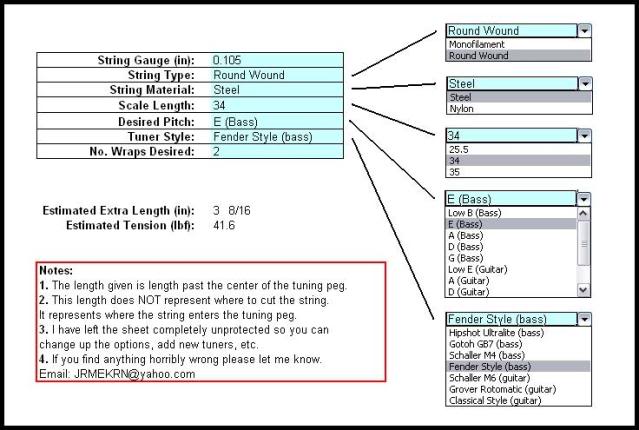
StringProgram.jpg


. . . and yes, I am an engineer.

Clarifications:
1. The length specified is extra string length past the center of the tuning peg.
2. This is NOT where to cut the string. This represents only approximately where the string should enter the tuning peg.


I have attached the .xls file to this post. Let me know how it works for you.

CYA: Use at your own risk. I am not responsible for any damage to strings or instrument resulting from use of this spreadsheet.

-
 

Attachments

  • Like
Reactions: moorebass and KaraQ
I don't know if I'm alone or if anyone else has the desire to know exactly where to start winding to get the correct number of wraps, but I solved it by writing a program in excel.
Check it out:

ExcelProgram.gif


. . . and yes, I am an engineer.

How do you account for the various string lengths from manufacturer to manufacturer? Is the cut length after the nut or from the end of the string? How do you account for different headstock layouts (like my Stingray 5 or other peg configurations)? What about string through (with slightly varying body thickness and/or ferril (sp) depth)?

Well, I'm waiting... ;)

I used to be a toolmaker who argued with engineers daily. :smug:
 
How do you account for the various string lengths from manufacturer to manufacturer? Is the cut length after the nut or from the end of the string? How do you account for different headstock layouts (like my Stingray 5 or other peg configurations)? What about string through (with slightly varying body thickness and/or ferril (sp) depth)?

Well, I'm waiting... ;)

I used to be a toolmaker who argued with engineers daily. :smug:

I think his distance indicated would be past the centerline of the peghead. That would leave as the only variable unaccounted for the diameter of the peghead. Think I'll PM for the file. What could it hurt?


But then again, I'm no engineer.:hiding:


Edit: Oops - I guess that's what the tuner style is for. (Slaps forehead)
 
I think his distance indicated would be past the centerline of the peghead. That would leave as the only variable unaccounted for the diameter of the peghead. Think I'll PM for the file. What could it hurt?


But then again, I'm no engineer.:hiding:

You are correct. The end result is the # inches past the center of the tuning peg. As regards to peg diameter, if you are fairly familiar with excel you can add any tuners models I failed to include.

Clarification: The length represents where to start winding NOT where to actually cut the string. On a bass it will represent approximately where to BEND the string, not cut the string.
 
Sending you a PM just as soon as I can get everything on my desk arranged just right.

Nice. :D

Actually, please don't imagine me as the TV character Monk playing bass. I just got tired of messing strings/setups up. Strings are expensive!

It especially gets tricky when the bass requires enough wraps on the E string to produce the right angle/tension across the nut. :rolleyes: Buzz, buzz

The straw that broke the camels back was me breaking the high D string on my 8-string bass because of too few wraps and the edge of the peg hole being sharp. I needed enough wraps to get above the through-hole.
 
I'll send the Excel file to anyone who wants it. Just PM me. I'm all for helping other anal retentive perfectionist string winders like myself. :p

I'd greatly appreaciate a copy!

Personally, I try to wrap as much of the string around the peg as possible, and prefer not to cut unless absolutely necessary. That's fine on the D and G strings, but the E is always a problem. Even after playing for 25 years!! :D
 
I'd greatly appreaciate a copy!

Personally, I try to wrap as much of the string around the peg as possible, and prefer not to cut unless absolutely necessary. That's fine on the D and G strings, but the E is always a problem. Even after playing for 25 years!! :D

Go ahead and PM me your email address and I'll send it to you!

Edit: I have attached the file to my 1st post. You can download it at any time.
 
I always use the 2 inch rule and I've never had any problems but I still want to try this out, it seems kinda cool to be honest :).

A few questions/suggestions Does this factor in the headstock style 4-in-line, 2-and-2, 3-and-1, etc (does that matter?), does is include calculations for the B and C strings on 5 and 6 string basses, and does it indicate where you should cut the string?
 
I always use the 2 inch rule and I've never had any problems but I still want to try this out, it seems kinda cool to be honest :).

A few questions/suggestions Does this factor in the headstock style 4-in-line, 2-and-2, 3-and-1, etc (does that matter?), does is include calculations for the B and C strings on 5 and 6 string basses, and does it indicate where you should cut the string?

Headstock style doesn't matter. Really it just calculates how far past the tuning peg you should start winding. The most important factor is just the diameter of the tuning peg. All other inputs are really just me trying to make it a little more accurate by accounting for how much the string stretches as it gets up to pitch. The image below should make it more clear exactly what the end result of the calculation is.

StringCalculatorDirections.jpg
 
  • Like
Reactions: KaraQ
To everyone I have already given the file to:
The Hipshot Ultralite Tuner referenced is the 3/8" version, not the 1/2" version. If you have the 1/2" version go ahead and select the "Fender Style" tuner. It's essentially the same peg diameter. Same thing with G&L and Music Man basses, go ahead and select the "Fender Style" tuner.