
OMG!
Huh? Is that an "I can't believe people would care to calculate this." OMG?

TalkBass has been independent since 1998. Add your voice.
Create a free account to reply to discussions, view embedded media, and browse with fewer display ads.
Join free Log in
Want zero display ads or expanded classifieds tools? Compare plans.
OMG!

I always use the 2 inch rule and I've never had any problemsQUOTE]
Don't try that on a jazz! That would be one around 1 wrap.
This program is quite interesting, but at the same time a little pointless unless you have 100 different basses all with different diameter posts.
Still it must have taken a lot of work, so well done!
This program is quite interesting, but at the same time a little pointless unless you have 100 different basses all with different diameter posts.
 so I have altered my original post accordingly. No need to PM me. Just please let me know how it works out for you!





I downloaded it. I will check it out. No comment on anal as
this isn't my forum.
But both my brother and father are engineers, so I have a
clue what you are up to.
LMAO a excell spreadsheet to learn how to do strings on posts for desired amount of wraps. Sure am glad that most everyone learns to do it by sight after a couple times.

Yes, you may laugh, but not everyone's headstocks look as good as mine.
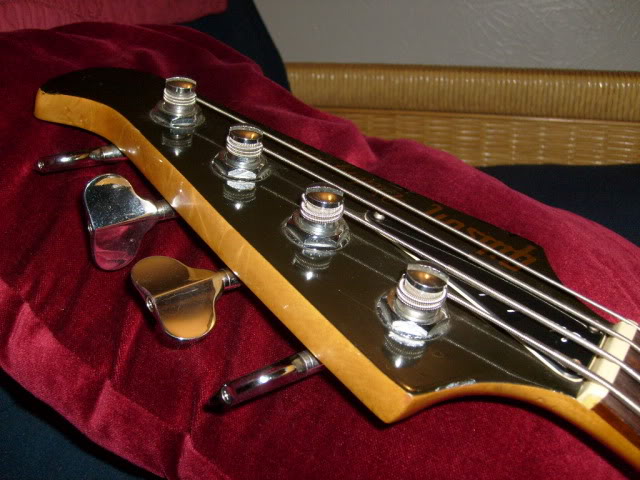

. .. My rule of thumb with electric basses and acoustic 12 strings is to allow a distance of 2 full peg holes. I.e., on an inline 4 like a jazz, insert the string into the bridge, lay it out and for an E, cut it at the center of the peg for the D string. Two center to center peg lengths. . .
Cept the break angle over the nut is too shallow. I think you need to do a Six Sigma project to perfect the method for obtaining the optimum break angle. Or maybe a Shingo project.

I like my method better, only because I was always taught to wrap the string to the bottom of the post. So, there may be 3 wraps on my E, but the G probably has 6 or 7.


