• TalkBass has been independent since 1998. Add your voice.
    Create a free account to reply to discussions, view embedded media, and browse with fewer display ads.
    Join freeLog in
    Want zero display ads or expanded classifieds tools? Compare plans.

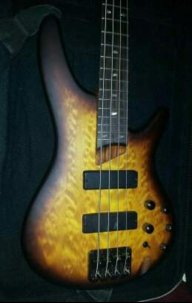
Excuse me... what the Bass?

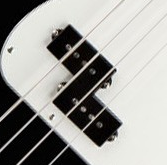
It will. It's gonna sound like a P in the musicman sweet spot, and that sounds like a pretty glorious tone to me.
And reversing it is just common sense in that position. A regular P slant is too unbalanced for a bridge position. Reversed makes more sense in ANY position actually, I really do think Leo got this small detail plain wrong.

i always thought Reverse P made better sense

As far as pickup positioning, i think thats debating physics...you'll have to post an example to prove that...On the other hand, Positioning of the pickup will drastically affect voicing...its physics...and the basic premise of Line6 emulations by emulating pickup positioning via parametric...Do individual pickups of a J bass sound identical when soloing each?
 
i think thats debating physics...you'll have to post an example to prove that

It’s been discussed here in other threads. It has to do with how far the pickup is from the bridge saddles. Too far and things are boomy; too close and things are twangy. I’m firmly in the “reverse” camp, especially close to the bridge. Low strings sound tight and clear, while high strings sound full.
 
It’s been discussed here in other threads. It has to do with how far the pickup is from the bridge saddles. Too far and things are boomy; too close and things are twangy. I’m firmly in the “reverse” camp, especially close to the bridge. Low strings sound tight and clear, while high strings sound full.

Not sure why you are replying: I said Reverse P makes better sense :D

But putting a P-pickup in a J position or MM position doesnt sound remotely like a P-bass.
 
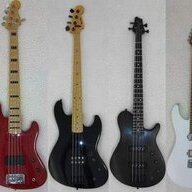
look closer at the photos everyone. they are photo shopped.
the musicman pickup and knobs are photo shopped. the tort pickguard with the p pickup is photo shopped in and the tort control plate and knobs. the strings on both basses do not line up.
Totally agree. That tortoise shell control panel on the MM wouldn't cover all the routing or the previous metal panel's holes if it were real.

The strings on both basses around the cut and pasted pickups don't join properly either. Look at the end of the fretless's neck!
 
  • Like
Reactions: Malak the Mad
Say what you will about these particular basses, but I’ve oft dreamed about picking up a pair of 5-string StingRays and installing Jazz p’ups in one and a split-coil in the other — in the proper J and P positions and passive electronics (or passive option). I just like everything about the StingRay topography but sometimes want that J or P sound, and not an approximation.
 
This one did OK, but maybe because it has 2 P/U...

leeskar.jpg
 
This one did OK, but maybe because it has 2 P/U...

View attachment 3399290
Well yeah but the Stingray position provides a much fuller tone than the P. It's not much far from the P location actually. So it doesn't strictly need a neck pickup, although many folks would probably have the need for one if they were to use that. I don't like basses with more than one pickup except a few exceptions so I don't.
But putting a P-pickup in a J position or MM position doesnt sound remotely like a P-bass.
No, It won't sound like a P bass. It will sound like a P pickup in rhe stingray position. And to me that means it'll sound monstruosly good. The woodiness of the P pickup combined with the dynamics and punch of the. MM placing (and, in my mind an MM preamp (and a parallel wiring option)) seems pretty cool to me. I heard some examples and I like it quite a lot. It's a meaner, middier P. But still a P. The DG coil is almost in the same position as on a stardard P. Just like Mark Hoppus's bass which has a P reversed in the other way, towards the neck, but still sounds like a P, just with an awesome low frequency meaty, grindy boost.
 
Well yeah but the Stingray position provides a much fuller tone than the P. It's not much far from the P location actually. So it doesn't strictly need a neck pickup, although many folks would probably have the need for one if they were to use that. I don't like basses with more than one pickup except a few exceptions so I don't.
I'm not trying to start an argument here, but having owned both a P & a Ray, I always thought it was the design of the Ray's mighty humbucker that gave that tone. Location definitely plays a huge role, I agree, but IME, the closer to the bridge, the thinner the sound.

Any thoughts?
 

Latest posts