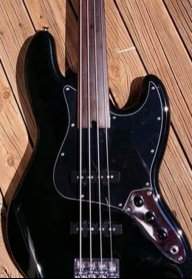
All magnetic guitar/bass pickups (there is no magic difference, other than where the pole pieces are and how the thing is mounted), that makes a pickup a "guitar pickup" or a "bass pickup" have a similar frequency response. They are all flat in the bass and lover mids, have a peak somewhere in the upper mids or lower treble, and above that, the response falls off at 12 dB/octave. The frequency where that resonant peak in the upper mids/lower treble shows up depends on the inductance of the pickup, and the capacitive load - some of which is in the windings, and the rest in in your cable. You can also add your own loading if you want to - a loading capacitor. The height of that peak is determined by damping in the system. Some of that damping is in the pickup (you can add or remove damping in the construction of a pickup with shorting rings or similar structures that add eddy currents), some of it is in the pots you use in the bass, and some of it is in the input impedance of whatever you plug it into.
As far as how much you can alter the tone of a pickup, that depends on a number of things. In the case of Fenderish pickups - where the magnets are the same in pretty much all the Fender designs, and most of the clones, in a lot of designs, the only things that makes one sound different from the next one are the number of turns and the winding pattern. Yes, there are other things that can affect performance, but there are a whole lot of folks that copy magnet materials, sizes, and wire gauges (there is a religious adherence to 42 gauge wire in many of these winders), to where the only real difference is the number of turns and the winding pattern. The number of turns affects the inductance, and the winding pattern alters the pickup's interwinding capacitance.
If your buy pickups that are on the low side in terms of inductance, you can tune their response via loading capacitance to where they can sound like a pickup with more turns. If you buy a pickup on the high side in terms of inductance, you can't undo that - there are no negative capacitors.
My step son had a Squier affinity strat. The pickups on that were wound rather low in inductance - they seem to have actually used a bigger gauge of wire, and wound with lower turns than a "normal" strat". Why would they do that? One of the things you can do to make a pickup cheaper is wind them faster. Fewer turns means less time on the machine (more pickups per hour), and a fatter wire gauge means it's stronger, so you can wind the turns faster without breaking wires. so , the thing sounded thin - low inductance. With some shorted turns and loading caps to move the resonance peak to where a normal strat would be, the thing sounded a LOT better.
Pickups are magnets, sometimes pole pieces, and wire. Everything else is there to hold those things in place - there is no magic in the flatwork materials, the plastic used in the covers, etc. And the differences between most pickups of the same flavor (P pickups, for example) are smaller than most folks want to think they are. If the winder's name on your Fenderish pickup makes you think it's special, I have no problem with that, but in reality, it's not as magical as you think. In a blind test, I'm sure i could find (and load) a cheaper alternative pickup that would sound just the same to you.
If you buy a fancy pickup to put in your bass, and you want it to sound better, I highly suggest you put on fresh strings when you change pickups. You'll be amazed at how much better the "new pickup" makes your bass sound.