If it helps, Alembic recommends neck-thru with ebony lamination to bump the fundalmental.
My Alembic does seem to have a bit more fundamental than my Ibanez BTB

TalkBass has been independent since 1998. Add your voice.
Create a free account to reply to discussions, view embedded media, and browse with fewer display ads.
Join free Log in
Want zero display ads or expanded classifieds tools? Compare plans.
If it helps, Alembic recommends neck-thru with ebony lamination to bump the fundalmental.


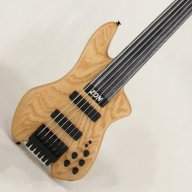
Now, if you insist on generating the waveforms with complex wound strings, fretted furniture and magnetic pickups that are, as you pointed out, eminently unsuited to the task, you're beating your head against a wall for no clear reason, hence back to my original question about the objective.
Here's what my father and I have come up with:
Rather than placing pickups in the neck, extend the body 8-9 inches and then you could place the pickup near the neck, and it would be in the middle of the scale. It would be a MUCH longer scale than standard, but you'd be getting your sound, ja?
Failing that idea, recessing pickups in the neck, running the wires for them in a channel alongside the truss.
I had another thought though. What would happen if you were to replace the standard alnico mags in the pickups with neodymium magnets? Those are much stronger, and may cause unwanted issues (i.e. string sticking to the polepiece, VERY LOUD noise), since as far as I know, nothing like this has been done. My theory is that since they pick up on much more than alnico mags, that they may, in a standard position, pick up the frequencey you are looking for.
EDIT: Neo mags are VERY powerful. They could also build up an electircal charge (in a pickup application) that could shock/electricute you, or blow your guitar/bass/amps/effects. Since this has never been tried, EXTREME CAUTION should be excercised.
This is the best we've come up with, since we're not really sure of all the ins and outs of exactly why you are wanting to do what you are, and for that matter, dont really know enough about this "fundamental" of which you speak.
I hope that I have helped in some way, either by ruling out ideas, or by getting it right on!
Peace out,
A.J.

The easiest way I can think of to measure the output is use a decent FFT (Spectrum analizer). Put it on hold Data and pluck a string.
I have noticed fundamental decay much quicker than 2nd harmonic also. But the Fundamental is never as great as the 2nd, until I applied EQ.
Just some food for thought Tone. Here's a waterfall spectrum analysis (a standard feature in Wavelab BTW) of my BSX 4 string EUB plucked on a stopped note on the E string, a few notes up from open E. The recording was done with my DIY tube line driver straight to soundcard, with the standard (minimal) EQ settings that I always use on this bass.
Link Removed
FWIW, this bass uses four individual piezo elements just below the saddles. I've never measured the inherent EQ curve of the onboard preamp, but as you've inferred it's probably pretty substantial.
Thats a pretty substantial, fundamental. I guess BSX are the only people to you can ask about the Pre EQ, without pulling the thing apart. Since thats a semi hollow body I'm sure that help our sustain too.
That thing must have quite a voice.
Whats your standard EQ?


Those are some decent fundamentals...upright?
As far as 'picking up fundamental' it doesn't matter so much where the pickup is to actually pick up the fundamental, but the middle of the string vibrates with more amplitude, giving a bigger, fatter low end.
To get big low notes you need long strings. While fat strings can bring a big fat tone, the length/diameter ratio of a thinner string is more positive for getting the Fundamental frequency.
Turn down your low mids and turn up your low bass. If anything's there you'll give it more space in the sonic spectrum to get around its harmonics.
It also takes more energy to create low frequencies, and this is another reason it is hard to get true fundamentals from a stringed instrument.
Also, try standing back from your amp. It takes room for a big low wave to propagate properly.
The Piezo unit wouldn't have to be huge to pick up fendamental...it would have to be sensitive and close to the string for real definition.
If it were in the body of the instrument it might pick up the tone better but would be muddy.
Have fun building wacky basses with pickups al over the neck.
In time you might find that you'll enjoy making better instruments and having a cleaner, stronger signal path.
IMO the real fundamental killer is the harmonics that drown them out.
Maybe that's the real scoop for this story.

IMO the real fundamental killer is the harmonics that drown them out.
Maybe that's the real scoop for this story.
I'm surprised that no one's suggested using flatwounds--the quickest route to fuller fundamental/fewer harmonics. I'm guessing that Passinwind's BSX is strung with flats, which would contribute to the bottom-heavy harmonic spectrum.
BSX model 2000 electric upright.
Link Removed
That thing looks like fun.
Do you play pitz mostly? do you bow as well?