Ok, on to your post, Amos. Thanks for taking some time to post your ideas on your own plans. So then, onward ....
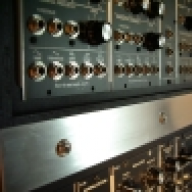
..... I am actually more into tonal synth sounds and songwriting and performance. Eurorack is appealing to me because of its small form factor, price point, and the eurorack module companies here in the US. Pittsburgh modular for instance makes minimal-looking but great sounding stuff, with big ole classic moog-type knobs.
I hear ya mangs. I was (stress "
was") interested in the Pittsburgh stuff, until I saw this video and got a perspective of how itsy-bitsy things are. Anytime an operator has to use the ~tip~ of their finger to turn a knob because the panel is so tightly engineered or packed-full of patchcords, it kinda kills it for me ....

Yes, I am
highly biased on this modular synth stuff. But it isn't because I haven't researched the holy crap out of the entire pile of formats and types, that is for sure!
BOX11 system ($1500 -- fully expandable, of course - and if you flip the solid walnut endbells around it can be made to sit flat at a slight angle rather than stand up as it does in this picture, like the lower unit does in the picture just below this one) ....
BOX22 system ($2,716 -- again, fully expandable, or course. This one is my all time favorite. The perfect little 3-VCO synth. Like a "Super Minimoog") ....
And so on, all the way up to the Box66 system. And of course their are the portable systems that are built into clamshell folding boxes, and the studio systems built into mega-high quality solid walnut cases. And there's also the rack-adaptor systems, like what I'm using for my bass routing setup .....
Before I went with the metal rack adaptor rails that I use now (above) I started out using some oak trim stock that I got at Lowes for like $4.00 for 3-feet. I cut it to fit inside of a 12u rack, predrilled mounting holes in it to accept the Dot Com modules, and went from there. Very inexpensive solution to mounting the "MU" ("Moog Unit") sized synth modules.
But the Box11 system is something I favor at the moment. The basic Box11 frame lends itself to many mods, in fact I'm nearly ready to adopt one of those ino my own DIY modular rig soon. $150, and it includes all of the DC-squid, two mults and is powered by my 28space modular rig via a 5-pin/4-conductor DIN cable. Instead of buying the walnut endbells I will just DIY my own out of something like 1x4 pine, they are easy to make due to the way Roger designed the basic BOX11 frame.
Of course I'll post my progress with that addition here in this very thread soon.
..... I really love pretty much everything about the Buchla systems, especially the fact that the few people who can afford them are more prone to using them to a musical end; Richard Lainheart (RIP) and Alessandro Cortini for instance, work strictly in the Buchla domain. The multi-timbrality and patch-memory, among other things, seem to lend the Buchla systems to more music writing and less bleep blooping, as well as less headaches for playing live!
It was the bleep-blooping that originally turned me off to modular stuff as well, until I delved a little deeper. For the last year I'd pretty much made up my mind on a semi-modular with a built in keyboard of some sort.
Lastly the dotcom stuff has that warm, vintage, vibey analog tone that we all know and love, the sound of the ladder filter for instance. this is what originally got me into analog synthesis, so perhaps a dotcom system is a better idea.
So while I would love live performance, size, and musicality to be the primary goals, I think I will have to make sacrifices somewhere, since dreaming about a Buchla is a waste of my time at this point, and probably the near-future as well.
The Oberheim SEM is probably my favorite monosynth sound. I had pretty much had my mind set on the new two-voice pro (when it starts shipping), and then I went and started looking at modular stuff like a dummy. The TVP will retail for $3500. You can buy a lot of fun modular stuff for less than that. Also, I don't have $3500

I'm not much of an R2D2 sounds kinda person, the best example of the type of synth rock I like to (attempt!) make is the ELP song "Toccata". That pretty much sums it up. As for the Oberheim sounds, the new reissue SEM patchpanel module is a thing to behold. I totally LOVE that thing. My original plan was to use the SEM as the central core of my system, and use some Dot Com modules as modulators and expansion. As I got into the Dot Com stuff I realized that I could easily create anything the SEM does with a few Dot Com modules, so I ended up going full-on Dot Com. Zero regrets!
I will say that there is a VST out there called the OPX and OPX Pro that NAIL .. and I mean NAIL ... the sound of the Oberheim OB-X and OB-Xa ... and it's pretty inexpensive as well. Look it up, check out the numerous videos of it as well. It just KILLS the Oberheim sound as perfectly as it's gonna get. FAR and AWAY better than the Arturia SEMv ... not even on the same planet. It does Subdivisions, Countdown, Camera Eye, Tom Sawyer .. without even breaking a sweat.
..... I did not know about the surface-mount vs. through-hole thing. That certainly counts for something. I would imagine that some of the discrete modules use through-hole though.
Yea, surface mount totally turns me off. It makes it's way into everything. It is even now in "boutique" stomp boxes. People that don't know any different think they are buying hand wired/hand made gear when in fact it's just more robotically constructed surface-mount crap (which is totally non-repairable and non-moddable by nearly anyone that solders). I consider myself a pretty highly experienced solder jockey, and there is
very little surface mount stuff I would even
DARE to attempt to repair or modify.
For those that are not familiar with what "surface mount" is I'll do another post this morning regarding the differences, with pics to illustrate the point.
..... To answer your last question, what I'm thinking I want to try to do right now is sequence an analog synth and drum modules as a tool for solo composition which can later be transfered into a live band setting, with say a live drummer, at the least. I tried the computer thing, and found it to be more like work and less like music. I was thinking about something like the pittsburgh modular foundation, which is a 3u full synth voice, and then get a few extra things like a delay, and then a bunch of drum modules and a drum computer module, and a sequencer. And of course play bass w/ fx and sing, which is what I prefer to do on stage (so you guys know this isn't too wildly off-topic).
You are on
precisely the exact same road I am on. So stick around here, you may find some things I'm doing usefull. And moving even closer towards that same end that you and I are both progressing towards, I'm also constructing a set (2-sets, actually) of Hammond bass pedals that are converted to midi and CV output to control cv/modular synth and FX, as well as control/trigger anything that is midi-fired. There are links to those projects at the very top of this page in the first post.
..... So much for my brief post. Interested in your opinion. Again, great stuff, love the demos. It also makes perfect sense to me that you don't try to replicate a synth with your bass per say, since you played analog synth before you picked up the bass. It wasn't until I started delving into synthesis, as well as analog fx boxes, that I realized the fixed harmonic overtone structure of the midrange of abass guitar will always keep it sounding like a guitar, and only a synth oscillator with ever oscillate like a synth lol! I hope this paragraph made sense. And also, lord knows guys like John Davis have gotten really goddamned good at it, so I believe it is an utterly worth endeavor, don't get me wrong.
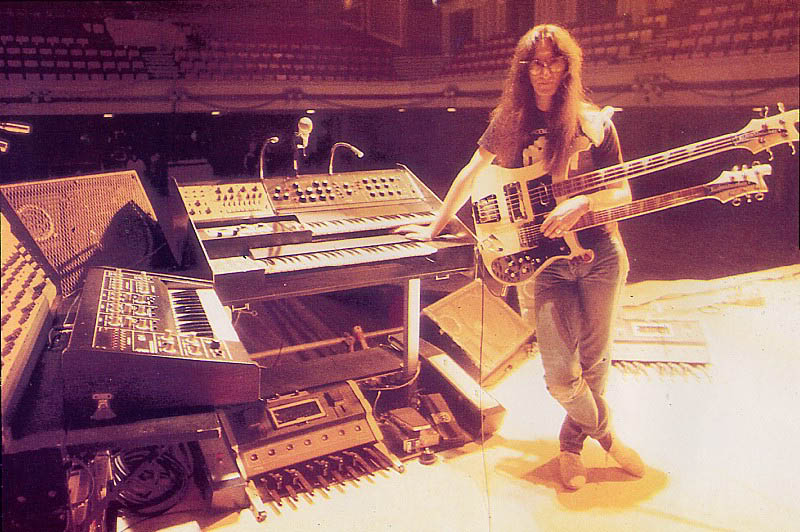
Geddy Lee was an
enormous inspiration for me with the way he incorporated bass guitar, analog/digital synths, bass pedals, and sample triggering all simultaneously.
My other mega-strong influence is Keith Emerson of the progressive power trio ELP (Emerson, Lake, and Palmer). In fact is was ELP that drove me to begin playing music in the first place. Keith's use of multi-instruments was highly inspirational, and I really REALLY love the way he made the Hammond into a credible rock machine. No-one else in the history of rock music ever did what Emerson did with the Hammond (or the synth for that matter). What most metal-heads are totally unaware of is that 90% of the heavy metal guitar riffs heard are nearly direct replays of the riffing and phrasing that Emerson was doing in the early 70's on his Hammond C3 (played through Leslie cabs that were powered with Hiwatt bass and guitar amp heads .. my own Leslie is powered with a Marshall Lead/Bass guitar amp that I built from a kit). When I hear most heavy metal of the 80's I hear Emerson's riffs
everywhere. I think those riffs and phrasings got into many guitar players' heads sortof unconsciously.
Emerson is most definitely my "Jimi Hendrix" or my "Geddy Lee" .... he is my absolute rock hero and is the person that infuenced me the most, Geddy Lee is a very strong second place.
Anyhow, keep on truckin'. Stay tuned.