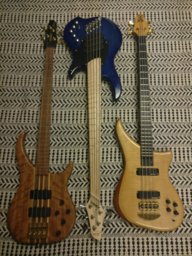
Is it a guitar? Is it a bass? Who plays these things and in what settings? What's up with the whammy? I've never seen these things in person, but they show up in my Reverb feed and I'm curious

TalkBass has been independent since 1998. Add your voice.
Create a free account to reply to discussions, view embedded media, and browse with fewer display ads.
Join free Log in
Want zero display ads or expanded classifieds tools? Compare plans.


The Fender VI was released in 1961 and followed the concept of the Danelectro six-string bass released in 1956, having six strings tuned E to E, an octave below the Spanish guitar. The Bass VI was closely related to the Fender Jaguar, with which it shared styling and technical details, notably the Invalid Link Removed. The VI had an offset body similar but not identical to that of the Jazzmaster/Jaguar.
It departed from the concept of the Fender Precision Bass in having six strings, a shorter scale and thinner strings, and a mechanical vibrato arm. The Bass VI never caught on to the extent that the four-string Precision Bass and its derivatives did. The model was discontinued in 1975.
ReissueEdit
In 2006, the Fender Custom Shop released a re-creation of the Bass VI, featuring three single-coil pickups and identical electronics. This format was previously available as a 1962 vintage reissue model made by Fender Japan in 1995.
In 2013 Fender released a Bass VI model as part of its Pawn Shop series. In line with the series' purpose to reconfigure classic Fender designs, the new Bass VI has a Jazzmaster-type P-90 bridge pickup and a Stratocaster-style five-position pickup selector, as opposed to separate switches.[1] There are three available colors: brown sunburst with a tortoiseshell pickguard, black with a tortoiseshell pickguard, and candy-apple red with a white pickguard and painted headstock.
Also in 2013, Squier released a Bass VI as part of the Vintage Modified series. This model was similar to the traditional Bass VI design with four switches (on/off for each pickup and a strangle switch) and a Jaguar-style control plate. It continued the trend set by the Squier Vintage Modified Jaguars and Jazzmasters of having a non-locking tremolo plate. It was available in three-color sunburst finish with tortoiseshell pickguard, Olympic White with a brown tortoiseshell pickguard and black with a tortoiseshell pickguard. It currently is available in three-color sunburst and Olympic white.
In 2019, Squier released its Classic Vibe Bass VI, available in three-color sunburst and black. It has a slightly wider width at the nut than the Vintage Modified Bass VI (1.685" vs. 1.65") and is equipped with narrow, tall frets. Most of the other main features are similar to the Vintage Modified model.
Oh, yeah, they're a little on the heavy side.

Is it a guitar? Is it a bass? Who plays these things and in what settings? What's up with the whammy? I've never seen these things in person, but they show up in my Reverb feed and I'm curious
They're all over older songs by The Cure as well. Robert Smith used one as a 3rd guitar in that setting. Lots of high partials and low drones.



Jack Bruce played one in Cream on a couple of early albums.


Beat me to it.Wichita Lineman is a great example of using one as the main melodic instrument in a song.
They sound like a low guitar when played through a guitar amp, and like a twangy bass when played through a bass amp. You can sort of do either function, but I've always thought they should be considered a 3rd, unique instrument.
They're great for layering in the studio, or as a 3rd or 4th voice in a band. They're all over the old Phil Spector wall of sound recordings, doubling muted bass parts. As well as in older country music doubling upright parts. That style of arrangement was called Tic Tac bass.
Wichita Lineman is a great example of using one as the main melodic instrument in a song. There's a couple of songs on SRV's Live Alive that have one in a melodic role as well, played by Stevie's brother Jimmy. It's as good a reason to give that album a listen as any.
They're all over older songs by The Cure as well. Robert Smith used one as a 3rd guitar in that setting. Lots of high partials and low drones.

It's tuned just like a regular guitar except it's an octave lower.I am oversimplifying it or is this a 7 string guitar without the high E? I've seen it classified as a "baritone guitar". To me this is not a bass at all...
I am oversimplifying it or is this a 7 string guitar without the high E? I've seen it classified as a "baritone guitar". To me this is not a bass at all...