• TalkBass has been independent since 1998. Add your voice.
    Create a free account to reply to discussions, view embedded media, and browse with fewer display ads.
    Join freeLog in
    Want zero display ads or expanded classifieds tools? Compare plans.

Fanned 5

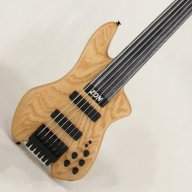
Allright. This REALLY makes me want to try out a fanned fret bass. And soon.


While I do think this is a wicked looking bass, I have issues. SORRY! I'm really not trying to bring ya down or be picky or annoying, but here's my thoughts...

The headstock deserves a good looking veneer. That rosewood filler block and that white headstock looks so contrasting and so awkward. If you got a very thin veneer of, say, quilted maple, and gave it a dark stain or oiling, it would match the body and balance out the color of the bass.

The neck joint and the visible wood of the neck, is just begging for a really eye-catching bit of woodworking or inlay. Like perhaps a logo of some sort? Yin-yang, celtic ring, iron cross, dragon wings, something fancy and really dark to pop out from that bright neck wood. Kinda how Laggan Basses have their emblem in between the pickups.

And yes, preliminary electronics while you prove out the comfort and playability of the design, wise choice. Otherwise, you'd have really great electronics put into a bass you don't like to play!
 
And all of the photos are in the kitchen - seriously, you can put together a bass of this quality in a month, without a workshop? :eek:
Well i don't make it in the kitchen, else I really would be left without a wife! But the workshop I have is the garage with workbench, plunge router and jigsaw, electric planer, hand belt sander, that's about it. :bassist:
The neck joint and the visible wood of the neck, is just begging for a really eye-catching bit of woodworking or inlay. Like perhaps a logo of some sort?
Now that's a really neat idea. I must try working on my inlay skills when I get a sec. Some sort of design would look great there on the maple join piece.
preliminary electronics while you prove out the comfort and playability of the design, wise choice
Once pups and pre-amp are upgraded, i can recylce the cheap ones so they are available to test drive my next project. Neat.
 
So, Al.....sweet bass, BTW!!

Question: I think I've figured out an easy way to lay out fanned frets and I'm curious if I'm correct or not? How'd you do it? How'd you cut the fret slots accurately in relation to each other?

I've been wanting to build my own, since getting my first Dingwall, but the fanned frets scared me off. Plus, I don't have the tools to build a quality neck. I plan on getting an unlined fretless neck from Carvin maybe to use for my project.
 
I use a jigsaw and a disc sander in a drill to build my necks. That's all you need - and maybe a rasp, file, spokeshave. Nothing fancy. They're not Dingwall-quality by any means but they come out nicely playable after a couple of practices;)
I laid out the fanning by;
a) Marking out the 34.5" sclae fret position on the bass side 4mm in from the edge of the fingerboard.
b) marking out the 32.5" scale fret positions on the high C side 4mm in from the edge of the fingerboard, using Fret 7 as the perpendicular alignment point.
c) join the dots.
d) stout steel rule from a set square held against each drawn fret line and gently cut with a gents/fretting saw. Once the cut is established it can be deepened.
Recheck alignment twice (at least) before cutting into the wood.
 
I use a jigsaw and a disc sander in a drill to build my necks. That's all you need - and maybe a rasp, file, spokeshave. Nothing fancy. They're not Dingwall-quality by any means but they come out nicely playable after a couple of practices;)
I laid out the fanning by;
a) Marking out the 34.5" sclae fret position on the bass side 4mm in from the edge of the fingerboard.
b) marking out the 32.5" scale fret positions on the high C side 4mm in from the edge of the fingerboard, using Fret 7 as the perpendicular alignment point.
c) join the dots.
d) stout steel rule from a set square held against each drawn fret line and gently cut with a gents/fretting saw. Once the cut is established it can be deepened.
Recheck alignment twice (at least) before cutting into the wood.


That was my first theory.

Then I thought, wouldn't the risk of misalignment (fret to fret) and possible intonation issues be minimized by using a metal yardstick (perhaps) with a hole drilled at one end, and a bolt thru it. It would also work better if a slot was cut in the center, for fret marking, that was aligned with the bolt-hole in the opposite end. The bolt would act as a hinge. You'd need to do some math to figure out the correct length for the swinging/hinged yardstick. Once the math was figured out, fix the neck in position with only the bass side marked for scale, bolted down on the same surface that the yardstick is bolted too. Then, swing the yardstick as you mark the frets along the board. Pup tilt and bridge placement could also be marked this way.

Whatch think?
 
Is this the (now expired) patented Novax way of sorting fanned fret positioning? It looks to me like it would not work. I laid out my bass on the carpet and with a couple of metre-rules sighted along the 1st fret and the 24th fret. Then noted where they interesected. ( a little over a metre away) Now using that point as the pivot, the rule does not line up with the other frets in the middle. So this would not give you correct spacing. SOmething is wrong with the thought pattern here. I think it's to do with 2 different linear scales trying to be imposed onto something radial. The matchs is wrong. Sorry!
 
Puzzling, 'cause it works on my Dingwall. All the frets point to one common point. I just checked. I don't know about the Novax system. I just came up with the idea, and hadn't checked it on my bass 'til just now. Sheldon actually mentioned that the frets on his basses all point to a common point in a forum once, and my mind started working!

Now, of course the neck and yardstick have to be fixed in place, and at a fixed distance apart.
 
Is this the (now expired) patented Novax way of sorting fanned fret positioning? It looks to me like it would not work. I laid out my bass on the carpet and with a couple of metre-rules sighted along the 1st fret and the 24th fret. Then noted where they interesected. ( a little over a metre away) Now using that point as the pivot, the rule does not line up with the other frets in the middle. So this would not give you correct spacing. SOmething is wrong with the thought pattern here. I think it's to do with 2 different linear scales trying to be imposed onto something radial. The matchs is wrong. Sorry!

Something else... it may not work on your bass because you did not build your bass by this method. If your scale difference is equal at the nut and bridge, it should work. In other words a 4 inch scale difference would have to be split: 2 inches difference at the nut, and 2 inches difference at the bridge.
 
They don't. The novax method only works for parallel strings. Only when the strings have the same spacing at the nut and bridge, then will the frets all fall to one common point. It will be close, either way.


Ahaah, interesting!! So, the geometry is more complex then I originally thought... figures! :(

I was gonna say that my yardstick findings aren't exact, of course. I had the bass on my bed, and it appearred that the points would intersect... def room for error there :).
 
If your scale difference is equal at the nut and bridge, it should work. In other words a 4 inch scale difference would have to be split: 2 inches difference at the nut, and 2 inches difference at the bridge.
Parity is at F7, that is the seventh fret is perpendicular. So there is a wider difference at the bridge than there is at the nut. In either caase all this would do is shift the fulcrum up or down along the length of the guitar.
 
Parity is at F7, that is the seventh fret is perpendicular. So there is a wider difference at the bridge than there is at the nut. In either caase all this would do is shift the fulcrum up or down along the length of the guitar.

True.

Looks like an easier way is still out of reach for me at this point. I figured the connect the dots method left too much room for error, for me with my limited tools, and all. I'm sure it works very well for someone with the tools and experience, like you Al. I don't even have a shop at this point. Although the guitarist I work with does, hmm :).

Thanks for the help guys. And, have fun with the beautiful bass Al.
 
This simplified diagram will show you straight away the flaw in your method, although it sounds like a neat idea. I have only the most basic tools for this, Jedi, and I encourage you to have a go, you may surprise yourself!
fanny.jpg
 
I may. I've already bought the templates, haven't printed them off yet: 37" and 35". I actually wanna try a simple 3 string bass design: BEA 37-35. Thought about getting a 5 string jazz set of pups, since the poles seem evenly dispersed, and slanting the heck out of them to get them under the strings correctly. Other option is blade style pups. Shave a 4 string Carvin neck-thru blank down to 3-string width and build a body around the blank. Any thoughts?
 
I would say that the benefits of using fanned frets are a lot more apparent when you have a wide scale range, ie: 5 or 6 string bass or 6/7/8 string lead. The tonal improvements this fanning gives will not be so apparent on a 3 string instrument, though I am intrigued by your plans.
 
I would say that the benefits of using fanned frets are a lot more apparent when you have a wide scale range, ie: 5 or 6 string bass or 6/7/8 string lead. The tonal improvements this fanning gives will not be so apparent on a 3 string instrument, though I am intrigued by your plans.

I've been a 6 string only player since '92, only recently acquiring my 1st 5er 9 months ago, a Lakland followed by the Dingwall 5 and Dingwall 6. I wanna go to the other extreme, and build a Rock bass with just the essentials: B, E, & A but with the benefits of piano-like clarity that you can only get from fanned frets. And, I LOVE the 37" B !! I've considered doing a 3 string w/ parrallel frets and 37" scale, but the E and A would not sound as good, and I'd have trouble getting strings probably. I'd rarely play it as I'm used to using at least 5 strings in almost every song I play. But, I wanna cut my teeth on an oddball, simpler design.

I got the idea from talking with a friend who wanted a Dingwall 4 w/ BEAD tuning. He said he didn't want a 5 'cause he never used the D and G in his current band.
 
I thought I'd post a final update since this bass has had a good workout now, a bit more fret levelling and a few truss rod tweaks. First practice tonight at good volume. First thing to notice is how totally natural and easy the fanned frets feel.
The MM pickup pushed quite far forward gives a huge warm bass sound, th3e (cheap) JB bridge pup is quite aggressive and nasal. When they are set up height-wise to feed in balanced volume together its a good, usable blend with a bit of everything, but overall quite accentuated mid range. The pre-amp can do everything you want to the tone, take all the mid out, deepen the bass which can easily sound a little too boomy if you're not careful. The top C string cuts through very nicely, clear and sparkly. It's fair to say the tone is totally unique to any other bass I have owned/made/played, even with all the tone extremes the pre-amp can give you, there's an underlying character behind it which sounds quite woody and punchy. I guess with a set of decent pickups, a better pre-amp and better work on the neck pocket this could sound really heavenly. I have a feeling the imperfections in the neck joint may be giving a little loss of sustain, but the bass is very playable and overall I'm very pleased with her.:bassist:
 
Al - as an aside, I asked the guys at GuitarFetish about that preamp - the boost frequencies are:

Bass - 40hz

Mid - 800hz

Treble - 8Khz

(they didn't state the boost/cut amount in dB).

==================================================

Here are the specs on the Aguilar OBP-3:

Bass - plus/minus 18 dB @ 40 Hz.

Mid - plus/minus 16 dB @ 400Hz or 800 Hz. User selectable frequency center.

Treble - plus/minus 16 dB @ 6.5 KHz.

==================================================

So, it looks like, at least frequency-wise, you are fairly close to what Aguilar puts out, for less than half the price...

I found when I used the OBP-3 in a couple of instruments that I rarely boosted the treble control, as the frequency was a little high to sweeten things up, it just made it really "high-fi"... you could hear every squeak of the strings. :crying:

I mostly use OBP-1's now, plus a passive tone control. The OBP-1 boosts 18dB at 40Hz and 4KHz, which is just a bit mellower, to my ear...

Still, looks like you got a decent preamp at a decent price. Can't beat that!

Kudos on the bass! Looks good, and apparently sounds good, too... on that note, I'd be interested in hearing some sound clips, if you get the chance. :D
 
Al - as an aside, I asked the guys at GuitarFetish about that preamp - the boost frequencies are:

Bass - 40hz

Mid - 800hz

Treble - 8Khz

(they didn't state the boost/cut amount in dB).

==================================================

Here are the specs on the Aguilar OBP-3:

Bass - plus/minus 18 dB @ 40 Hz.

Mid - plus/minus 16 dB @ 400Hz or 800 Hz. User selectable frequency center.

Treble - plus/minus 16 dB @ 6.5 KHz.

==================================================

So, it looks like, at least frequency-wise, you are fairly close to what Aguilar puts out, for less than half the price...

Nice! I'm definitely going to get one of these for my OLP.

Asad