
Enjoy the benefits of a premium membership!
Upgrade Account
-
TalkBass has been independent since 1998. Add your voice.
Create a free account to reply to discussions, view embedded media, and browse with fewer display ads.
Join free Log in
Want zero display ads or expanded classifieds tools? Compare plans.
You are using an out of date browser. It may not display this or other websites correctly.
You should upgrade or use an alternative browser.
You should upgrade or use an alternative browser.
Fat sounding D and G strings on a P
- Thread starter bdplaid
- Start date
More options
Who Replied?

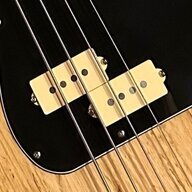
The strings that are closest to the pickup magnets.
I wouldn't say that there are particular strings that sound fatter. You can experiment with gauges, i.e. 45-65-80-100 or 50-70-85-105, but on a P there will always be some sound difference due to the construction of the split coil pickup. This is a part of the sound signature of the instrument.
As said above, try to play with the height of the pickup on the treble side.
As said above, try to play with the height of the pickup on the treble side.

I've found lowering the pickup under the G string makes that string in particular sound meatier, combined with a slightly lighter gauge to decrease the tensionI wouldn't say that there are particular strings that sound fatter. You can experiment with gauges, i.e. 45-65-80-100 or 50-70-85-105, but on a P there will always be some sound difference due to the construction of the split coil pickup. This is a part of the sound signature of the instrument.
As said above, try to play with the height of the pickup on the treble side.
My deal is that yesterday, using a bass and amp with which I've never had this happen, when I went to play the d and g they sounded like the bass had been drastically lowered for just those 2 strings. Very strange, yes .
Bass is Sandberg VT 4, amp is GK MB800 through subway 212.
And then today I went to rehearsal in a different place with same bass but different amp, and no issues.
All I can figure is that the rooms aren't cooperating. But low end on just the d and g? Just weird.
Bass is Sandberg VT 4, amp is GK MB800 through subway 212.
And then today I went to rehearsal in a different place with same bass but different amp, and no issues.
All I can figure is that the rooms aren't cooperating. But low end on just the d and g? Just weird.
Took me over 50 years to actually put Fender strings on a Fender and it changes the bass. Now my P bass is the one I play most at home. The tone changes using Fender nickel rounds more than any other string I have tried. Cheap too.
DR Nickel LoRiders FTW. To me, they have excellent consistency across all four strings.
But, yeah, I think your issue is actually with the different rooms.
But, yeah, I think your issue is actually with the different rooms.

The G string in a set is usually a single layer of windings, the other strings have 2 (or 3). Hence a lot of G strings will sound twangier than the rest of the set. If you want your G string to not out-twang the rest of the set, you may want to get a G string from a "duller" set than the rest of the strings.
Not weird at all--different frequencies are happening and accentuated on the different strings (even playing the same pitch).But low end on just the d and g? Just weird.

Mod it to Reverse P . Case Close.


Ernie Ball Power Slinky 110, 90, 75, 55.
I love these heavy gauge rounds for standard tuning on my P. They have a smooth feel for rounds and are more flexible than you would think. I can get super low action without buzzing and play with a light touch. Plenty of meat on the strings so your fingers don’t slip off. Really a joy to play.
D & G strings are nice and fat, but still flexible enough to pop if you’re into slapping.
At $20 they are really affordable and last me a long time.
I love these heavy gauge rounds for standard tuning on my P. They have a smooth feel for rounds and are more flexible than you would think. I can get super low action without buzzing and play with a light touch. Plenty of meat on the strings so your fingers don’t slip off. Really a joy to play.
D & G strings are nice and fat, but still flexible enough to pop if you’re into slapping.
At $20 they are really affordable and last me a long time.
Last edited:

Since you're asking only about roundwound strings, I'd suggest nickel like DR Sunbeams.Which roundwound strings do you think have the fattest sounding D and G strings on a P bass?

There are a lot of threads here on TB and on other Internet forums that discuss whether light strings or heavy strings have the best / most low end response. The evidence points to light gauge strings as the winner due primarily to their flexibility, but you asked about “Fat sounding” which isn’t the same the most low end. It’s been my experience that heavier strings, even though they might not have better low end response, they do have more punch, and can be played harder without string buzz / fret rattle.
Another factor is the alloy of the string. It seems Ernie Ball cobalt flats have great volume on the D & G strings, but I don’t think it’s due to the string construction, so it probably had a lot to do with the Cobalt alloy.
EB makes a Cobalt round wound string I’ve never personally tried, but I’ve seen a lot of posts praising their sound, so I’m thinking a 050, .070, .085, .105 set of EB Cobalt rounds might get what you are after.
Here’s a demo video of them on a Stingray.
Another factor is the alloy of the string. It seems Ernie Ball cobalt flats have great volume on the D & G strings, but I don’t think it’s due to the string construction, so it probably had a lot to do with the Cobalt alloy.
EB makes a Cobalt round wound string I’ve never personally tried, but I’ve seen a lot of posts praising their sound, so I’m thinking a 050, .070, .085, .105 set of EB Cobalt rounds might get what you are after.
Here’s a demo video of them on a Stingray.
I've used both EB Cobalt sets. The flats were actually where my thoughts went. I'm not especially a fan of the cobalt rounds, but they're not bad.
On this bass, I'm currently digging Dunlop regular stainless in 40 to 100. Those strings give me great clarity. But as I am a pathological string buyer, I have pretty much every set mentioned.
As for heavier gauges like 50 to 110, I use them strictly for downtuned basses. The tension is a little much for me tuned to standard.
Right now, the plan is for the next rehearsal in the room where the problem reared it's head, I'm going to take a different cab, leave everything else the same. I want to see what happens.
On this bass, I'm currently digging Dunlop regular stainless in 40 to 100. Those strings give me great clarity. But as I am a pathological string buyer, I have pretty much every set mentioned.
As for heavier gauges like 50 to 110, I use them strictly for downtuned basses. The tension is a little much for me tuned to standard.
Right now, the plan is for the next rehearsal in the room where the problem reared it's head, I'm going to take a different cab, leave everything else the same. I want to see what happens.
There are a lot of threads here on TB and on other Internet forums that discuss whether light strings or heavy strings have the best / most low end response. The evidence points to light gauge strings as the winner due primarily to their flexibility, but you asked about “Fat sounding” which isn’t the same the most low end. It’s been my experience that heavier strings, even though they might not have better low end response, they do have more punch, and can be played harder without string buzz / fret rattle.
Another factor is the alloy of the string. It seems Ernie Ball cobalt flats have great volume on the D & G strings, but I don’t think it’s due to the string construction, so it probably had a lot to do with the Cobalt alloy.
EB makes a Cobalt round wound string I’ve never personally tried, but I’ve seen a lot of posts praising their sound, so I’m thinking a 050, .070, .085, .105 set of EB Cobalt rounds might get what you are after.
Here’s a demo video
Another factor is the alloy of the string. It seems Ernie Ball cobalt flats have great volume on the D & G strings, but I don’t think it’s due to the string construction, so it probably had a lot to do with the Cobalt alloy.
EB makes a Cobalt round wound string I’ve never personally tried, but I’ve seen a lot of posts praising their sound, so I’m thinking a 050, .070, .085, .105 set of EB Cobalt rounds might get what you are after.
Here’s a demo video
There are a lot of threads here on TB and on other Internet forums that discuss whether light strings or heavy strings have the best / most low end response. The evidence points to light gauge strings as the winner due primarily to their flexibility, but you asked about “Fat sounding” which isn’t the same the most low end. It’s been my experience that heavier strings, even though they might not have better low end response, they do have more punch, and can be played harder without string buzz / fret rattle.
Another factor is the alloy of the string. It seems Ernie Ball cobalt flats have great volume on the D & G strings, but I don’t think it’s due to the string construction, so it probably had a lot to do with the Cobalt alloy.
EB makes a Cobalt round wound string I’ve never personally tried, but I’ve seen a lot of posts praising their sound, so I’m thinking a 050, .070, .085, .105 set of EB Cobalt rounds might get what you are after.
Here’s a demo video of them on a Stingray.
I tried Cobalt rounds on my P bass. Some of the brightest strings I've ever played. But at $35 the price is pretty steep for rounds. They felt and sounded quite similar to Roto 66's and DR Lo-Riders to me. I'm too used the smoother feeling Slinky's and 110 E, but I could see people loving these strings, especially on something like a Stingray.
If anyone wants to try a set with about 2hrs of playing time pay for shipping and I'll send them to you.
Last edited:

Jazzdogg
Less barking, more wagging!
Which roundwound strings do you think have the fattest sounding D and G strings on a P bass?
The ones that are plucked with your thumb over the end of the fingerboard.

Sandberg VT4, mentioned as the bass causing the problem, already has a reverse P.Mod it to Reverse P . Case Close.

