• TalkBass has been independent since 1998. Add your voice.
    Create a free account to reply to discussions, view embedded media, and browse with fewer display ads.
    Join freeLog in
    Want zero display ads or expanded classifieds tools? Compare plans.

Double Bass Favorite bass transport wheels??

There are basically three types of endpin wheels, I've used. The Gaines which is very heavy, the Onyx Foamcore wheel, and the David Gage Wheel, with shock absorbers.
Since I have a Tonnengies Endpin (which is similar to the Goetz but has a improved design) I have to use the Onyx or the David Gage.
 
I have seen that and I’m still not sure if the shaft does move in the collar or not.
First time I have seen it I was almost sure it does move and it can only do that if it is not fixed there. In that case it can slip out.

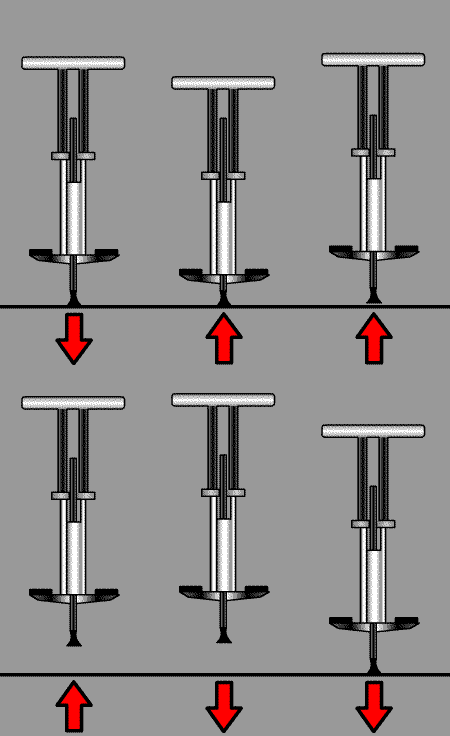
I see what you're thinking. But I think that what may be hard to see in the photos is that I believe that the top portion of the shaft (the part that goes in the bass) is not fixed; that part is the "piston" that goes in and out and activates the spring (like an automobile's shock absorber). It has some sort of capture to keep it from coming out. So you still tighten the shaft of the endpin collar around the pin, and it stays secure.

On a side note, I guess someone took this year's April Fool's Day joke seriously!
[Invalid or Expired Link Removed]
pogopost1__53950.1648223262.jpg
 
  • Like
Reactions: mikeGJ
I see what you're thinking. But I think that what may be hard to see in the photos is that I believe that the top portion of the shaft (the part that goes in the bass) is not fixed; that part is the "piston" that goes in and out and activates the spring (like an automobile's shock absorber). It has some sort of capture to keep it from coming out. So you still tighten the shaft of the endpin collar around the pin, and it stays secure.

On a side note, I guess someone took this year's April Fool's Day joke seriously!
[Invalid or Expired Link Removed]
View attachment 4692201
So it seems I was right with my assumptions. But I didn’t see anything that keeps the shaft from falling out.

Anyway, I just wanted to warn others that they may need to keep an eye on the wheel to keep it from falling out of the instrument.
The first who got one of them please correct me if my assumptions were wrong.

A rubber band from wheel mount to collar thumb screw might hold it in position as long as the wheel shaft is not twisted too much during transport.
 
So it seems I was right with my assumptions. But I didn’t see anything that keeps the shaft from falling out.

Anyway, I just wanted to warn others that they may need to keep an eye on the wheel to keep it from falling out of the instrument.
The first who got one of them please correct me if my assumptions were wrong.

A rubber band from wheel mount to collar thumb screw might hold it in position as long as the wheel shaft is not twisted too much during transport.

I'm saying that I see why you thought that, but I think you could be wrong about the design/construction. The bottom of the bass doesn't rest on that ring, that ring is just there to capture the spring. You clamp the endpin collar to the post that extends above, and the post is what is "sprung" - like a shock absorber. The pin can't come fully out, but can spring - like a pogo stick - but upside down.
Pogoanim.gif
 
  • Like
Reactions: Chris Fitzgerald
Sorry, misunderstanding by a foreigner with bad knowledge of the English language…

Yes, that was the other possibility, but a bit harder to construct and with a rather short way for the spring. So the spring needs to be hard to avoid a hard impact when the string gets totally compressed.
I think an inflatable wheel would damp impacts better than this spring-loaded one and is adjustable by the inflated pressure.

But I prefer the Bass Buggie and Kolstein way of bass transport. Maybe not as easy to maneuver than the wheels, but more healthy for the instrument. Specially if equipped with inflatable wheels.
 
  • Like
Reactions: Mark Gollihur
I really think that you fix the shaft in the socket and section inside the spring is what moves. Looks pretty clever. Still though, and I've said this before, I think that people get too worked up about this topic. The risk of damaging something by using a wheel is plausible, but has it ever happened?

Screenshot 2022-05-16 at 20-49-55 Bass wheel with spring D10 Free.png
d the part of the shaft below
 
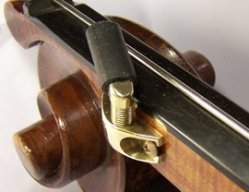
If you have a carbon fiber endpin, you might have trouble using an endpin wheel. Take a look at how the mechanism for securing the endpin at any given position works; it likely differs from a steel endpin's simple thumbscrew, which just screws against the endpin, holding it in place. With CF endpins, this type of arrangement will likely split the fibers in the CF, eventually causing severe damage and potential failure.

The CF endpins I've seen instead use a collar that wraps around the endpin, and when you tighten it, the threads PULL the collar around the endpin and against the body of the endpin plug, holding it in place.

If yours is like that, here's why it's a problem - it will HOLD the endpin wheel, but unlike the simple thumbscrew version, it will not screw against a flat portion of the wheel's shaft; and therefore it will not protect you from a sudden, unexpected TURNING of the wheel, and subsequent catastrophic crash and burn.


Mark Gollihur for the win! This has been driving me crazy. I kept thinking it was one of the bolts on the wheel that I wasn't tightening enough. I switched to CF a few years ago and started having issues. I never considered that it wasn't a simple thumbscrew. Thank you for clarifying this!