
• TalkBass has been independent since 1998. Add your voice.
    Create a free account to reply to discussions, view embedded media, and browse with fewer display ads.
    Join freeLog in
    Want zero display ads or expanded classifieds tools? Compare plans.

Favorite TRACE Amp of all time -

My approach is similar to yours, but many players use their amp and speaker as a means to attain a specific tone. Also the EQ in many amps is not really even useful in compensating for variations in room acoustics. Basically you set the EQ to get a specific tone and pretty much leave it alone after that. With such an amps, I find an outboard EQ or even the tone controls on my bass is far more useful in compensating for room to room variation.

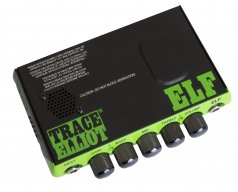
OK, fair enough. I just wanted to share with the manufacturer my preferences based upon the way how I work with my equipment. I can understand that my preferences might not be shared by others. Still, ELF is a great tool!
 
Time do to a little product development ...

Besides the current models (elf etc) What is your favorite Trace Elliot amp or preamp of all time, and why? Same goes for cabs...

Also what you dislike about them is helpful as well ....
Favorite Preamp is the GP12 with none of the bells and whistles like biband compressors tube/ss. If you look across time and products the simple stuff are the big sellers. A small little Class AB head in the 10 pound region built on the classic Trace preamp would be amazing.

500 watts at 4 ohms, I would buy it .
 
Favorite Preamp is the GP12 with none of the bells and whistles like biband compressors tube/ss. If you look across time and products the simple stuff are the big sellers. A small little Class AB head in the 10 pound region built on the classic Trace preamp would be amazing.

500 watts at 4 ohms, I would buy it .


What don't you like about Class D?
 
What don't you like about Class D?

It could be Class D and 4 pounds but I actually would prefer a slightly heavier Class AB and every amp doesnt have to be tiny.

A good example was the Thunderfunk 550B it weighed 17 Pounds but was a Class AB Amp .

Why not use some of the technology to make a new style Class AB?

But I can tell you if you guys make a liggtweight GP11/12 with traditional Trace looks (as best you can) Im buying it . Class D or Class AB.
 
Last edited:
@Fred from Peavey

Out of curiosity, what was "wrong" with the recently discontinued, heavy duty Trace Elliot gear, made by Peavey?

It seemed to get great reviews, and seemed to be very well regarded by old school Trace users.

Personally, I thought the feel of the sliders etc was too plasticy, and whilst the illumination was a smart idea, the old style blacklight is way cooler, also, from a purely aesthetic point of view, 3 unit heads look more natural than 2U heads.


Whilst I don't think it was ever anyone's favourite (largely because no one knew about them / could afford them), now may be the time for an iOS / Android controlled MP11 pre-amp.

Thanks for the note - nothing is "wrong" with the larger Trace gear ...other then the market has changed. Very few customers for that type of gear anymore. We are focused on modern power supplies and amplifiers - like the ELF - we can do things now that were literally impossible when the "heavy duty" gear was designed more than 10 years ago. In any case stay tuned - we are mindful that the ELF and Transit B won't fit all professional applications. I am bass player myself ..and my rig consisted of a 2X15 and 2X12 cab....so I get the need to move some large air ;)
 
Some other cool designs might be a 500 watt Elf. bigger is fine. My bigggest trouble with my current Elf is while pushing it my transients shut the amp down occasionally. So just a little more headroom would be great though I love the amp.

Also another cool unit might be a powered Transit B.

You can bet your bottom booty you would definitely sell many of a smaller GP12 .
 
  • Like
Reactions: TrevorR
Actually, I would go the other direction: professional nano head, 1/2 or 2/3 of the Elf's weight, very simple EQ (either bass and treble concentric potentiometer or parametric control which would allow cut or boost anywhere between 80Hz and 4kHz), DI pre EQ, 50-100watts into 4ohms, powered by phantom power. That's my dream.

I'm sure the one of those they would sell to you would totally be worth the cost of development and production.

Seriously, what is the advantage of going from 2 pounds to 1 pound? The elf is already verging on being TOO small to be practical as is.
 
Couldn't agree more!

Curious if you have played a V-Type? I would caution against writing off such an exceptional amp if you have not experienced one simply because of the architecture of its tone stack.

The Fender tone stack really doesn't determine the voicing of the amp, and IMHO it only loosely determines how the EQ behaves. I have several amps with Fender tone stacks that all sound and behave drastically different. The Ashdown 427 and CTM300 have the most quirky EQ I have ever used and both amps are voiced drastically different. The CTM300 has a bigger low mid push than my SVT, so no typical Fender mid scoop.

Next, my Sadowsky SA200 has the most musical EQ I have ever come across in an all tube amp. IMHO this amp is voiced more like a solid state amps than most tube amps. The Sadowsky has a 5 band EQ, but guess what...the middle three controls are formed with a Fender tone stack.

I also have series I and series II TE V-Types. IMHO the series II is a bit more transparent and aggressive sounding, but I haven't come across a tube amp yet with a fatter, more focused low end than a TE V6 or V4. These amps also put out more power than most amps with equivalent output sections.

I would say take a listen to/play a series I V-Type. If you decide the voicing and feel is worth exploring, it doesn't have to be implemented with a Fender tone stack.
 
Last edited:
  • Like
Reactions: Red Planet
Seriously, what is the advantage of going from 2 pounds to 1 pound? The elf is already verging on being TOO small to be practical as is.

The advantage would be that it would be lighter, obviously. Not only because it would be smaller, but because the phantom power would allow you not to carry the power cable which adds some weight. In my case, when I do not travel to my gig by car, I need to walk 10 minutes to catch a train, and than again make some walking in the city to get to the club-all done with bass, amp and cabinet hanging over my shoulders. In the end of the night, I can feel every pound, I can tell you.
 
Last edited:
The advantage would be that it would be lighter, obviously. Not only because it would be smaller, but because the phantom power would allow you not to carry the power cable which adds some weight. In my case, when I do not travel to my gig by car, I need to walk 10 minutes to catch a train, and than again make some walking in the city to get to the club-all done with bass, amp and cabinet hanging over my shoulders. In the end of the night, I can feel every pound, I can tell you.

I mentioned earlier in the thread, that I think a Trace Elliot D.I. box (passive version, and active version) with nothing more than a switchable pre-shape, would be a really useful stage & studio tool for engineers.

I can see that a deluxe version, with the tone controls, and compressor / limiter of the ELF, would be a really useful tool for bassists.

But I don't see how a 48volt phantom feed could power the ELF, and enable it to deliver 200 Watts of power to a 4 Ohm speaker load.

Unless Trace sold powered versions of the ELF speakers, and then you've just shifted the weight of the power supply from one device, to the other.
 
But I don't see how a 48volt phantom feed could power the ELF, and enable it to deliver 200 Watts of power to a 4 Ohm speaker load.

I think it should be possible. There are examples out there of small amps being fed by low voltage.

GSS 06B400BPA bass amp - delivers 100W being fed by 35Volts.

Boutique

Quilter MicroBlock 45 guitar amp delivers 45W being fed by 72Volts.

[Invalid or Expired Link Removed]

And there is the Roland bass combo which works on batteries.

Considering the above examples, I think that a hypothetical nanoELF delivering 50-100W being fed by 48V should be theoretically possible.

I don't have technical education, so I can imagine there are technical difficulties which I am totally unaware of. But, overcoming such difficulties is what the RD departments are for, right?
 
I think it should be possible. There are examples out there of small amps being fed by low voltage.

GSS 06B400BPA bass amp - delivers 100W being fed by 35Volts.

Boutique

Quilter MicroBlock 45 guitar amp delivers 45W being fed by 72Volts.

[Invalid or Expired Link Removed]

And there is the Roland bass combo which works on batteries.

Considering the above examples, I think that a hypothetical nanoELF delivering 50-100W being fed by 48V should be theoretically possible.

I don't have technical education, so I can imagine there are technical difficulties which I am totally unaware of. But, overcoming such difficulties is what the RD departments are for, right?
The department of common sense believes no way you can get 100w out of a phantom power system designed to light up condenser microphones.
 
  • Like
Reactions: Omega Monkey
Some other cool designs might be a 500 watt Elf. bigger is fine. My bigggest trouble with my current Elf is while pushing it my transients shut the amp down occasionally. So just a little more headroom would be great though I love the amp.

I have been lucky so far that my ELF has never failed me. It is probably due to the fact that it has even more power than I need so I do not push it too hard (electric upright in semi-acoustic band with PA support). So I love it too!
 
I used a TE Series 6 200w 1215 combo for many years - 1988/9 to 2006. I'd still be using it now (weight notwithstanding) if, thanks to another band member idiot, it hadn't fallen off a trolley and down some stairs on a load in once... :( Look on the bright side, at least he was helping with the load in...

Somehow I just liked the Series 6 12-band preamp more than the SMX models that followed it. Sure the SMX has some additional cool features but every single Series 6 amp I ever tried just had a sound and some real mojo to me. And those 200 Trace Elliot watts coped beautifully with every situation I ever had to throw at it!
 
  • Like
Reactions: Kitsapbass
I think it should be possible. There are examples out there of small amps being fed by low voltage.

GSS 06B400BPA bass amp - delivers 100W being fed by 35Volts.

Boutique

Quilter MicroBlock 45 guitar amp delivers 45W being fed by 72Volts.

[Invalid or Expired Link Removed]

And there is the Roland bass combo which works on batteries.

Considering the above examples, I think that a hypothetical nanoELF delivering 50-100W being fed by 48V should be theoretically possible.

I don't have technical education, so I can imagine there are technical difficulties which I am totally unaware of. But, overcoming such difficulties is what the RD departments are for, right?


An amp could easily be designed to make 100W off 48V, but only if enough current is available. Phantom power is only designed to supply about 10mA of current. Not even enough current for 1 watt.