• TalkBass has been independent since 1998. Add your voice.
    Create a free account to reply to discussions, view embedded media, and browse with fewer display ads.
    Join freeLog in
    Want zero display ads or expanded classifieds tools? Compare plans.

Fearless/full build question

I've played a friends Fear type 115 3way a few times and really dig it but I'm not crazy about the form factor. So, just brainstorming here I thought about the possibility of reworking the size/shape but keeping the same internal volume and porting size making it more of a tower shape. So here's my question. Is there any technical reason that the cab couldn't be made much taller, narrower and possibly less deep. IF the internal volume and port size remains the same per the spec. This makes sense to me for a couple of reasons. Narrower makes it less bulky, shallower transfers to hight which gets the hi/mid speakers closer to ear level. And the porting would be the same physical size just reshaped. This makes sense to me on a practical level. Now tell me why it's not a good idea from a technical point of view. Or if it's a feasible possibility.

Thoughts?
 
I've played a friends Fear type 115 3way a few times and really dig it but I'm not crazy about the form factor. So, just brainstorming here I thought about the possibility of reworking the size/shape but keeping the same internal volume and porting size making it more of a tower shape. So here's my question. Is there any technical reason that the cab couldn't be made much taller, narrower and possibly less deep. IF the internal volume and port size remains the same per the spec. This makes sense to me for a couple of reasons. Narrower makes it less bulky, shallower transfers to height which gets the hi/mid speakers closer to ear level. And the porting would be the same physical size just reshaped. This makes sense to me on a practical level. Now tell me why it's not a good idea from a technical point of view. Or if it's a feasible possibility.

Thoughts?

Baffle size and shape and driver locations on the baffle both matter sonically. If you don't care about preserving the nuances of the crossover design your idea is perfectly workable though. FWIW, I have quite a bit of experience with these types of cabs and keeping the mid driver(s) and tweeter(s) far away from being right on axis to my ears makes me much happier most of the time, personally.
 
Last edited:
I've believe also IIRC that I've read Duke saying that aligning mids and highs vertically is more optimal than a side by side configuration. Is this correct?

Different set of tradeoffs, but generally correct for a single cab. Dave did it that way mostly so the mid drivers stack better when using multiple cabs.

You already know my answer to all this, I reckon: start with a white sheet and build a better mousetrap. But of course I've always preferred to keep the design aspect of DIY building in-house as much as possible, and many people don't necessarily want to go there. If "do the math" creeps you out, "follow the plans" can look a lot more attractive, for sure.
 
Last edited:
You know I bow to you, technically speaking, Charlie. So, please if you can, explain to me how baffle size, and driver location actually affect the sound. In real world terms and tones. And as to me starting off with a white sheet, the only place that happens is.....never mind. I just plain do not have the skills to even consider doing this. Hence my question to you gurus of all things sonically technical. What brought this to mind was a pair of JBL stereo towers for home audio.
 
You know I bow to you, technically speaking, Charlie. So, please if you can, explain to me how baffle size, and driver location actually affect the sound. In real world terms and tones.

Here's a "moderately" technical treatment Kirk: True Audio TechTopics: Diffraction Loss . Let's also ping @DukeLeJeune and see if he wants to contribute in his usual thorough yet concise explanatory style here.

So, for example a bigger cab face pushes the baffle step frequency lower, which might sound "congested" (or better, depending on your taste), and moving the smaller drivers around to various locations changes horizontal vs. vertical edge diffraction in various ways that may not match up so well with the woofer. The "aiming focus" of the drivers changes as you change their spatial relationships too. With a 3-way design that can make a significant difference, and using the crossover to effectively "steer" high and mids content can require a designer with a pretty high pay grade. But as usual, you may or may not even really care about any of this stuff.
 
Last edited:
  • Like
Reactions: HaphAsSard and Foz
Thanks guys. As a student of sound I try my best to understand all your tech talk and to incorporate that knowledge into my limited grasp of these topics.

You have good experience and ears, nothing wrong with just mostly trusting in that.

FWIW, I've done both side by side and vertically arrayed mids and tweets and don't have a really strong preference either way, for bass cabs anyway. In either case the result is a lot more to my liking than anything without those extra drivers, and I also care more or less equally about finding a form factor that works optimally with my other gear, playing and transport situations, etc.
 
  • Like
Reactions: Interceptor
Charlie's point about the value of form factor is so right.

Compare the shape of a fearful 12/6 cube and one of Duke's offerings. Then think about moving the darn thing from your car, through the laundry room, over dog toys, down the basement stairs to its post gig resting place. After a brandy or two.

At some point, the hunt for those last few dB of low end gets trumped by form factor.
 
  • Like
Reactions: BassIsBoss
One more thought. Most designers end up building a series of cabinets in order to hit the goals. Or build a "lab dog" cabinet that they can try different tunings with to find what talks to them. Plywood is relatively cheap - perhaps the best advice is to consider a lab dog cabinet where you can try different configs fairly easy, then move on to a final configuration.
 
  • Like
Reactions: Passinwind
Perhaps a better way to ask my question is how tall can a F-type cab be built trading width and depth for height without a significant loss or compromise in performance.

OK, let's try a top-down design approach as an exercise. How high does the tweeter need to be to make you happy? You want a vertical alignment, and the acoustic centers of the drivers need to be as close together to each other as practically possible. A further constraint is that the face needs to be at least a bit wider than the 15. Then we'll want to look at weight balance to make the carry reasonable. Once you juggle all those factors a minimum form factor is going to be pretty well set, I think.
 
Last edited:
You may want to read up on the golden ratio for speaker enclosures.

And then on non rectangular cab shapes...
Yel_wink.gif
 
3649b8c711d0bae5b88c486055279091-jpg.jpg
I don't understand guys? cause his assumptions about making the cabinet taller and closer to ear level is correct. It's better simply for that reason. and just like the jbl studio monitor he compared it to. a more narrow baffle is ideal. it reduces baffle diffraction and is common practice for audio systems. why he's being encouraged to use a wider baffle is confusing? cause yes the extra height should retain the airspace. likewise first guys say old cabs aren't deep enough. and then when people ask if cabinet depth has a effect people say no. lol. but everything you proposed is absolutely possible and your intentions to bring things closer to ear level is good. only thing I would retain is cabinet depth. cause one , a taller cabinet is more stable with depth. and two , it's known that deeper cabinets will improve low end performance. and yes the jbl design works great. and the shelf port on the fearful can be thrown in the trash. and simply use 2 flared round ports like the jbl. only the 2" ports are little too small for the velocity seen by the higher spl for live audio. simple increase them to 2 x4" ports. or use 4 x3" ports placed symmetrical around the woofer. which will yield a lower velocity than only 2 four inch ports.
every body acts like the 3015lf can only go in a green boy cab. but actually the woofer can perform better in more airspace. likewise I don't understand square cabinets are discouraged in audio practice. they are rectangular. and the suggested reading of golden ratio is wise. and a 1.618 ratio is rectangular.
 

Attachments

  • 3649b8c711d0bae5b88c486055279091.jpg
    3649b8c711d0bae5b88c486055279091.jpg
    13.3 KB · Views: 657
Last edited:
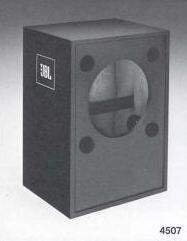
the JBL 4507 uses 4x3" ports and places them symmetrical around the woofer. so I'm just showing it as a example. since your looking for a more narrow baffle. using 2 x4" can be a challenge to fit and common practice is to offset the woofer and have 2 ports to one side. so it's why I recommend using smaller ports that can be mounted symetrical and close to the woofer and still fit easily on a more narrow baffle. and aside from other benefits using 4 smaller ports as opposed to 2 large ports, again using multiple small ports will actually yield a lower velocity. the reason for correct velocity is because to high velocity makes chuffing, lower velocity is ideal. no worries 4x3" ports will achieve ideal port velocity. of course there is no midrange etc etc I'm just showing this as a symmetrical port example.
and showing JBL uses very deep cabinets for high spl systems. the studio monitors are not as deep.
646db26b_vbattach191320-jpeg.jpg
 

Attachments

  • 646db26b_vbattach191320.jpeg
    646db26b_vbattach191320.jpeg
    4.7 KB · Views: 636
Last edited:
As interceptor said plywood is cheap. And there is so much stuff that will influence the eventual outcome, building it is the only way to be absolutely sure about how it will sound.

IME (and thats cab building experience, I have no fearfull/less experience) the main basic differenceswill be:
-The narrower cab will result in a shift of the small mid peak ( baffle step) to a higher frequency, and if you make the cab almost as narrow as the 15" there will be less of a peak. But the tradeoff here is that you'll have to take in account the stronger internal reflections from the side.
-In general the coupling between the drivers and directivity will be better if they are alligned vertically. But the trade off here is exactly that stronger coulping. As I understand the big plus in those designs are the realy great crossovers that factor in all small inconsistencies of those drivers acting together in that cab. Those inconsistencies partly arise from the drivers coupling in the small frequency band where both drivers overlap. So a different baffle layout may partly undo al the clever design that went into those crossovers.

If you want to build a cab to the specs you want with the orignal crossovers it will not have those fabled perfect transitions between the drivers, and internally it will act a little differently. That does not mean they will sound bad. If you'd use the same drivers in your design and go for a more standard crossover design they will still be to higher standard than most cabs you can buy in the shop. You will need to study up on the tech behind it though, or otherwise find someone who can accurately calculate them for you.

On that golden ratio: there is not "one" golden ratio in speaker design. The idea of those ratio's is that the internal dimensions are not identical or multiplications of each other. You can calculate alternative dimensions by using only prime numbers in the ratio's i.e. w/l/d = 3/5/7 or 3/11/5 or 17/11/7 whatever works for you.
 
  • Like
Reactions: Passinwind