Enjoy the benefits of a premium membership!
Upgrade Account
-
TalkBass has been independent since 1998. Add your voice.
Create a free account to reply to discussions, view embedded media, and browse with fewer display ads.
Join free Log in
Want zero display ads or expanded classifieds tools? Compare plans.
You are using an out of date browser. It may not display this or other websites correctly.
You should upgrade or use an alternative browser.
You should upgrade or use an alternative browser.
Fender American Vintage II Precision Side Dots
- Thread starter Moondog
- Start date
More options
Who Replied?


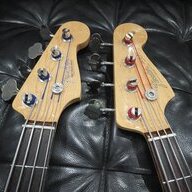
Looks like someone marked them up with a sharpie or something? Doesn't appear to have helped visibility much.
Looks like someone marked them up with a sharpie or something? Doesn't appear to have helped visibility much.
Yeah, I guess that must be what it is.
Does anyone have a good idea on how to remove The marks without damaging the finish?

I've filed fret sprout using a #4 aka the finest metal file, flat, along the edges, and subsequently restored the glossy finish using 9 grits of micro mesh pads.
I suggest you skip the file and use the coarsest micro mesh pad and go up from there.
Alternatively, medium fine wet sandpaper. Whatever grit you have where you live. In Poland I would use 1000 grit. Look up what grit it matches where you live.
What this a used bass? Did anybody do this or is it a factory job?
I recently bought a Vintera II Precision and a few of the side dots are misdrilled into the rosewood instead of being half and half.
Unacceptable and that's half the price of the a AVII but I let is slide because it's just cosmetic.
Years ago I received a Player P with what looked like black sharpie marks on the body. They rubbed off with a wet rag and light elbow grease.
I suggest you skip the file and use the coarsest micro mesh pad and go up from there.
Alternatively, medium fine wet sandpaper. Whatever grit you have where you live. In Poland I would use 1000 grit. Look up what grit it matches where you live.
What this a used bass? Did anybody do this or is it a factory job?
I recently bought a Vintera II Precision and a few of the side dots are misdrilled into the rosewood instead of being half and half.
Unacceptable and that's half the price of the a AVII but I let is slide because it's just cosmetic.
Years ago I received a Player P with what looked like black sharpie marks on the body. They rubbed off with a wet rag and light elbow grease.
Thanks for the recommendations. I bought it used online, so I didn't know about this until i received it.

Thanks for the recommendations. I bought it used online, so I didn't know about this until i received it.
Glad to hear it didn’t come from the factory looking like that. This is a nitro finish, right? Not sure what I’d use, but be very careful. I’m not sure if rubbing alcohol is advisable on nitro. Hopefully a luthier can chime in here. Knowing what use to clean finishes is a minefield - there is just SO much conflicting advice out there. I wanted to clean sticker residue off a body, and ended up using peanut butter because no-one could agree on whether WD-40 or rubbing alcohol (or what we here call isopropyl alcohol - which I think is the same thing) would damage the finish. (Peanut butter works incredibly well on the sticker goo, BTW, but I doubt it’s any use to you here.)
I've filed and polished nitro with the method I described above. No issues. Never needed to use any solvents.
If you're sure that is ink that someone used to mask the dots and not the neck tint bleeding in, you can try sanding one dot. Tape all around it and use some of the materials I described. Light touch. You will see immediately if it's working.
Otherwise enlist the help of a reputable luthier, someone who actually builds acoustic instruments. They know all about varnishes and finishes.
Hope you get the issue fixed. And next time ask for more pics before pulling the trigger :|
If you're sure that is ink that someone used to mask the dots and not the neck tint bleeding in, you can try sanding one dot. Tape all around it and use some of the materials I described. Light touch. You will see immediately if it's working.
Otherwise enlist the help of a reputable luthier, someone who actually builds acoustic instruments. They know all about varnishes and finishes.
Hope you get the issue fixed. And next time ask for more pics before pulling the trigger :|

Time to check out Luminlay markers. This would look so much better with glowing blue dots. And visible white in daylight.
Looks like sharpie marker. Try a bit of acetone on a rag, followed by some very fine sand paper.
Looks like sharpie marker. Try a bit of acetone on a rag, followed by some very fine sand paper.

Looks like a Sharpie marker was used. I recommend a careful, incremental, least destructive approach.
I'd start with Zippo/Ronsonol lighter fluid in combination with something like 800 to 1000-grit micromesh or a fine (maroon) 3M ScotchBrite pad. The Zippo fluid would at least provide lubrication.
If that fine abrasive and fluid cuts it, I'd possibly follow that with a medium to fine mirror glaze-cut cleaner to finish the job and restore the sheen along that side/edge of the neck.
Cleaning or rubbing alcohol would be the last resort thing I'd try--I doubt I would need to. I'd apply it to soft cotton cloth quite sparingly and work quickly. I would not soak the area and I'd wipe it off immediately.
DON'T USE ACETONE ON LACQUER! (Unless you wish to melt or strip the lacquer.)
I'd start with Zippo/Ronsonol lighter fluid in combination with something like 800 to 1000-grit micromesh or a fine (maroon) 3M ScotchBrite pad. The Zippo fluid would at least provide lubrication.
If that fine abrasive and fluid cuts it, I'd possibly follow that with a medium to fine mirror glaze-cut cleaner to finish the job and restore the sheen along that side/edge of the neck.
Cleaning or rubbing alcohol would be the last resort thing I'd try--I doubt I would need to. I'd apply it to soft cotton cloth quite sparingly and work quickly. I would not soak the area and I'd wipe it off immediately.
DON'T USE ACETONE ON LACQUER! (Unless you wish to melt or strip the lacquer.)
Last edited:
I had actually posted that mine were like that too, and then I went to take pictures and they aren't anymore. So I think mine must have come off when I started using FastFret recently and must have been just sharpie.
Time to check out Luminlay markers. This would look so much better with glowing blue dots. And visible white in daylight.
Looks like sharpie marker. Try a bit of acetone on a rag, followed by some very fine sand paper.
Do not acetone unless you want to soften or melt the lacquer.

D
Did you pay money for that bass? What a POS job they did on your neck...sad...
D
Did you pay money for that bass? What a POS job they did on your neck...sad...
+1
What's the context? Was this bass acquired second-hand?
I bought it used online.
I'm trying to decide whether to keep it and attempt to clean up the mess or just return it.
I'm trying to decide whether to keep it and attempt to clean up the mess or just return it.