• TalkBass has been independent since 1998. Add your voice.
    Create a free account to reply to discussions, view embedded media, and browse with fewer display ads.
    Join freeLog in
    Want zero display ads or expanded classifieds tools? Compare plans.

Fender Custom Shop Club

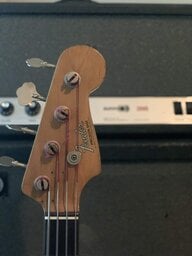
I’ve got a FCS Jazz relic with the typical raw wood on the back of the neck. I lightly buffed it with very fine grit sandpaper to smooth it out, but the first time my hand got sweaty, it got rough again. It rather annoys me but I don’t really feel like sanding it a again.

I thought I might swap my bass for a less-relic’d instrument, but when I checked Reverb I discovered thats not a viable option; virtually all the FCS Jazzes were that way.

How are you guys dealing with this? What’s your maintenance routine?
Good to know! I just got a FCS 64 Jazz NOS with a nitrocellulose lacquer finish on the neck and I'm having to regularly polish it smoother with ultra fine scotch-brite pads...was thinking maybe the raw wood relic option would be smoother before seeing your post. Both my EBMM and Sadowsky have necks that stay smoother for much longer after polishing.
 
Good to know! I just got a FCS 64 Jazz NOS with a nitrocellulose lacquer finish on the neck and I'm having to regularly polish it smoother with ultra fine scotch-brite pads...was thinking maybe the raw wood relic option would be smoother before seeing your post. Both my EBMM and Sadowsky have necks that stay smoother for much longer after polishing.
I’ve got two FCS guitars with nitro finished necks that are much, much smoother than the raw wood on my Jazz.

I contacted Fender Support about this and they told me it was a maintenance issue and to find a repairman. Yeah thanks Fender.
 
  • Like
Reactions: 4StringTheory
Man thats a bummer to hear, the worn necks look so smooth in pics

After I sanded it with 5000 grit sandpaper or whatever it was, it was AMAZING. It just didn’t last.

The most common internet answer is to use Tru-oil, but internet wisdom also says tru-oil over lacquer is a bad idea.

Virtually all new FCS Jazzes have raw wood necks, so I assume I’m the oddball in the crowd.

EDIT: I might have just found the answer I was looking for. Ron Thorn, former head of the FCS, said in another forum that he uses a couple coats of Goodstuff to finish raw necks.
 
  • Like
Reactions: 4StringTheory
New to me, CS 66 jazz. Really like it so far.

IMG_2321.jpeg
 
If that was a 1 5/8 and it had the 65/70 pickups, I'd be all over it. It reminds me of the Artisan Maple Burl. Obviously different woods.

Invalid Link Removed

That's a beautiful bass! I like the tone and body shape of the precision over the offset jazz bass for some reason, but have never gotten along with the wider width necks. I had a 59 RI for several years but could never get comfortable with the 1.75" nut. The jazz bass is what I learned to play on and that neck just feels like home for me, and I'm always looking out for P basses with a jazz nut.
 
  • Like
Reactions: WWilliam
I would want to see the floor traveler. If everything checked out, that would be a phenomenal price.
The writing on the neck and in the pocket looks like the 2022 I just bought. If I hadn't already spent my last disposable dime on a FCS Sonic Blue '60 Jazz, I'd definitely take a chance on it. Wonder if anyone has called Fender for info on the s/n - R110649? Might find out how the original was configured.
 
  • Like
Reactions: SJLee
The writing on the neck and in the pocket looks like the 2022 I just bought. If I hadn't already spent my last disposable dime on a FCS Sonic Blue '60 Jazz, I'd definitely take a chance on it. Wonder if anyone has called Fender for info on the s/n - R110649? Might find out how the original was configured.

I checked the serial numbers on both the neck plate and the neck, but none of them matched anything in Fender’s database. If the bass were truly legitimate, it would be drastically undervalued. With no COA, Floor Traveler, FCS case, and unverified serials, it raises far too many red flags for me.
 
I checked the serial numbers on both the neck plate and the neck, but none of them matched anything in Fender’s database. If the bass were truly legitimate, it would be drastically undervalued. With no COA, Floor Traveler, FCS case, and unverified serials, it raises far too many red flags for me.
I was curious about the neck and emailed Fender last month, this is what they sent back for that serial #
 

Attachments

  • Screenshot_20250602_091927_Adobe Acrobat.jpg
    Screenshot_20250602_091927_Adobe Acrobat.jpg
    273.3 KB · Views: 22
I checked the serial numbers on both the neck plate and the neck, but none of them matched anything in Fender’s database. If the bass were truly legitimate, it would be drastically undervalued. With no COA, Floor Traveler, FCS case, and unverified serials, it raises far too many red flags for me.
This screams “buy cheap, buy twice” to me. The description on Reverb is a huge warning sign.
 
  • Like
Reactions: projectapollo
This screams “buy cheap, buy twice” to me. The description on Reverb is a huge warning sign.

Yeah, that was my initial thought. Even the Shop Floor Traveler doesn't represent the bass correctly. It should have a fretboard wood listed if there is not skunk stripe and the truss rod is top loaded. I have not heard back from the seller yet.
 
After I sanded it with 5000 grit sandpaper or whatever it was, it was AMAZING. It just didn’t last.

The most common internet answer is to use Tru-oil, but internet wisdom also says tru-oil over lacquer is a bad idea.

Virtually all new FCS Jazzes have raw wood necks, so I assume I’m the oddball in the crowd.

EDIT: I might have just found the answer I was looking for. Ron Thorn, former head of the FCS, said in another forum that he uses a couple coats of Goodstuff to finish raw necks.

So, replying to myself here…

Emmet’s Good Stuff solved my problem.

I smoothed out the neck in my FCS Jazz with 0000 steel wool, then went through 4-5 iterations of:

- applying Emmet’s Good Stuff with bits of an old t-shirt
- allowing it to dry somewhat
- wiping off the excess with more t-shirt
- smoothing with 0000 steel wool

IMG_7626.jpeg


I am absolutely thrilled with the results. It was super easy to do, cost me maybe $25, and the neck is amazing now.

I was never one to complain about the stickiness of nitro on a neck, but after feeling the difference between the Emmet’s and the nitro, I see what the fuss is about. The nitro really does feel sticky in comparison.

I did this a couple weeks ago, and it has drastically improved my attitude towards this Jazz. It’s soooo much nicer to play.

IMG_7624.jpeg


A caveat though: if you do this but later decide to sell, you’ll either have to sand the neck or disclose the mod.

@Larrster
 
So, replying to myself here…

Emmet’s Good Stuff solved my problem.

I smoothed out the neck in my FCS Jazz with 0000 steel wool, then went through 4-5 iterations of:

- applying Emmet’s Good Stuff with bits of an old t-shirt
- allowing it to dry somewhat
- wiping off the excess with more t-shirt
- smoothing with 0000 steel wool

View attachment 7250026

I am absolutely thrilled with the results. It was super easy to do, cost me maybe $25, and the neck is amazing now.

I was never one to complain about the stickiness of nitro on a neck, but after feeling the difference between the Emmet’s and the nitro, I see what the fuss is about. The nitro really does feel sticky in comparison.

I did this a couple weeks ago, and it has drastically improved my attitude towards this Jazz. It’s soooo much nicer to play.

View attachment 7250045

A caveat though: if you do this but later decide to sell, you’ll either have to sand the neck or disclose the mod.

@Larrster

It's a bit funny when a polyurethane coating is an improvement on a bass that is supposed to replicate the old stuff. 😁
 
  • Haha
Reactions: OlyWhite
So, replying to myself here…

Emmet’s Good Stuff solved my problem.

I smoothed out the neck in my FCS Jazz with 0000 steel wool, then went through 4-5 iterations of:

- applying Emmet’s Good Stuff with bits of an old t-shirt
- allowing it to dry somewhat
- wiping off the excess with more t-shirt
- smoothing with 0000 steel wool

View attachment 7250026

I am absolutely thrilled with the results. It was super easy to do, cost me maybe $25, and the neck is amazing now.

I was never one to complain about the stickiness of nitro on a neck, but after feeling the difference between the Emmet’s and the nitro, I see what the fuss is about. The nitro really does feel sticky in comparison.

I did this a couple weeks ago, and it has drastically improved my attitude towards this Jazz. It’s soooo much nicer to play.

View attachment 7250045

A caveat though: if you do this but later decide to sell, you’ll either have to sand the neck or disclose the mod.

@Larrster
Great to know this, thanks for the update 🤙🎶
 
  • Like
Reactions: OlyWhite