• TalkBass has been independent since 1998. Add your voice.
    Create a free account to reply to discussions, view embedded media, and browse with fewer display ads.
    Join freeLog in
    Want zero display ads or expanded classifieds tools? Compare plans.

Fender Jazz only with 20 frets; why?

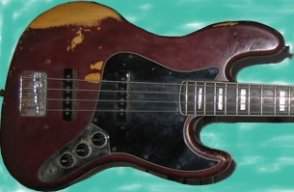
Fender has come out with Jazz basses with more frets in the past. With people like Wooten, Jimmy Johnson, John Pattatucci and many others who solo up the neck, if there is no disadvantage with only making 20 frets, it is seems odd that a company who updated pickups, bridge, neck design, and tuners did not add more frets for jazz players.

The new Elites have 21 frets, so why not the standard?

Funny you mention that. I owned a 'boner' jazz bass, back in 1994. It was a little strange looking, I believe it had 22 frets. It was beset by problems with the bridge pickup. the finish on the neck started to crack and was rough to the feel. Poor build quality.
 
  • Like
Reactions: johnson79
Why do cars have 4 wheels? Why does a coffee mug have one handle? Why do forks have four (or three) tines)? Because they were first popularized in that version, and kept selling. When razors started being made with multiple blades, people stopped buying single blade razors, even though four blades won't give you a better shave.

When Fender made 24 fret basses, they didn't sell as well. Why are people blaming them for selling what sells? You want to solo above there, buy a different bass.

Why be so obnoxious with your statement? No one is blaming Fender for anything, a simple question was asked.
Have a good day
 
Was contemplating on this last week so I start doing some research and noticed fender has 20, 21, 22 and did a run for even 24s frets
 

Attachments

  • 0306760505_gtr_frt_001_rr.jpg
    0306760505_gtr_frt_001_rr.jpg
    84.2 KB · Views: 56
  • images.jpg
    images.jpg
    7.6 KB · Views: 55
  • jazz2010dlx.jpg
    jazz2010dlx.jpg
    118.6 KB · Views: 65
  • 019-456.jpg
    019-456.jpg
    18.1 KB · Views: 55
  • Like
Reactions: Super Real
Funny you mention that. I owned a 'boner' jazz bass, back in 1994. It was a little strange looking, I believe it had 22 frets. It was beset by problems with the bridge pickup. the finish on the neck started to crack and was rough to the feel. Poor build quality.

I had one too! I ended up selling off the neck and stripping the body thinking I would rebuild it. Only then did I realize a standard neck wouldn't work. Fortunately I was able to sell the body to a guy that had a boner neck!
 
In 50 years of playing i've only done 1 song that used the 20th fret: the bass intro to The Real Me by The Who. Outside of that and another interlude with bass only, the song doesn't require anything over the 5th fret. I've never had a need or desire to play any fret higher than 20. I have some 21 and 24 fret basses and I've noodled around up there in the ozone but I don't go there when I'm performing.

More power to you if you can successfully use pitches that high, but I play bass because I like to keep the low end present and groovin'. If I wanted to play solos and pitches that high I would have played guitar. If you play jazz YMMD.
 
  • Like
Reactions: sgtpepper
I've never actually heard a recording of one of these (or that I'm aware of). With the pup so far away from the bridge, this thing has got to sound fairly tubby, even with steel rounds on.

"The Fender Bass V was only seen on the first leg of the 1973 (Led Zeppelin) US Tour from May 04, 1973 until June 03, 1973 for songs such as Over The Hills And Far Away, The Song Remains The Same and Heartbreaker, to name a few." so if you can find some live recordings from that time frame, you can hear it played by john paul jones. he only played it for two months? must not have liked it; not enough frets 8-)
 
I own basses with 20, 21, and 24 frets. Intellectually I like the idea of 24 frets (or better yet the 30 "fret" Ibanez Portamento!) but I can't really say that I am hampered by a lack of frets when I play the 20 fret bass. Those basses have 4, 6, and 5 strings respectively. If I seriously need more range I turn to the ones with the higher string count, the fret number differences are kinda in the noise level, IMO.
 
  • Like
Reactions: Dougie44
I believe there is a simple and musical explanation for 20 frets: It is the fewest number of frets to give the instrument a full two-octave range in all 12 keys. If for example there were only 19 frets (highest note D), then we wouldn't be able to play a two-octave Eb scale.

Another way to look at it is that a 20-fret Fender bass has a range of 36 half-steps, which means we can play each of the 12 notes of the chromatic scale in exactly 3 different octaves: low/mid/high E, low/mid/high F, low/mid/high F#/Gb, low/mid/high G, and so on up to low/mid/high Eb.

There is a lot of musical symmetry in the patterns we can unlock on the fretboard of the 20-fret bass. There's no question in my mind, the invention of a bass instrument that can comfortably modulate, in tune, through all 12 keys, changed the course of 20th century music and beyond.
 
Last edited:
I believe there is a simple and musical explanation for 20 frets: It is the fewest number of frets to give the instrument a full two-octave range in all 12 keys. If for example there were only 19 frets (highest note D), then we wouldn't be able to play a two-octave Eb scale.

Another way to look at it is that a 20-fret Fender bass has a range of 36 half-steps, which means we can play each of the 12 notes of the chromatic scale in exactly 3 different octaves: low/mid/high E, low/mid/high F, low/mid/high F#/Gb, low/mid/high G, and so on.

There is a lot of musical symmetry in the patterns we can unlock on the fretboard of the 20-fret bass.

Interesting point!
 
Why be so obnoxious with your statement? No one is blaming Fender for anything, a simple question was asked.
Have a good day

It wasn't aimed at OP, but rather the people who are getting all over Fender in their replies - just people who call Rickenbacker leadership for THEIR decisions.

Dumping on Fender, Ric, and GC is almost a daily routine here - it gets old.
 
I believe there is a simple and musical explanation for 20 frets: It is the fewest number of frets to give the instrument a full two-octave range in all 12 keys. If for example there were only 19 frets (highest note D), then we wouldn't be able to play a two-octave Eb scale.

Another way to look at it is that a 20-fret Fender bass has a range of 36 half-steps, which means we can play each of the 12 notes of the chromatic scale in exactly 3 different octaves: low/mid/high E, low/mid/high F, low/mid/high F#/Gb, low/mid/high G, and so on up to low/mid/high Eb.

There is a lot of musical symmetry in the patterns we can unlock on the fretboard of the 20-fret bass. There's no question in my mind, the invention of a bass instrument that can comfortably modulate, in tune, through all 12 keys, changed the course of 20th century music and beyond.


This makes sense!

That said, I like extra frets for the additional range - I play some jazz and also get solo space in my latin rock band. I think the Yamaha/Patitucci basses have 26 frets, IIRC the Warwick Thumb also has 26, and Lord knows how many "frets" would reside along Michael Manring's Hyperbass. However, for a host of ergonomic reasons, I'm clustering around a pair of basses (fretted and fretless) with 22 fret spacing. I honestly don't know the extent to which the number of frets contributes to this ergonomic perception - I think it goes more to body shape, body size and neck width and depth - but who knows? Also gotta recognize the utility of 21 frets so you can get that high E.

I should also add that less frets means more range for timbral variation via right-hand placement. Consider the nice dubby tone you can get on a 20-fret jazz by playing up at the edge of the fingerboard, and still able to get a lot of fingerflesh onto the string without the 21st, 22nd etc. frets in the way. And my slapping technique is minimal and often reliant upon bounce off of the fretboard, but I gather a lot of slappers like the open terrain that comes with fewer frets.

22 frets features on some of the more playable axes out there - Lakland 4-94 and variants, the Roscoe Beck basses that Fender made, and the Sadowsky Will Lee models (have never played one of those but am confident they would feel great). Gotta wonder if Roscoe Beck and Will Lee deliberately chose 22 as the best compromise between range and timbral flexibility.
 
Last edited: