
I love the little flower stickers on it! Do you know where you got them/where they are from? That's the type of stickerage I can get behind.

TalkBass has been independent since 1998. Add your voice.
Create a free account to reply to discussions, view embedded media, and browse with fewer display ads.
Join free Log in
Want zero display ads or expanded classifieds tools? Compare plans.
I love the little flower stickers on it! Do you know where you got them/where they are from? That's the type of stickerage I can get behind.
~
Uh-Oh !
I was considering that model, due to some of its other specs.
So do ANY of the current models have the body contours, or must I seek original vintage ones to get the cutaways ?
~

Thanx i really dig them on this bass, feels less naked with the natural finish. I got them on etsy.com and they are transparent vinyl stickerI love the little flower stickers on it! Do you know where you got them/where they are from? That's the type of stickerage I can get behind.

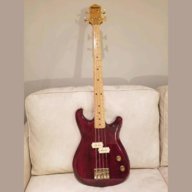
~Not currently. Would be nice to see at some point a American Pro style mustang that is a classic mustang with some of the forward thinking appointments, like contours!


A different take on these 'contours'-- Since I only play seated now with my Mustang (and other basses) resting on my leg and with my arm draped over the top edge, I don't see or feel where 'body contours' are helpful at all? In fact I feel they sometimes make my playing more uncomfortable as the upper part of the bass that my arm rests on is thinner and sharper on contoured basses. I see these contours as perhaps only being advantageous over a slab body if one plays mostly standing and with the bass strapped on rather low, so the upper cutout part leans back into you belly. ~~Otherwise? Well.....??
I also have an Ibanez Mikro which is even lighter than my Squier Mustang but has the Ibby body contours, and I find no real advantage to it having that upper body contour cutout. Playing the Mikro is indeed different from playing my slab Mustang, but IMO it's not better (or especially worse for that matter), it's just 'different'...
I'd be interested to read others' takes on this?

A different take on these 'contours'-- Since I only play seated now with my Mustang (and other basses) resting on my leg and with my arm draped over the top edge, I don't see or feel where 'body contours' are helpful at all? In fact I feel they sometimes make my playing more uncomfortable as the upper part of the bass that my arm rests on is thinner and sharper on contoured basses. I see these contours as perhaps only being advantageous over a slab body if one plays mostly standing and with the bass strapped on rather low, so the upper cutout part leans back into you belly. ~~Otherwise? Well.....??
I also have an Ibanez Mikro which is even lighter than my Squier Mustang but has the Ibby body contours, and I find no real advantage to it having that upper body contour cutout. Playing the Mikro is indeed different from playing my slab Mustang, but IMO it's not better (or especially worse for that matter), it's just 'different'...
I'd be interested to read others' takes on this?
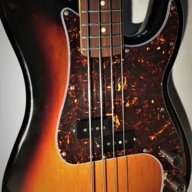
A different take on these 'contours'-- Since I only play seated now with my Mustang (and other basses) resting on my leg and with my arm draped over the top edge, I don't see or feel where 'body contours' are helpful at all? In fact I feel they sometimes make my playing more uncomfortable as the upper part of the bass that my arm rests on is thinner and sharper on contoured basses. I see these contours as perhaps only being advantageous over a slab body if one plays mostly standing and with the bass strapped on rather low, so the upper cutout part leans back into you belly. ~~Otherwise? Well.....??
I also have an Ibanez Mikro which is even lighter than my Squier Mustang but has the Ibby body contours, and I find no real advantage to it having that upper body contour cutout. Playing the Mikro is indeed different from playing my slab Mustang, but IMO it's not better (or especially worse for that matter), it's just 'different'...
I'd be interested to read others' takes on this?
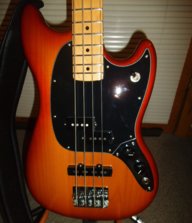
~A different take on these 'contours'-- Since I only play seated now with my Mustang (and other basses) resting on my leg and with my arm draped over the top edge, I don't see or feel where 'body contours' are helpful at all? In fact I feel they sometimes make my playing more uncomfortable as the upper part of the bass that my arm rests on is thinner and sharper on contoured basses. I see these contours as perhaps only being advantageous over a slab body if one plays mostly standing and with the bass strapped on rather low, so the upper cutout part leans back into you belly. ~~Otherwise? Well.....??
I also have an Ibanez Mikro which is even lighter than my Squier Mustang but has the Ibby body contours, and I find no real advantage to it having that upper body contour cutout. Playing the Mikro is indeed different from playing my slab Mustang, but IMO it's not better (or especially worse for that matter), it's just 'different'...
I'd be interested to read others' takes on this?
~None of my 3 basses have contours. Only my Strat has them. The only time I play sitting is around the campfire with my acoustic 6 string.
Never gave them being there or not a 2nd thought.

~I think it'd be cool to have a Mustang with body contours and just one stacked (volume/tone) knob.
Super simple in looks and function.

I'd be interested to read others' takes on this?
~
However, when you get to be MY age, it might become EVERY 2nd thought.
~
~That's true, I was just responding to Greywoulf's comment on others' take on the subject of contours.


Yeah, 3 times makes you cocky...~
Yes, and I was just being flippant [in my reply to you].
Hmmm.... I wonder whether getting a 3rd Covid jab two days ago has anything to do with my attitude ?
~
~I think it'd be cool to have a Mustang with body contours and just one stacked (volume/tone) knob.
Super simple in looks and function.
I think it'd be cool to have a Mustang with body contours and just one stacked (volume/tone) knob.
Super simple in looks and function.

Yeah, 3 times makes you cocky...
.


