• TalkBass has been independent since 1998. Add your voice.
    Create a free account to reply to discussions, view embedded media, and browse with fewer display ads.
    Join freeLog in
    Want zero display ads or expanded classifieds tools? Compare plans.

Fender Mustang Club

And 20 frets.


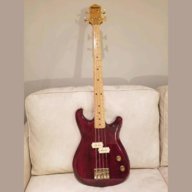
Mine is 8.5 pounds and I think it helps balance better than a lighter body would. Bought the pickguard on eBay from someone who took it off their Squier Mustang for another color.

I have found that anything under 8lbs. is subject to neck dive. To me, the sweet-spot is between 8.0 and 8.5 lbs. but, that is JMHO. and I am not going to argue ;).

I am just a cranky old guy who sits down if a good bass has neck dive :D!
 
My CV Squier from last year really is 1.5"
~
Yes, that's what they published for the regular production of those.

Well lately, it seems like it's 50-50 odds as to whether Fender will post correct or erroneous info for any given spec.

Does anyone here have an original 60s Mustang bass, for which they can measure the nut width and tell us ?
~
 
~
Really !

I wonder whether the nut width is really 1.5" ?

Does anyone know what the nut width was on the original 60s Mustang basses ?

[not that they would necessarily be copying that spec for this bass, even though they ought to be]
~

The nut width on mine is 1.5". The only difference between this bass and the standard production model is the paint job.
 
~
Really ! - I wonder whether the nut width is really 1.5" ? [on the CME Squier 60s Mustang bass special]

Does anyone know what the nut width was on the original 60s Mustang basses ?

[not that they would necessarily be copying that spec for this bass, even though they ought to be]
~
The nut width on mine is 1.5".

The only difference between this bass and the standard production model is the paint job.
~
Thanks. :)

So Fender started out at 1.5" nut width for the original 60s Mustang basses, then went to 1.625" for their 70s models ?

I gotta clear up the numbers, as I may be doing some shopping.... :whistle: :greedy:
~
 
Last edited:
I really wanted one of those but I checked with CME and it seems the normal weight these days in 8 pounds and with my issues I'll just keep my white Squier CV Mustang that weighs in at 6 pounds and 8 ounces and be envious of the Lake Placid blue!

@HelpImaRock Who made the tort guard - looks awesome!
Same, same! Got my own CV60 Squier down from 7.something to 6.8 with Hipshot tuners. -And I always play sitting now with the neck tilted upwards, so there's really no such thing as 'neck dive' that way... And while I do like this new color (but hate that awful new faded shell pink), there's no way I'm giving up my light and lovely surf green Stang for the same version with 'heavier' paint!! :roflmao:
 
Last edited:
  • Like
Reactions: don21480
Due to the excessive pressure from @DavesnothereCA hahaha

I've got a set of standard-gauge (SS) GHS Brite Flats on the way! This will tremendously add to the diversity of my Fender bass string choices. Here's what I will, thencely, have:

50s Classic Precision, all stock: Pressurewounds, light set
Vintage 1960 Precision w/Curtis Novak PB-V: Precision Flats, light set (sounds *absolutely incredible* as a whole btw*
Mustang Offset PJ w/EMG GZR+J: Brite Flats once they arrive

Apparently I'm a sucker for this pairing. The Brite Flats are widely regarded as being very stiff for actually being groundwounds, and more mellow than Pressurewounds but more lively than Precisions. Dave prob talked me into a perfect midpoint among these three, and I'm excited for the chance to try some out.


And I still have to file the application, but at this point, I really would be game to endorse GHS. Them strings thump real real nice.
 
  • Like
Reactions: DavesnothereCA
~
That's purty ! :drool:

And not too expensive either.

But I'll bet a doughnut to a dollar that dealers in Canada will not be getting them, same as with the shell pink Broncos and Mustangs, and as y'all know, Fender prohibits dealers located everywhere else from shipping their products to Canada, even when none of our dealers will be having any. :sour: :confused: o_O

That all said, I wonder when they will make an authentic circa 1970s reissue Squier Mustang bass, complete with with Maple fretboard, 1.625" nut width, and maybe also a natural finish on the body ?

Will I live to see the day ?


One of THOSE, regardless of the corporate politics, I would find a way to snag ! :woot:
~

Man, I hear you on the Canadian dealer thing. Frustrating, to put it mildly, and requires friends / relatives in USA to get around. A giant pain.

As for natural finishes - definitely down for that. There was an ash version sold in Japan about 15 years ago that I'd really like to get my hands on. I'll see if I can find of photo of it somewhere.

GT
 
  • Like
Reactions: DavesnothereCA
Due to the excessive pressure from @DavesnothereCA hahaha

I've got a set of standard-gauge (SS) GHS Brite Flats on the way! This will tremendously add to the diversity of my Fender bass string choices. Here's what I will, thencely, have:

50s Classic Precision, all stock: Pressurewounds, light set
Vintage 1960 Precision w/Curtis Novak PB-V: Precision Flats, light set (sounds *absolutely incredible* as a whole btw*
Mustang Offset PJ w/EMG GZR+J: Brite Flats once they arrive

Apparently I'm a sucker for this pairing. The Brite Flats are widely regarded as being very stiff for actually being groundwounds, and more mellow than Pressurewounds but more lively than Precisions. Dave prob talked me into a perfect midpoint among these three, and I'm excited for the chance to try some out.

And I still have to file the application, but at this point, I really would be game to endorse GHS. Them strings thump real real nice.
~
Thanks - I'm pleased to promote any product which I like.

In this particular instance, the tension due to the heavier than average gauge [49-108] for short scale strings, is the primary contributor to the stiffness, IMO.

On my long scale Ric [where there IS a choice], I've for several decades been using the light gauge version of Brite Flats [or their Dean Markley branded predecessors], which, according to GHS, have a similar tension for long scale as their heavier version would for short scale applications.

I suspect that LaBella DT Flats of the 49-109 gauge [and they offer those in 4 or 5 gauge choices for most scale lengths] would feel similar in tension and stiffness to Brite Flats, though smoother on the surface.

BTW, it looks like D'Addario has disco'd their half rounds for short and medium scale basses, and those were 45-100, IIRC, which limits further our overall string choices for short and medium scale basses, and more specifically the ground style.

Please update us after trying the Brite Flats.
~
 
Last edited:
  • Like
Reactions: Real Soon
Man, I hear you on the Canadian dealer thing. Frustrating, to put it mildly, and requires friends / relatives in USA to get around. A giant pain.

As for natural finishes - definitely down for that. There was an ash version sold in Japan about 15 years ago that I'd really like to get my hands on. I'll see if I can find of photo of it somewhere.

GT
~
Or a broker. - And can make Canadian customers willing to spend REAL MONEY feel like they've done something wrong, if they leverage the alternate acquisition channels.

On that MIJ bass, I wonder what the rest of the specs were for that one, such as the nut width ?

Wider like the 70s American Mustang basses ?
~
 
Last edited:
upload_2022-2-5_6-57-35.png


Pickguard replaced and strung with LaBella LTFs. An amazing bass at any price.
 
Just put out an album featuring two Mustangs as well as a sub-short scale bass. The Mustang sound is most noticable on the opening track, "Faaborg Hævn", and on "Men du taler til mig" and "Eiskalt" to a lesser extent due to a medium-sized pedal board :) Here's a link to the thread about the album, which gives more information about the music and use of basses:
I have a new album out (short and sub-short bass content!)
 
So Fender started out at 1.5" nut width for the original 60s Mustang basses, then went to 1.625" for their 70s models ?

I gotta clear up the numbers, as I may be doing some shopping.... :whistle: :greedy:
~

Just the opposite. The earlier Mustangs had the wider 1.625" nut. The JMJ Mustang (based on a 1966 original) reflects this.
The nut went to 1.5" in late 1969 when the body contours and competition stripe were introduced.