
• TalkBass has been independent since 1998. Add your voice.
    Create a free account to reply to discussions, view embedded media, and browse with fewer display ads.
    Join freeLog in
    Want zero display ads or expanded classifieds tools? Compare plans.

Fender P Bass: Thump versus Ring

Grubgroove

Supporting Member
Jun 26, 2020
41
108
I came across a used Fender 2016 American Standard P Bass in excellent condition at a good price and bought it. I've been happy with my MIM Player P Bass for a few years but had to try the American Standard. I'm comparing the two and this is what I'm hearing: The American is more solid and true to the fundamentals in lower registers, and the MIM has much better clarity, sustain and "ring like a bell" tone in the upper registers. My intent was to sell one. As Leland Sklar says, "The low end is the 'cash register'" so I'm leaning toward keeping the American. It also has more consistent volume and voice across the whole fretboard. (Sits in the mix.) Any reason I should prioritize the "ring like a bell" high tones of the MIM over the depth and consistency of the American Standard? Thanks for any advice. - John
 
  • Like
Reactions: ElCrowg
I came across a used Fender 2016 American Standard P Bass in excellent condition at a good price and bought it. I've been happy with my MIM Player P Bass for a few years but had to try the American Standard. I'm comparing the two and this is what I'm hearing: The American is more solid and true to the fundamentals in lower registers, and the MIM has much better clarity, sustain and "ring like a bell" tone in the upper registers. My intent was to sell one. As Leland Sklar says, "The low end is the 'cash register'" so I'm leaning toward keeping the American. It also has more consistent volume and voice across the whole fretboard. (Sits in the mix.) Any reason I should prioritize the "ring like a bell" high tones of the MIM over the depth and consistency of the American Standard? Thanks for any advice. - John
Hi John. Are you using the same brand/type of strings on both basses?
 
I came across a used Fender 2016 American Standard P Bass in excellent condition at a good price and bought it. I've been happy with my MIM Player P Bass for a few years but had to try the American Standard. I'm comparing the two and this is what I'm hearing: The American is more solid and true to the fundamentals in lower registers, and the MIM has much better clarity, sustain and "ring like a bell" tone in the upper registers. My intent was to sell one. As Leland Sklar says, "The low end is the 'cash register'" so I'm leaning toward keeping the American. It also has more consistent volume and voice across the whole fretboard. (Sits in the mix.) Any reason I should prioritize the "ring like a bell" high tones of the MIM over the depth and consistency of the American Standard? Thanks for any advice. - John



Set up can have a huge impact on a bass's sound and playability and timbre. Do you have the same strings at about the same age on them?
 
Excellent point about what the audience hears! That's specially true of the high notes because, to use another Sklar line, "If you spend a lot of time up there you're going to need a bass player." I should probably quit comparing basses fret by fret and get back to playing with the band to see what works.


I have been told by non-musician audience members that they liked my bass sound which came straight from my amp. Do you have the same strings on both basses?
 
Last edited:
Strings: I put La Bella Deep Talking flats on the MIM, and the American Standard came (second hand) with La Bella flats on it. I've been advised that there is a lot to the technique of putting on strings (making sure they're not twisted, proper crimping, even pre-boiling), so they may have been handled differently. The strings are similar, at least.
 
  • Like
Reactions: bobyoung53
Strings: I put La Bella Deep Talking flats on the MIM, and the American Standard came (second hand) with La Bella flats on it. I've been advised that there is a lot to the technique of putting on strings (making sure they're not twisted, proper crimping, even pre-boiling), so they may have been handled differently. The strings are similar, at least.


New La Bella DTB are a lot brighter than old ones. Twisting them will cause dissonance in them, make sure that the end in the bridge can rotate at the last minute before you tighten them. I have always bent them before I cut them. I've never heard of pre-boiling. Years ago people use to boil Rotos to try to get them to sound like new ones again, it wasn't really worth the effort to me though. But yeah, there is a big difference between old and new La Bellas, they take a few months to settle down. I would especially not boil new strings.
 
I do agree that the cash is in the low end, but….

If the character of the MIM one inspires you to play to where you practice more, that’s worth more than a better low end. I have no idea if this is the case for you, but if it is, consider it.

You don’t get called for gigs because your tone is a few percent better. Well, maybe you do once in a while, but it has to be a really close decision for that to tilt the decision. Far more often, you will get the call because you outwork other players as far as practicing goes (and aren’t a jerk). Given that, the bass you want is the bass that inspires you enough that you practice more.

And don’t be a jerk.
 
Interesting analysis and funny refer to “Cash Registers” but do you think that the tonal qualities you ID’d will make a difference to any audience? Fifty years of live performance makes me skeptical of audiophiles in attendance anywhere.


I do agree that the cash is in the low end, but….

If the character of the MIM one inspires you to play to where you practice more, that’s worth more than a better low end. I have no idea if this is the case for you, but if it is, consider it.

You don’t get called for gigs because your tone is a few percent better. Well, maybe you do once in a while, but it has to be a really close decision for that to tilt the decision. Far more often, you will get the call because you outwork other players as far as practicing goes (and aren’t a jerk). Given that, the bass you want is the bass that inspires you enough that you practice more.

And don’t be a jerk.

I think these two very good comments fit together to complete an idea or perspective.

Chasing tone is lot more about having an instrument that inspires you to play and practice more. The bass you want, with a certain tone, can be a muse for creating a cool sections, whole songs and a whole style of playing.

That's the stuff audiences can hear and appreciate, inspired playing. Is not about thrilling audiophiles in the audience. Few if any will hear or appreciate much about the subtleties that you hear and work for you in your intimate relationship with the instrument.
 
The American is more solid and true to the fundamentals in lower registers... It also has more consistent volume and voice across the whole fretboard. (Sits in the mix.)
There's two good reasons to keep that one.

Personally, I'd take the other one. I like the higher notes to ring out. Lends itself well for melodic fills, tasty passages, and my very rare solos. I don't go up that high alot, but when it's needed, it's there. Worked good in the rock and modern country genres. The lower notes are always available at the other end of the neck for the meat and potatoes bass.

For what it's worth, I agree that the audience doesn't care much about the tone. They just care about how well you played the song.
 
Last edited:
  • Like
Reactions: XLunacy
The audience does care about tone, just not in they way that players do. They care in that they want it to sound good (what ever that subjective thing is to them)…they dont care about what you use to achieve it, unless there is some preconceived genre visual thing. Try both basses in as many settings as possible and stick with one works for you best
 
All my listening has been through amplification. I'll give a listen to the unamplified instruments.
The MIM with the greater high-end sustain has higher action.
I'll look more closely at the fretboard relief. My first impression was that both are good, but I'll run a straight edge and see if there are differences in curvature points.
I also appreciates the thoughts about inspiration versus stage performance. There are relationships, certainly. The more I like what I hear in practice the more motivated I'll be to put new ideas out to the band and audience, even if the upper registers get little attention in performance.
I'm impressed with the feedback. Glad I asked.
 
  • Like
Reactions: DrThumpenstein
I came across a used Fender 2016 American Standard P Bass in excellent condition at a good price and bought it. I've been happy with my MIM Player P Bass for a few years but had to try the American Standard. I'm comparing the two and this is what I'm hearing: The American is more solid and true to the fundamentals in lower registers, and the MIM has much better clarity, sustain and "ring like a bell" tone in the upper registers. My intent was to sell one. As Leland Sklar says, "The low end is the 'cash register'" so I'm leaning toward keeping the American. It also has more consistent volume and voice across the whole fretboard. (Sits in the mix.) Any reason I should prioritize the "ring like a bell" high tones of the MIM over the depth and consistency of the American Standard? Thanks for any advice. - John
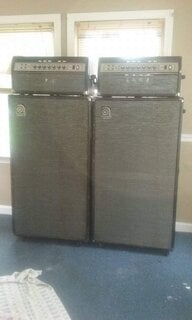
I have played AM PBs for over a half of a century. With recently newer strings,,and without that stupid bridge cover with the foam in it, I have zero problems getting them to ring. My advice is to buy the MIA PB, put a new set of rounds on it, like GHS Bass Boomer for instance and let it rip.

One other tip is you may need to adjust your EQ for satisfactory results. Don’t be afraid to twist some knobs to get what you are looking for.
 
  • Like
Reactions: rockinrayduke