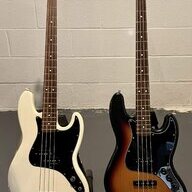
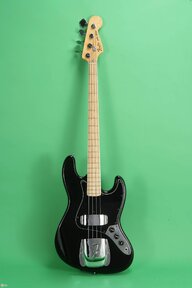
J has imbalanced string volume, a slightly (but noticeably) thinner sounding pickup, and single coil hum at certain angles. Amp settings, subtly applied high quality noise gates, and technique can pretty much equalize the two. The imbalance in string to string volume is the most glaring difference, the worst difference, and the hardest difference to correct. In combination with the mid-sucked blended tones, it gives the J an anemic midrange with a strong bottom end and top end. Not good bass tone IMO. I play mine on neck pickup only 95 percent of the time.
Jazz Basses were supposed to be higher end and more capable than Ps, but IMO, their disadvantages (mentioned above) outweigh their advantages (more tones available via onboard tweaking – almost none of which I like or use during a set They have worse ergonomics/comfort from the offset body. I also dislike the 1.5” nut. So for my uses, they are actually a de-evolution from P. A bass that has imbalanced strings and hum on the control setting that I use 95 percent of the time is not a better tool for me.
All of my Jazzes except the AVs have been modified with staggered or adjustable pole pickups – and all but one have hum canceling pickups too.
Leo Fender and crew “fixed” the J in 1981, with the L-2000. Unless you’re highly reliant on all the variations in pickup blends, and can’t live with just a simple 100:100 blend, the 2K is superior to me in every way. Wide nut, non-offset body, balanced string volume, hum canceling on tap, added bass control, not to mention an onboard boost that can be used or bypassed. They had also expanded the capabilities of the P the year before, with the L-1K.