• TalkBass has been independent since 1998. Add your voice.
    Create a free account to reply to discussions, view embedded media, and browse with fewer display ads.
    Join freeLog in
    Want zero display ads or expanded classifieds tools? Compare plans.

Fender Rumble Club

Welll... I used to think that about Peavey... until a 210 cab being used as a vocal monitor instantly went kerblooey. still don't know how it happened, it had been working well until that fateful moment.

To be truthful, I haven't bought anything Peavey in over 15 years. I was going to buy the IRP 3000, to power a cab I planned on buying, but for some reason this turned into a Rumble 500!
 
I can't stand Peavey. Meh with a capital MEH! So BLAH, it's not funny. And ampig. Total dumpster diving good for nothing garbage from the very get go!

Having played both (Peavey MAX 800 and Ampeg SVT-3PRO to be exact), the Peavey was powerful but I didn’t care for the overall tone (or the weight!), and the Ampeg was ok, but I never felt satisfied. Quite satisfied with Fender.
 
  • Like
Reactions: Linnin
Nah. Not nice or funny. This guy has done nothing but turn me off of Fenders. I'd rather buy a Crate at this point.

I suppose you are talking about Linnin. He has been a heart and soul of this thread for a long time. And most of us here are really enjoying his enthusiasm and knowledge. He didn't do anything that is not frequently seen in other brand threads anyway.
 
  • Like
Reactions: Linnin
Welcome to the Fender Rumble Club, Mattrill!:woot: You are member #393 :hyper:
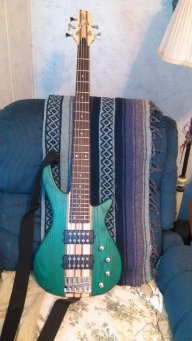
Your Fender Jazz bass looks exactly like Angeline Saris's . :thumbsup: Very nice indeed.

:cool: Rumble On! :cool:

Hey Linnin, thanks!

I remember when I got my bass and then I see it here (is this the lady you speak of?) very visually appealing bass :woot:. Just saving to cure the P gas (never had a p bass)
 
  • Like
Reactions: Linnin
Well, from an electrical standpoint, distortion is distortion, It's all some form of clipping, but might mean a hard square wave. But it does mean clipping in some form. How much clipping and the eq particulars of each amp and pedal vary. for example, just the very tops of the wave can be clipped (more like overdrive, not very distorted), or it's pushed into full square wave, which just sounds awful and buzzy and not very useful IMO.

My explanation was about distortion in general, but it applies everywhere - amps, speakers, all of it. But this is why all the guys are saying that distortion is bad for speakers, eg, if you have an uber powerful amp that sends a HUGE clean signal to a speaker that can't reproduce it, then you get a square wave at the speaker level, which kills it. But if you mash that signal long before it gets to the speakers - like with a pedal, or by overdriving the gain, as in the Rumble's overdrive circuit, it's controllable by the master volume. That way you have your cake and eat it too - wildly distorted sound, but at a lower volume that's controlled by the master so it's safe for the speakers to reproduce. However, that signal is still a clipped signal, and the louder it is, the harder it is for the speaker to reproduce it. But to be clear, the thing you don't want to do is to send to the speakers themselves in a square wave. the square wave is like 0db > +100% db > 0db > -100%db, etc etc, doing it many times per second. That makes the speaker go off-on-off-on-off-on... which they're try to do, but probably can't cool the vpoicecoil, and depending onthe powere they are receiving, over extend the cone, too. God, there are so many ways to fry a speaker... I've even seen them catch fire. They'll fart out before this, so you have warning. very small warning, though.

But even having said all that, if you run a super-bassy sound of the proper voltage and wattage into speakers with voice coils that can't cool themselves down over the long run of you playing it that way, the voice coils will burn up and the speaker dies (see fire reference above). You might not hear any farting under those circumstances. It all depends on the speaker.

I had a GK MB210 that made a burning plastic aroma every time I got near the volume at which I usually play. That was my sign that the speakers weren't for me. In other words, always keep your ears (and nose, in my case) open to trouble signs.

more info:
Distortion - Wikipedia, the free encyclopedia

Hope I answered that.

You sure did answer that, thanks. Let's first see if I got it right and then I have a follow up question.

So what you say is that if the signal is "appropriately" distorted at the right time on the signal travel path, even if it squares as long as it is controllable at the end (like a master volume) it is safe?

Follow up question: if what hurts speakers/drivers the most is low frequencies and distortion/clipping how do guitar amps survive 5 minutes? My thinking is, I thought guitar amps had speakers let's say less sturdy(?) that those meant for bass, so guitar Rock players who use distortion pedals of all sorts, in all their songs, how do they handle it?
 
You sure did answer that, thanks. Let's first see if I got it right and then I have a follow up question.

So what you say is that if the signal is "appropriately" distorted at the right time on the signal travel path, even if it squares as long as it is controllable at the end (like a master volume) it is safe?

Follow up question: if what hurts speakers/drivers the most is low frequencies and distortion/clipping how do guitar amps survive 5 minutes? My thinking is, I thought guitar amps had speakers let's say less sturdy(?) that those meant for bass, so guitar Rock players who use distortion pedals of all sorts, in all their songs, how do they handle it?

Guitars play at higher frequencies than bass. The lowest note on a standard tuned guitar is the equivalent of the 12th fret on the E string of a standard tuned bass.

The higher the frequencies, the less air needs to be moved so the less travel the speaker needs to make to reproduce these sounds. If you think about a tweeter compared to a woofer you get the idea.

This is why some bassists will send a clean signal to their bass amp, and then just distort the higher frequencies and send them to a guitar amp.

I don't use distortion very often, but when I have played around with it through my main rig, I would keep the lows clean and distort the higher frequencies only.
 
  • Like
Reactions: dbbltime
Little sound clip of my Rumbles (500 combo and 115 cab) in action on our band (The Howlin' Wolves) on a track from our brand new EP - written by me, in fact!


Recorded with the amp/cab mic'd up. Bass is a 2014 USA Standard Precision - no effects or anything! Using a pick rather than fingerstyle.

Out of interest, the EP, 'Leave It...' is out to download and stream from all the usual sites.....:bassist:
 

Latest posts