
Enjoy the benefits of a premium membership!
Upgrade Account
-
TalkBass has been independent since 1998. Add your voice.
Create a free account to reply to discussions, view embedded media, and browse with fewer display ads.
Join free Log in
Want zero display ads or expanded classifieds tools? Compare plans.
You are using an out of date browser. It may not display this or other websites correctly.
You should upgrade or use an alternative browser.
You should upgrade or use an alternative browser.
More options
Who Replied?
Those are not the settings I use, its just hypothetical to see how "far" ir can be safely pushed.
Jacinc what if i'm using heavy fuzz and other pedals?
Unfortunately, there is no "one size fits all".
As was mentioned earlier, the most dangerous signals for speakers are extreme bass and distortion.
You can send too much power to a decent speaker, and it will withstand it for a while (more or less time depending on the quality of the speaker), however, a clipped signal can kill a speaker pretty quick.
With each effect you use, you will need to listen to the speaker to hear any damage. If it sounds as though your speakers are struggling, they probably are.
You could probably (note, I say probably) run the Rumble on full for a full show without it breaking, but if you do this with too much bass in the signal, or while giving it a lot of distortion and fuzz (especially with too much bass), it won't be as happy.
Sorry that this is of no use, but the only way to be 100% certain that you are not damaging the speakers is to listen to them and judge for yourself.
Yes, I completely understand what you are trying to say. It is indeed a bit frustrating as, first, I think that among so many warning they come with manuals should also come with instructions regarding this. Players with little knowledge on this technical stuff may ruin expensive gear by just turning knobs. And secondly because I'm sure that while using cleaner sound I can see if the speaker is struggling, if I want to create a heavy, dirty, distorted sound I'm not sure I'll identify "bad" noises from the speakers.

Awesome that you love the amp, but have to say - with great respect - that I really dislike it when people say things like this. I suspect you're better than you think, but the point is to have a good time and be happy.I really am just an average bassist, but tonight I sounded pretty darn good.
While it's true the vast majority of us will never be Jaco, remember that at one time Jaco was also "just an average bassist." Just keep working on it, that's what artists do.
In his 80's virtuoso cellist Pablo Casals made a comment about his routine of practicing every day. "Why do you still practice??" "Because I think I'm making progress," was his answer.
So, the Rumble's part in this: It's my opinion that the better your instrument sounds to you, the more you will play. And that's the key to getting where you want to go.
Keep on keepin' on, brotha!
Google Image Result for http://thehairpin.com/wp-content/uploads/2014/07/little-engine-that-could.jpg

Yes, I completely understand what you are trying to say. It is indeed a bit frustrating as, first, I think that among so many warning they come with manuals should also come with instructions regarding this. Players with little knowledge on this technical stuff may ruin expensive gear by just turning knobs. And secondly because I'm sure that while using cleaner sound I can see if the speaker is struggling, if I want to create a heavy, dirty, distorted sound I'm not sure I'll identify "bad" noises from the speakers.
I'm don't think the Rumble combos are the best for heavy dirty sounds, unless you have them paired with extension cabs.
Distortion works like this: it's a clipped signal, meaning that, through overamplification, the "sine wave" type signal has been turned into a square wave. A square wave means that the wave is going from the positive side of the wave (eg, speaker being pushed all the way out) *immediately* to the opposite (eg, speaker being pulled all the way in). Generally this is hard on speakers because they're designed to vibrate differently, more in varied movements, not full-excursion from in-out-in-out... This condition will blow up a speaker pretty fast.
Having said that, if the volume is low enough such that the speaker isn't using it's full amount of travel, it can do this for a longer period of . time. Alternately, you can use more speakers, which disperses all that clipped signal over more area, making each speaker work less. Which is why you see rock band bass players with lots of cabs.
In short, asking two little 10 inch speakers to do something like this while simultaneously making a lot of volume is a recipe for a blown speaker. So pretty much, if that's your sound, take it easy on the volume. Or buy more speakers.
As for it being in the manual - manufacturers just don't do that. Experience teaches us such things. Usually with blown speakers littering the path behind us...

@J.Nuno
I don't recommend turning bass to 100% ever, not on this amp or any amp!
Just to be clear, JACink, are you referring to the volume on the bass itself or the master volume on the amp?
I can understand the volume on the amp not going to 100%, but the signal coming from a passive bass, even at 100%, is not in itself going to ruin a speaker. I just want to make sure I understand what you're referring to in your statement.
Just to be clear, JACink, are you referring to the volume on the bass itself or the master volume on the amp?
I can understand the volume on the amp not going to 100%, but the signal coming from a passive bass, even at 100%, is not in itself going to ruin a speaker. I just want to make sure I understand what you're referring to in your statement.
I was referring to the Bass EQ knob.
@bdplaid thanks a lot for the explanation. Also, to make things clear I don't typically use a heady, distorted sound. In my band I use mostly a clean sound. It was really just an example (as were the EQ settings) to try to figure out what I'm allowed to try if I want to. Because I like to experiment I find myself trying weird things and sounds which might, in fact, hurt the speakers.
Regarding your explanation on distortion, I got intrigued by something I believe might be causing confusion: is that kind of sound distortion (by signal clipping) the same nature of the distortion we get by using a pedal? Because when I asked what were the boundaries of safeness while trying to get a very distorted, dirty sound I meant by the use of overdrive, fuzz, distortion, muff, etc. kind of pedals, not by pushing the gain, treble and master too far.
Regarding your explanation on distortion, I got intrigued by something I believe might be causing confusion: is that kind of sound distortion (by signal clipping) the same nature of the distortion we get by using a pedal? Because when I asked what were the boundaries of safeness while trying to get a very distorted, dirty sound I meant by the use of overdrive, fuzz, distortion, muff, etc. kind of pedals, not by pushing the gain, treble and master too far.

Been using the 200 now since last December every weekend. Lately been using bright,vintage and contour all on with bass knob at a quarter ,both mids and treble at half,gain at quarter and master quarter to half. Sometimes use the horn depending on bass. Most time plug in extra 8ohm old fender single 15 in a cab in larger rooms and use by itself in smallEveryone is always invited to share their pre-amp settings at anytime. All are welcome here.
. I thought I heard a very slight buzz but couldn't trace it at practice and that could be something in the room,so I retightened all the screws and don't hear it anymore. This is my new workhorse and Im lovin it!



Welcome to the Fender Rumble Club, Mattrill!Rumble 100V3 and Fender Jazz crunch galore
 You are member #393
Your Fender Jazz bass looks exactly like Angeline Saris's .
 Very nice indeed.
 Rumble On!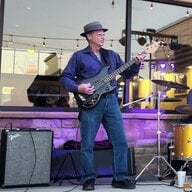
I really am just an average bassist, but tonight I sounded pretty darn good.
Awesome that you love the amp, but have to say - with great respect - that I really dislike it when people say things like this. I suspect you're better than you think, but the point is to have a good time and be happy.
While it's true the vast majority of us will never be Jaco, remember that at one time Jaco was also "just an average bassist." Just keep working on it, that's what artists do.
I just wanted to clarify that I consider myself very fortunate to be an average bassist. I shouldn't have used the word "just". I am competent enough to play on a lot of stages and I can hold up the bottom end. Some TB members are working toward this as a goal. Then there are so many TB members who have so much knowledge and experience. Far better than average. For now I am pretty much right in the middle and so happy to be here. Lately, I have been concentrating on becoming a better bass player and it is paying off. If I keep up the good work, there may be a day when I can actually consider myself a better-than-average bassist. I really do have a ways to go, and getting there is fun and challenging. I realize what I said could sound like I was putting myself down. I didn't mean it like that though. I saw a show in Branson last week. The Country Jubilee. Larry with his Musicman Stingray V was an excellent bassist! I saw a level of proficiency I would like to achieve. I am having so much fun with bass is just isn't right.
The Rumble 200 just makes it that much better. That was my real conclusion from playing it last night. It made everything I did sound good. I should have bought a Rumble 200 v2 40 years ago!

Last edited:
That would have been the Rumble 150 combo. As good as the Rumble 150 was and still is, what you have now is a much better and flexible combo.I should have bought a Rumble 200 v2 years ago!
Well, from an electrical standpoint, distortion is distortion, It's all some form of clipping, but might mean a hard square wave. But it does mean clipping in some form. How much clipping and the eq particulars of each amp and pedal vary. for example, just the very tops of the wave can be clipped (more like overdrive, not very distorted), or it's pushed into full square wave, which just sounds awful and buzzy and not very useful IMO.@bdplaid thanks a lot for the explanation. Also, to make things clear I don't typically use a heady, distorted sound. In my band I use mostly a clean sound. It was really just an example (as were the EQ settings) to try to figure out what I'm allowed to try if I want to. Because I like to experiment I find myself trying weird things and sounds which might, in fact, hurt the speakers.
Regarding your explanation on distortion, I got intrigued by something I believe might be causing confusion: is that kind of sound distortion (by signal clipping) the same nature of the distortion we get by using a pedal? Because when I asked what were the boundaries of safeness while trying to get a very distorted, dirty sound I meant by the use of overdrive, fuzz, distortion, muff, etc. kind of pedals, not by pushing the gain, treble and master too far.
My explanation was about distortion in general, but it applies everywhere - amps, speakers, all of it. But this is why all the guys are saying that distortion is bad for speakers, eg, if you have an uber powerful amp that sends a HUGE clean signal to a speaker that can't reproduce it, then you get a square wave at the speaker level, which kills it. But if you mash that signal long before it gets to the speakers - like with a pedal, or by overdriving the gain, as in the Rumble's overdrive circuit, it's controllable by the master volume. That way you have your cake and eat it too - wildly distorted sound, but at a lower volume that's controlled by the master so it's safe for the speakers to reproduce. However, that signal is still a clipped signal, and the louder it is, the harder it is for the speaker to reproduce it. But to be clear, the thing you don't want to do is to send to the speakers themselves in a square wave. the square wave is like 0db > +100% db > 0db > -100%db, etc etc, doing it many times per second. That makes the speaker go off-on-off-on-off-on... which they're try to do, but probably can't cool the vpoicecoil, and depending onthe powere they are receiving, over extend the cone, too. God, there are so many ways to fry a speaker... I've even seen them catch fire. They'll fart out before this, so you have warning. very small warning, though.
But even having said all that, if you run a super-bassy sound of the proper voltage and wattage into speakers with voice coils that can't cool themselves down over the long run of you playing it that way, the voice coils will burn up and the speaker dies (see fire reference above). You might not hear any farting under those circumstances. It all depends on the speaker.
I had a GK MB210 that made a burning plastic aroma every time I got near the volume at which I usually play. That was my sign that the speakers weren't for me. In other words, always keep your ears (and nose, in my case) open to trouble signs.
more info:
Distortion - Wikipedia, the free encyclopedia
Hope I answered that.
Perfectly well done plaid one.Hope I answered that.
Going a bit further on distortion and the rumble as a practical matter - the Rumble 210's seem to be able to take a lot. I've pushed them pretty hard and all that happened was it got loud. But I run as clean a bass signal as I can.
One last thought: to instantaneously fry a speaker, plug it into an amp which is working - making sound. It's no guarantee that the speaker will fry, but I've done it and well... I won't do it again.
One last thought: to instantaneously fry a speaker, plug it into an amp which is working - making sound. It's no guarantee that the speaker will fry, but I've done it and well... I won't do it again.
I've sent a few voice coils to the electric chair. Fried And Died. The 'Green Mile' got nothin' on me.
Yeah, there's no crime in being what and where you want to be. I hate that snobbery of, "well, he can't even play Jaco licks..." I can play Jaco licks, and have yet to use even one in anything I've ever played. I remember guys in a music store joking that that'd kill the next guy who came in and played "Lopsy Lu."I just wanted to clarify that I consider myself very fortunate to be an average bassist. I shouldn't have used the word "just". I am competent enough to play on a lot of stages and I can hold up the bottom end. Some TB members are working toward this as a goal. Then there are so many TB members who have so much knowledge and experience. Far better than average. For now I am pretty much right in the middle and so happy to be here. Lately, I have been concentrating on becoming a better bass player and it is paying off. If I keep up the good work, there may be a day when I can actually consider myself a better-than-average bassist. I really do have a ways to go, and getting there is fun and challenging. I realize what I said could sound like I was putting myself down. I didn't mean it like that though. I saw a show in Branson last week. The Country Jubilee. Larry with his Musicman Stingray V was an excellent bassist! I saw a level of proficiency I would like to achieve. I am having so much fun with bass is just isn't right.
The Rumble 200 just makes it that much better. That was my real conclusion from playing it last night. It made everything I did sound good. I should have bought a Rumble 200 v2 40 years ago!
Where I am now is a joyous regression - despite all my past high-mindedness about playing fusion and all that, I find myself channelling Bernard Odum (look him up, he's worth knowing about) all the time, and really digging the simple lines that come forthwith. I'm focussing on groove, dynamics and expression, and letting all the woodshedding crap fall away. I won't even take a solo anymore. My solos are the song themselves, I like to think.
So good luck to us both!
One last thought: to instantaneously fry a speaker, plug it into an amp which is working - making sound. It's no guarantee that the speaker will fry, but I've done it and well... I won't do it again.
I must say that Peavey PA speakers are good at withstanding this. I have a Peavey PA system that I used to set up for DJ parties, you can't imagine the crazy things people have done to that PA system, and it still works fine!
Welll... I used to think that about Peavey... until a 210 cab being used as a vocal monitor instantly went kerblooey. still don't know how it happened, it had been working well until that fateful moment.I must say that Peavey PA speakers are good at withstanding this. I have a Peavey PA system that I used to set up for DJ parties, you can't imagine the crazy things people have done to that PA system, and it still works fine!


