Looks good. I see they also mention silver. Interesting.

TalkBass has been independent since 1998. Add your voice.
Create a free account to reply to discussions, view embedded media, and browse with fewer display ads.
Join free Log in
Want zero display ads or expanded classifieds tools? Compare plans.
Looks good. I see they also mention silver. Interesting.

Posted May 26, 2025: Quite a different look!
The image is clipped from the Bass Centre website in Australia. These are the same price as the original black combos.

Saw there was an Ivory Rumble at 25 and 500 watts. Did not know any available in between wattage wise?
Guitar Center
www.guitarcenter.com
No, AFAIK, there is currently only the Rumble 25 & 500 combos offered in ivory color.
Do you have, or are you contemplating, a Rumble Jszzy?
There are R100s and R200s listed on Reverb in ivory. Legit or not, I don't know. I *thought* I saw an ivory R200 at GC, but may be misremembering.

“Ivory snd silver”. I suspected silver refers to the grillcloth & trim bits.Looks good. I see they also mention silver. Interesting.
Now you're talkin!
Hmm. If I had a second R100 in "Ivory", at least I'd know which was which w/o resorting to "Post-It" notes.Yeah, Giffy. Apparently you Aussies have had at least the 25, 40, 100, 200 & 500 for the last several months! And on Reverb I could only find one 230v UK Ivory R200 sold from Malaysia.
But, in the US, I've only ever seen the Ivory Rumble 25 or 500 from GC or MF.

Dunno. Changed the speaker in one of my r100s and there is a significant volume difference. Now I got two 100W combos, except one is louder.Yeah, it's a complex mess. Watts only matter in terms of what you are drawing from the AC mains, and to make sure you don't fry anything. But the quest is to have a single number for the widest possible potential customer base so watts it is. IF you understand all hte caveats, and IF the manufacturers all use reasonably comparably efficient speakers and cabinets, watts is at least a mostly reasonable way to compare things.
 If I compare them by Watts, they're equal!
Well, OKAY, but RMS is just a mathematical formula to average/aggregate power.I'm pointing out that the maximum RMS is not the maximum power that an amp can actually deliver. Overdriven signal with amplitude X has higher RMS power than a sine wave with amplitude X.
But we just can't (OK let's say shouldn't) pump direct current to a speaker. It would just kill it even faster, because there would be 0 ventillation.The RMS of an alternating electric current equals the value of constant direct current that would dissipate the same power in a resistive load.


Yes, and it's the power figure that you need to calculate how much the voice coil will heat up.Well, OKAY, but RMS is just a mathematical formula to average/aggregate power.
And that's called sensitivity. I'm extremely annoyed that cabinet makers (including Fender) are so averse to mention frequency response (without saying whether it's ±3 dB, ±6 dB or -10 dB) and/or sensitivity/max SPL (then you could calculate sensitivity from impedance and maximum power handling), making direct comparisons difficult if not outright impossible.But we just can't (OK let's say shouldn't) pump direct current to a speaker. It would just kill it even faster, because there would be 0 ventillation.
Speakers (cabs) are a really complicated "resistive load" as in what the AMP "sees", it's not linear at all depending on the frequency and even the physical cab design changes it, as the "air itself does resist while moving".
So Yea, I get we introduce RMS as a simplified value, but at the same time don't really.
As we would measure different RMSs at different freqs and waveforms what even You've cleverly stated above.
Should I compare 2 bass combos by a measurement taken e.g. @1kHz @1W @1m? What if it's "RMS" came from mostly high freqs?
What I'm saying is that we compare "work" (Watts), but we do compare the electrical "work" (and even that is a calculated formula), not the physically moved air by any means and will be converted mostly into heat by the speaker anyways.
Pumping the same 100Watts into an 8x10" vs. a 1x12" will sound so different. It even sounds different in my 2 r100s after one has a different 12". @around 1.5kHz, the difference is huge: 5-7 dBs.
That's a very good question, actually. Considering that sensitivity is measured at 1 kHz and either 1 W or 2.83 V (which favors 4 Ω speakers since then they're measured at 2 watts!), you don't really know what frequency response the cab has. You can only hope it's flat (within ±3 dB) or reasonably flat (±6 dB), but if it's not, you're SOL as to what actual SPL you will get from it.Should I compare 2 bass combos by a measurement taken e.g. @1kHz @1W @1m? What if it's "RMS" came from mostly high freqs?
Yes. And if You look at the measurement table I made with a quick freq. analyisis, it is not linear at all. (why would it be)Yes, and it's the power figure that you need to calculate how much the voice coil will heat up.
And that's called sensitivity. I'm extremely annoyed that cabinet makers (including Fender) are so averse to mention frequency response (without saying whether it's ±3 dB, ±6 dB or -10 dB) and/or sensitivity/max SPL (then you could calculate sensitivity from impedance and maximum power handling), making direct comparisons difficult if not outright impossible.
That's a very good question, actually. Considering that sensitivity is measured at 1 kHz and either 1 W or 2.83 V (which favors 4 Ω speakers since then they're measured at 2 watts!), you don't really know what frequency response the cab has. You can only hope it's flat (within ±3 dB) or reasonably flat (±6 dB), but if it's not, you're SOL as to what actual SPL you will get from it.

Well yes and no at the same time?As it is, listing only power and impedance benefits only the manufacturers, definitely not the consumers.
If You want to match an amp and a speaker (or cab), those numbers are quite useful.That would be a good starting point, but as soon as You put a speaker in a specific cabinet, everything changes.quoting the frequency response and sensitivity for every speaker
*Correction, can't edit: For every cab they sell.That would be a good starting point, but as soon as You put a speaker in a specific cabinet, everything changes.
Fun fact, they had no graphs for the cab I bought*Correction, can't edit: For every cab they sell.

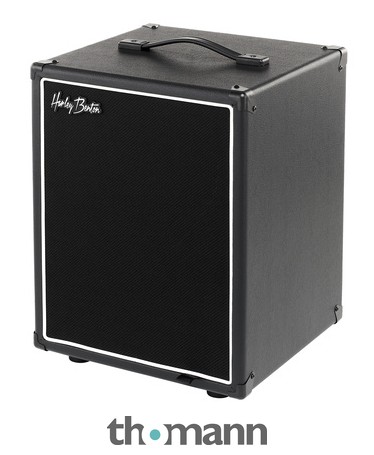
 www.thomann.de
My rumble 100's stock speaker lives in there. (changed the handle/feet to it's sides)Out of curiosity, I assume you used it as a bass guitar cab. What speaker did you put in it and did you measure it?
 Harley Benton GPA-100 to drive it. (from the r100's efx send mostly) That little thing is awesome.
You did notice the caveatal adverbs, right?Dunno. Changed the speaker in one of my r100s and there is a significant volume difference. Now I got two 100W combos, except one is louder.
We should all demand frequency response graphs like stereo speakers (used to?) come with.Thomann is moving in the right direction as they're quoting the frequency response and sensitivity for every speaker that they have specs for, making them more directly comparable, but when I last looked, a lot of cabs still had those details missing and some specs were misleading. I think they're constantly correcting those specs, and it would be great if all shops followed suit and if all manufacturers stopped clutching their pearls and listed those specs so we could actually compare them properly.
As it is, listing only power and impedance benefits only the manufacturers, definitely not the consumers.
YES! Like the good old Orions here.We should all demand frequency response graphs like stereo speakers (used to?) come with.
)
I use a 23” flat patch cord (EBS) to connect two R100s. When disconnected the patch cord is plugged into the #1 R100 FX out & in. Better than a sticky note!Hmm. If I had a second R100 in "Ivory", at least I'd know which was which w/o resorting to "Post-It" notes.
This, of course, assumes I could afford a second R100. Mufunzalo.