You probably mean the problem I had with my V4 and the 7581A’s redplating if standby was switched immediately?Another amp where this is not a good idea.

Enjoy the benefits of a premium membership!
Upgrade Account
-
TalkBass has been independent since 1998. Add your voice.
Create a free account to reply to discussions, view embedded media, and browse with fewer display ads.
Join free Log in
Want zero display ads or expanded classifieds tools? Compare plans.
You are using an out of date browser. It may not display this or other websites correctly.
You should upgrade or use an alternative browser.
You should upgrade or use an alternative browser.
Fender Super Twin Bass Head
- Thread starter johnk_10
- Start date
More options
Who Replied?
Hard to see but the Sylvania has a crack at the base, hence the white top. Fail number 1.There could also have been a small fracture around a pin or two or poor evacuation (soft vacuum) with result of heater burnout. Heaters are pretty stout.
Out of curiosity can you post photos of those two tubes?
This one looks fine but is definitely dead. I didn’t even bother to test it… Fail number 2.
BTW, the original 12AT7 suffered also from a bad manipulation (me) and completely separated from its base.
It’s the first time I have three tubes failing in such a short period (by my fault or defect confounded).
Last edited:

You definitely want to start an amp in standby. The small preamp tubes come up to temp fast, some flare when first power on and these only take a couple seconds or less but IIRC the specs are <10 seconds. The output tubes are a different story needing between 20-30 seconds before they are ready to operate the exception being the 6BQ5/EL84 <15 seconds. The old convention of cathode stripping on power (output) tubes from getting high voltage before the cathodes are warmed is a heated debate in some circles. I err on the side of having more stable high voltage with the tubes warmed up first.
Those pins look really black? Is that just lighting? If that is oxide coating it might be worth cleaning those pins and retrying. If there is not a solid ground (through that oxide) to pin 9 your heater on that tube will need 12.6 volts to operate and could barely "glow" with 6.3 volts. Just a thought. DeoxIt cuts through fairly well, a liquid jewelry cleaner or Tarnex then rinse and dry the tube well. The tube pins should be on the shiny side.
Those pins look really black? Is that just lighting? If that is oxide coating it might be worth cleaning those pins and retrying. If there is not a solid ground (through that oxide) to pin 9 your heater on that tube will need 12.6 volts to operate and could barely "glow" with 6.3 volts. Just a thought. DeoxIt cuts through fairly well, a liquid jewelry cleaner or Tarnex then rinse and dry the tube well. The tube pins should be on the shiny side.
Unfortunately, after a bit of Deoxit, the good looking 12AT7 didn’t came back to life as verified with my Precision 612 tube tester. Nothing on the meter and no filament glow at all. Tube gets a bit warm but that’s it, dead!You definitely want to start an amp in standby. The small preamp tubes come up to temp fast, some flare when first power on and these only take a couple seconds or less but IIRC the specs are <10 seconds. The output tubes are a different story needing between 20-30 seconds before they are ready to operate the exception being the 6BQ5/EL84 <15 seconds. The old convention of cathode stripping on power (output) tubes from getting high voltage before the cathodes are warmed is a heated debate in some circles. I err on the side of having more stable high voltage with the tubes warmed up first.
Those pins look really black? Is that just lighting? If that is oxide coating it might be worth cleaning those pins and retrying. If there is not a solid ground (through that oxide) to pin 9 your heater on that tube will need 12.6 volts to operate and could barely "glow" with 6.3 volts. Just a thought. DeoxIt cuts through fairly well, a liquid jewelry cleaner or Tarnex then rinse and dry the tube well. The tube pins should be on the shiny side.
Unfortunately, after a bit of Deoxit, the good looking 12AT7 didn’t came back to life as verified with my Precision 612 tube tester. Nothing on the meter and no filament glow at all. Tube gets a bit warm but that’s it, dead!
Keep in mind not all heaters are clearly visible, it depends on manufacturer. If the tube gets warm that can only happen by the tube's heater(s). The AT7 is the wrong tube for that position anyway. Higher in gain but tend to be grittier with less low end. Your tone section will sound better with the AU7 (the 12 in front is the heater voltage requirement in US typing in case you did not know it).
12AU7 I meant, sorry. Will retest as a 12AU7, maybe it’ll help!!Keep in mind not all heaters are clearly visible, it depends on manufacturer. If the tube gets warm that can only happen by the tube's heater(s). The AT7 is the wrong tube for that position anyway. Higher in gain but tend to be grittier with less low end. Your tone section will sound better with the AU7 (the 12 in front is the heater voltage requirement in US typing in case you did not know it).
***Edit: tested again, as a 12AU7 this time
 :
:- Precision 612: no meter movement, dead!
- Jackson 648: same, dead!
Shorts test on the Precision: nothing out of the ordinary unless I flip 4-5 and 9, obviously… so there is continuity in the filament, tube get really lukewarm but that’s it. Maybe the vacuum is lost even if the getter didn’t turned white, puzzled?
Last edited:
12AU7 I meant, sorry. Will retest as a 12AU7, maybe it’ll help!!
***Edit: tested again, as a 12AU7 this time
- Precision 612: no meter movement, dead!
- Jackson 648: same, dead!
Shorts test on the Precision: nothing out of the ordinary unless I flip 4-5 and 9, obviously… so there is continuity in the filament, tube get really lukewarm but that’s it. Maybe the vacuum is lost even if the getter didn’t turned white, puzzled?
Maybe I can help relieve your confusion. If the heaters can't get up to full "strength" (hot enough) the cathode that releases the "cloud" of electrons doesn't happen or insufficient amount to be of use. Like charges repel so the control grid uses a small negative voltage to gate the flow of electrons from the cathode to the high attraction of a positive charged plate (opposite charges attract). The "way" you get amplification is using a small voltage signal to cause an affect on a much larger positive voltage. It is the valve action of electron flow (control grid AC voltage) from the electron source (negative cathode) to the high positive voltage plate. This voltage change (or drop as +/- cancel each other) is registered usually on a "plate load" resistor after which the DC component is blocked by a "coupling" capacitor and the larger AC voltage is passed to the next stage. Hope this simplified triode operation helps.
A tube tester is a tool that is not much more than a guide. No tester is perfect and most are lucky to touch on "good" or acceptable as the only real test is in the circuits designed for them. I have three testers from a Hickok to a BK portable. Shorts test and gassy are solid indicators, I've had output tubes show very good on emissions with no shorts but light up like a Christmas tree on a Gm test (of course those tube fail in a spectacular way in circuit, bright blue cloud with a beautiful red plate color). You can perform a "life test" if you don't have that feature on your tester by dropping the heater voltage from, as an example, 6.3volts to 5volts. If the tube "emissions" are in the "good" range but drop in the "?" or "weak then the cathode may be indeed facing end of usefulness. That is all the "life test" is on testers with that momentary switch, a heater voltage drop.
Sorry for the ramble and I hope I didn't put you to sleep.

Last edited:

- Feb 16, 2008
- 21,240
- 23,636
- Disclosures
- John K Custom Basses
my Triplett 3444 tube tester works great for testing tubes and it's the best tube tester that i've ever owned.
i use a maximatcher for output tubes.
i use a maximatcher for output tubes.
Absolutely not, worth the read! Thanks @B-string ?Maybe I can help relieve your confusion. If the heaters can't get up to full "strength" (hot enough) the cathode that releases the "cloud" of electrons doesn't happen or insufficient amount to be of use. Like charges repel so the control grid uses a small negative voltage to gate the flow of electrons from the cathode to the high attraction of a positive charged plate (opposite charges attract). The "way" you get amplification is using a small voltage signal to cause an affect on a much larger positive voltage. It is the valve action of electron flow (control grid AC voltage) from the electron source (negative cathode) to the high positive voltage plate. This voltage change (or drop as +/- cancel each other) is registered usually on a "plate load" resistor after which the DC component is blocked by a "coupling" capacitor and the larger AC voltage is passed to the next stage. Hope this simplified triode operation helps.
A tube tester is a tool that is not much more than a guide. No tester is perfect and most are lucky to touch on "good" or acceptable as the only real test is in the circuits designed for them. I have three testers from a Hickok to a BK portable. Shorts test and gassy are solid indicators, I've had output tubes show very good on emissions with no shorts but light up like a Christmas tree on a Gm test (of course those tube fail in a spectacular way in circuit, bright blue cloud with a beautiful red plate color). You can perform a "life test" if you don't have that feature on your tester by dropping the heater voltage from, as an example, 6.3volts to 5volts. If the tube "emissions" are in the "good" range but drop in the "?" or "weak then the cathode may be indeed facing end of usefulness. That is all the "life test" is on testers with that momentary switch, a heater voltage drop.
Sorry for the ramble and I hope I didn't put you to sleep.

Took the Super Twin/Acoustic 106 out for a spin last night. I’ve been using an Earthquaker Cloven Hoof fuzz pedal with the “fuzz” turned all the way down for just a little grit.

I don't know how useful it would really be on a gig, but I'm having fun running mine (finally in a box!) through this oversized guitar cabinet. Puts out enough to make the walls in the house shake and I haven't heard the speakers start to fart out yet, so maybe for smaller gigs or if I had some real PA support it could be useful.
But most of my gigs are jazz stuff anyways, so this is likely to stay an at-home toy for the foreseeable future.
(Not pictured, just behind it—a regular super twin, still in combo format. I'll get to putting that chassis in a box eventually. Probably.)
But most of my gigs are jazz stuff anyways, so this is likely to stay an at-home toy for the foreseeable future.
(Not pictured, just behind it—a regular super twin, still in combo format. I'll get to putting that chassis in a box eventually. Probably.)
Attachments

Last edited:

Question-
I picked up another ST and I noticed that the 100hz knob had no change. I changed out the cap and still there wasn't any sound difference with the control. Should I assume that coil went bad?
I picked up another ST and I noticed that the 100hz knob had no change. I changed out the cap and still there wasn't any sound difference with the control. Should I assume that coil went bad?
Does this look right to add a bias supply pot for the ST?
Also, my version has a 1.5k resistor off pin 3 on V1B. Some versions have a 820 ohm. In the past I was suggested to use a 680 ohm. Has any one changed theirs ?
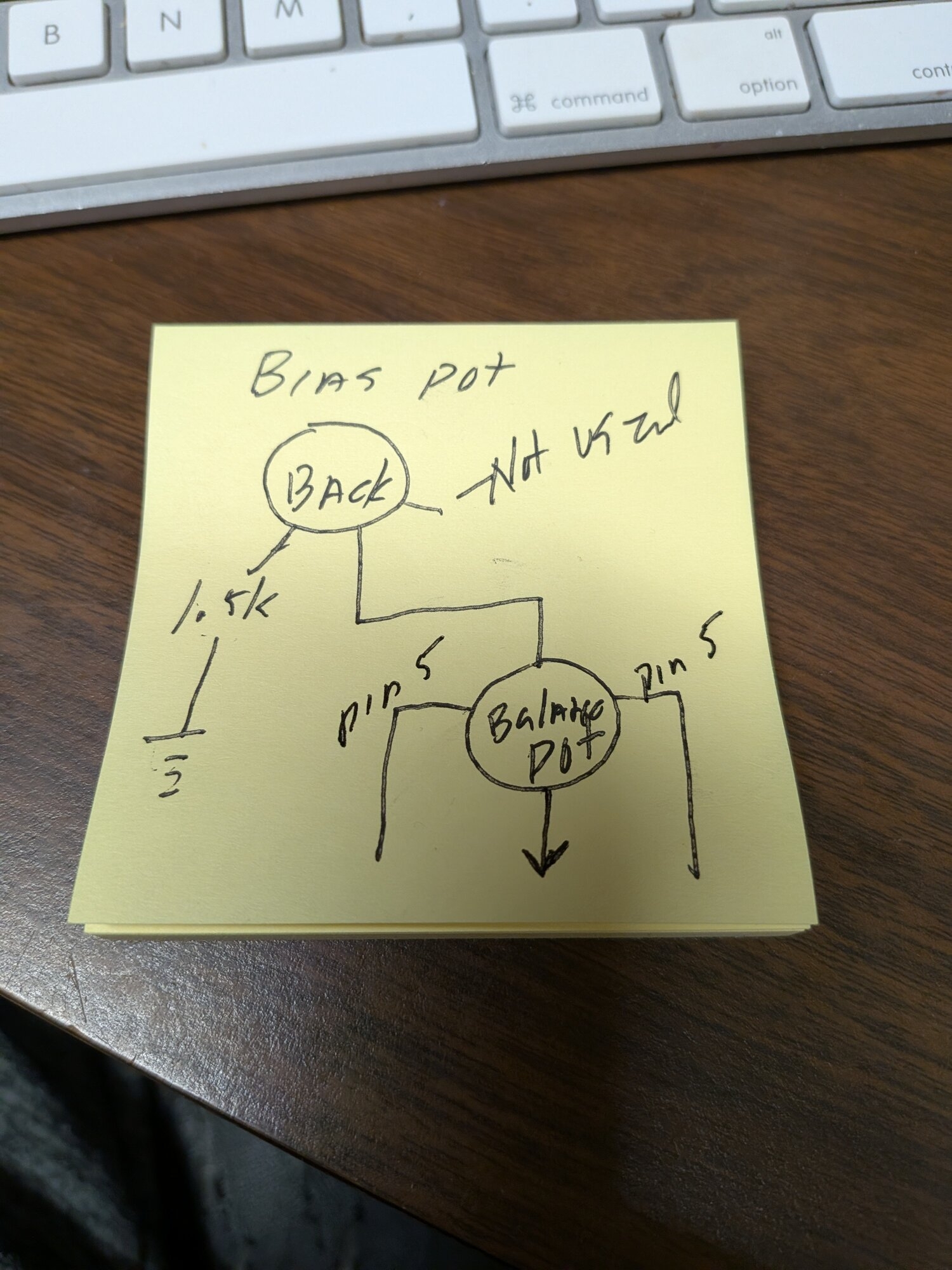
Also, my version has a 1.5k resistor off pin 3 on V1B. Some versions have a 820 ohm. In the past I was suggested to use a 680 ohm. Has any one changed theirs ?
Last edited:


