• TalkBass has been independent since 1998. Add your voice.
    Create a free account to reply to discussions, view embedded media, and browse with fewer display ads.
    Join freeLog in
    Want zero display ads or expanded classifieds tools? Compare plans.

Fender values in the future

When we take into account inflation and the declining value of the US dollar................the investment of an instrument will in many cases will equal what was originally paid for the bass.

A new Fender back in 1964 was about $270, and $270 back then is equal to about $2,700 today.

So, when we see a pre-CBS Fender for $15,000 today that would be about equal to $1,550 back in 1964.

Pretty much, as an instrument gains value, all in all, all it does is keep up with inflation.

Generally speaking!!!!!!!!!!!!!!!!!!!

Investment? There are better ways.
 
  • Like
Reactions: Plain Old Barry
Inflation on new instruments will likely also elevate used prices. Probably not lose your initial investment in 20 years but probably not make any profit.
They're way too hit and miss to count on as investments but like I said probably get out close to you paid in that time, just not worth as much due to inflation.
I kinda collect instruments also. I almost always buy American or high end imports. I play all of them and collect them for my enjoyment. When I'm gone my kids and grandkids can sell em, all profit for them.
The only one I saw go up alot was a Squier Vista series Super Sonic that I bought my daughter new in 99 for her 9th birthday. I got it at clearance for like 299 because they couldn't hardly give em away. She liked the sparkle blue, last time I heard they were north of 1000, but that's it. We do still have it and it's not for sale.
So ya never what's gonna go up, for me it was a "weird" Squier. Whooda thunk?
 
IMO your friend should buy Microsoft stock. Bass guitars are NOT the place to make money. It is impossible to predict market trends 10 to 20 years down the road. If someone told me 40 years ago that Antigua would be a desirable finish I would have died laughing. I still laugh at the prices asked for them. Point is that an eccentric feature may become valuable but it is valuable only because it is rare which is another way of saying it sucked in its day so nobody bought it. If he wants to take that risk he should buy a Meteora or other non-mainstream Fender and hope for the best.
 
  • Like
Reactions: mikewalker
Given the general trend of demographics heading towards fewer younger people picking up guitar and bass, and an oversupply of decent quality basses and guitars on the market, it seems unlikely that they will sustain value long-term, at least to the extent 60's and 70's era instruments did for Boomers. Who knows though, having played a bunch of Fender basses back in the 70's CBS era, and considering them kind of crappy compared to what came before them, I find myself perplexed that some 70's basses are now considered desirable "vintage" instruments that demand top dollar. The vintage market has always been more about psychology than reality anyway, so it's hard to predict what future generations will find valuable.
 
  • Like
Reactions: BobKos
An acquaintance just purchased an American Pro 2 Jazz. One of the reasons he purchased it he said an American Fender would be worth something 10 to 20 years down the road. I know there are tons of variables but I am also ignorant of these things. What do you all think?

I would imagine that a typical American Fender would retain more resale value than a typical Mexican Fender, so I reckon your friend is right in that sense.

I suspect that, like baseball cards and Star Wars figures and a bunch of other unexpected surprise vintage collectibles, Fenders today are so plentiful that they probably aren't going to go up in value like their 1960s counterparts ... but who knows? It's possible.
 
When we take into account inflation and the declining value of the US dollar................the investment of an instrument will in many cases will equal what was originally paid for the bass.

A new Fender back in 1964 was about $270, and $270 back then is equal to about $2,700 today.

So, when we see a pre-CBS Fender for $15,000 today that would be about equal to $1,550 back in 1964.

Pretty much, as an instrument gains value, all in all, all it does is keep up with inflation.

Generally speaking!!!!!!!!!!!!!!!!!!!

Investment? There are better ways.


Spot on! Here's a great tool to compare the past purchase price of an item compared to today:
Inflation Calculator | Find US Dollar's Value From 1913-2023
 
Can only echo the above... "anybody’s guess", "better ways", roulette ...

Who knows how long this electric stringed instrument "collectors market" will last or if electric stringed instruments will still play such an important role in music in 30 years time and if there will be an interest in and if such a high priced market for otherwise very standard used instruments will still exist.... It's partially fueled now by people who want a particular instrument they were not able to have in the past (or previously owned and want again) fair enough, but also a lot of it via people collecting for the purpose of banking on an investment.... the later a bubble which can quickly pop, the former something which the wheels of time will limit the market for.

If it is an especially historically important museum worthy instrument (e.g. a 1936 ES-150, a 1951 Precision, possibly even a somewhat less popular Gibson 1953 EB-1 etc), it will probably be worth something long term. Any thing else from the factory line, who knows. Synths, violas, kazoos, a vintage cell phone music composition app, didgeridoos or dulcimers may be the popular "in" instruments in 30-50 years time. With the current reduction in live music venues, who knows if amplified electric stringed instruments will persist long term as the main choice for "popular" music.

To avoid hurt feelings I'll use an E2 6 string guitar as an example. When the current collector's market considers an early 1960s, common, student grade, laminate (aka plywood) Gibson ES-125TCs as "collectable", you really do have to wonder.... (I do like, enjoy, play & have an ES-125TC - was my first electric guitar & picked one up cheap years ago for sentimental reasons mostly, but they really are not anything particularly "special" or to write home about. They are certainly not better than a Heritage 525 or possibly even a CN Loar 320T (have not tried one). When I see the current prices I can only shake my head... and these are comparatively inexpensive in the collector's universe).

I'd choose an instrument to play and enjoy, not as a "possible potential" investment.
 
Mmh, a custom shop guitar made by a legendary master builder might appreciate after the builder retires.

Of course, every manufacturer has eras that are considered more desirable whether it be because of rarity, or perceived quality/company founder involvement: Tobias-era MTD, pre-CBS Fender, pre-factory PRS etc. Not sure how contemporary Fender basses could achieve such a mythological status.
I never knew how 70s basses became that way, but they did. Never say never.
 
  • Like
Reactions: Windreaper
This is a tricky subject.

Let’s ask it a different way, keep up.

Would a Coca-Cola bottle made today be worth a lot of money in 50 years?

Would an Esso gas sign made today be collected and auctioned in 50 years?

Would a 2023 juke box be worth a fortune in 2070?

Probably not.
Why?
Answer to all 3 above is the generation who had a nostalgic bond with those items will have passed.
Pains you to read it more than it pains me to type it. But in 20 years nobody alive cares that Leo created the P and J and S and T because the generation that is bonded by the birth and impact of rock’n’roll will be gone.
Same reason you don’t spend your Saturdays hunting for old wagon wheels or Fiestaware. That was grandma’s thing.

Also, just as a numbers game, Fender just canceled over forecasted production orders for nearly 600,000 instruments. Divide that any way you want to guess MiA P basses. It’s still going to give you a hint because that was roughly 1/7 annual goal. They make so many and like it or not, they are commodities.

Worst of all, the competition like Yamaha, Ibanez to name a couple is growing rapidly too.

That’s not to suggest kids won’t care about guitars. Just that 20-30-50 years from now the kids that are in middle school TODAY don’t care AT ALL what bass James Jamerson played. And they don’t care what Eric Clapton played. Now stretch that loss of interest in player’s gear from 60 years ago out another 30-50 years.

DOES ANYONE HERE KNOW WILLIAM FODEN? Let alone what he played?
But bet your bee-hind they knew in 1910. And bet people in 1940 wanted what he used.
All incredibly valid points! From an investment standpoint, I don't think MIA Fenders are going to appreciate the way many here think they might. The only way that might change is if Fender puts out limited editions, limited / rare finishes, or abruptly discontinues the American Pro II line without replacing it.

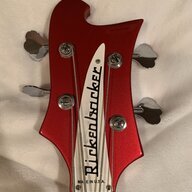
On another note, Rickenbacker is fantastic at putting out limited editions and rare finishes for their instruments, so there are plenty of Rics that are appreciating in value.
 
I want to think association with 70s disco and funk, they have their own appeal. Or maybe people are just being priced out of the 60s instruments and are moving on to the next best thing. Before we know it'll be the 80s stuff and we'll be dropping white pickups into our basses :rolleyes:.
The second theory is closest to the real scenario imho.
 
I want to think association with 70s disco and funk, they have their own appeal. Or maybe people are just being priced out of the 60s instruments and are moving on to the next best thing. Before we know it'll be the 80s stuff and we'll be dropping white pickups into our basses :rolleyes:.

Oh, yah, white pickups. That will put a close to the 60s and 70s, for sure :laugh::laugh::laugh:.
 
  • Like
Reactions: Windreaper
I think they will maintain value, but not gaining like the instruments of the 20th century. Not because these are particulary better, as said above, there's a lot of variables involved, affective memories, being linked with something particular or a particular era...
 

Latest posts