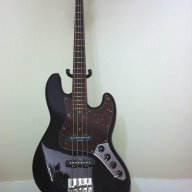
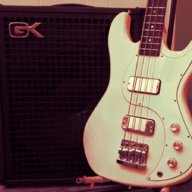
Disclosure: I own a Gibson SG bass (Miz Gibson) and an Epiphone Viola bass (Viola).
While I have not seen much discussion on this particular subject, one significant difference between Gibson and Fender instruments is the design of the headstock/neck.
The Fender headstock and neck are cut from one piece of wood, and are in straight alignment. The headstock portion is cut out to create the angle and downward force to keep the strings in place. For the E and A strings, the angle past the nut is sufficient to anchor the strings, but the for the D and G strings, Fender uses a string tree to "sharpen" the downward string angle.
The Gibson design also cuts out the headstock from one piece of wood, but to create the same downward force, Gibson cuts the angle into the wood itself. This is a big departure from the Fender design! The resulting change in grain direction weakens the neck/headstock as the grain direction changesask any luthier how many Gibson necks have suffered cracked necks near the headstock compared to Fender necks.
For an extreme example of the importance of grain orientation, cut out an ell shape from a short plank of wood. See how easy it is to snap the wood at the joint, where the grain makes its 90 degree bend. One way to make a stronger ell-shaped plank is with plywood, due to the alternating direction of the plies.
At the risk of upsetting Miz Gibson, I opt for the Fender neck/headstock design over the Gibson. The Fender has the obvious advantage of a quick unbolt and rebolt to change the neck, should it be necessary. The Fender truss rod is also easier to adjust than the Gibson.
We could talk forever about hard-to-quantify subjects like pickups, sound, playability, etc.
I prefer short scale basses, and Miz Gibson was too cheap to pass up! She plays nicely, and sounds marvelous. I will admit; however, that I have not had a chance to compare Miz Gibson against her Fender counterpart directly....
Bottom line? Inform yourself, try out both and play what you like.