• TalkBass has been independent since 1998. Add your voice.
    Create a free account to reply to discussions, view embedded media, and browse with fewer display ads.
    Join freeLog in
    Want zero display ads or expanded classifieds tools? Compare plans.

Double Bass Few q's on Pulcinella please...

Sep 24, 2011
1,335
318
For Pul 1 - what is a suggested fingering, currently doing 2, 2, Open, 1, 4? 1, 1, 3 or would it be better to go 1 (on A string) then F, G, A, Bb, C on D string, rest on G string?

For Pul 2, presumably open D an octave to be played?
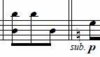
For Pul 3 - what does the bracket mean??

For Pul 4 - currently using 0, 1, 1 1 (as a bridge) then 3, given the speed are there other options?

Thanks all.
 

Attachments

  • pul1.JPG
    pul1.JPG
    4.1 KB · Views: 69
  • pul2.JPG
    pul2.JPG
    2.7 KB · Views: 68
  • pul3.JPG
    pul3.JPG
    2 KB · Views: 66
  • pul4.JPG
    pul4.JPG
    4.5 KB · Views: 67
Hi Andy. For Pul.1 stick to the easy 1st fingering, Pul.2 top D with 1st finger(setting thumb in base of neck guarantees intonation) and open D string, Pul.3 means Double Stop (play both notes simultaneously, open D and A on 1). Pul.4 gives 2 options, open D, 4 in 1st Posn, 1 - 1 at base of neck and extend (pivot) to 4. Or open D, Fsharp 4 on A string, then 1 - 1 - 4.

To me the music often is extroverted, uplifting, almost brassy or clanging in style. The bass part has to be played powerfully with very clean articulation. Bow lengths are often shorter with more punchy energetic clean note starts. This is why I would head for the simplest easiest fingerings.

Have fun. It's a great piece.
 
  • Like
Reactions: eerbrev
My current beast of a bass part is Mendelssohn's 5th (Reformation) Symphony. The most my LH has had to do for quite a while is to hold the paint pot while I finish my new kitchen. I am keenly aware of all the advice I so happily give out as I struggle to get my eyes, brain and fingers to work again together at blistering speeds. Every bit of advice I have ever given you, Andy, applies equally to me if I am to articulate the notes cleanly and powerfully in the fast runs and arpeggios. The bow must move sideways over every note so using the "comfort zone" of the hair length, particularly at the balance point for string crossings and arpeggios, is important.

With a copy of the bass part downloaded from IMSLP watch the Frankfurt Radio Orchestra's version on Youtube. Every member of the orchestra works hard with lots of energy in the results. The version by Claudio Abado conducting the LSO is overall 4 minutes faster!!

Cheers and keep safe. DP