
Speaking as a player rather than a builder -- multiscale requires you to develop muscle memory for a different scale length on every string, simultaneously. If this is your first fretless, take it easy on yourself.I think I forgot to say this in my original post but I would still have "fret" lines and markers on the neck as I have never played a fretless instrument other than messing around with my school's double bass and I don't believe I have my muscle memory developed enough

Enjoy the benefits of a premium membership!
Upgrade Account
-
TalkBass has been independent since 1998. Add your voice.
Create a free account to reply to discussions, view embedded media, and browse with fewer display ads.
Join free Log in
Want zero display ads or expanded classifieds tools? Compare plans.
You are using an out of date browser. It may not display this or other websites correctly.
You should upgrade or use an alternative browser.
You should upgrade or use an alternative browser.
More options
Who Replied?
Yeah I think you may be right, it's probably best if I keep it monoscale, thanksSpeaking as a player rather than a builder -- multiscale requires you to develop muscle memory for a different scale length on every string, simultaneously. If this is your first fretless, take it easy on yourself.

At least we can now point you in the right direction for assistance with supply and expertise. No point saying, "pop in to your nearest..." if you live out past the black stump!

Rural may not of been the best way to describe where I live that's my bad, without giving away exactly where I live it's a small town not too far from Lismore or Byron in NSW. My DT teacher may not have soldering/wiring expertise but there's other teachers at the school that may have some more experience
I’m 3 hours from you, at most. I have good friends in Lismore I visit a few times a years.
While there are people here with mountains more experience than me (I only have around 10 builds under my belt), I’d be more than happy to provide whatever assistance I can. I have an added benefit of coming from a family of teachers, having a wife that is a teacher, and most of my friends being teachers (including the local industrial arts teacher).
A kid I know (friend of a friend) got a band 6 with a guitar last year. It was a very plain Les Paul clone. The only fancy thing was an epoxy inlay of his initials on the headstock. The finish and general woodworking were very high quality, however.
As you would probably be aware, hardware is hellishly expensive in Australia. I buy a lot of stuff from AliExpress as a result. There’s a lot of junk on there, but also some higher quality stuff of Korean origin that is superb value for money.

I have a senior student building a Strat copy. He bought an Allparts neck and is making the body from wood and epoxy resin.
When you count getting materials and tools out at the beginning of class, plus putting them away and cleaning up at the end, the amount of productive work you can complete each day can be depressingly little. I will second all of the advice about planning, building mock-ups, and having your actual parts on hand. Everything you can do outside of class helps to maximize your progress. Teach yourself how to solder at home. Get a beater instrument, take all of the electronics out and put them back again. Build an effects pedal or headphone amp. Anything that gives you some experience soldering wires and components so when it's game time you are good-to-go. Do you already have woodworking experience, or will you be learning every skill as you go?
You'll be doing plenty of build documentation anyway - definitely post your progress in a build thread here!
I have given this same advice. I believe it is better to have something simple that is done really, really well, than something with a lot of trendy bits that appears to have been rushed to get finished in time. If you complete the build early, then you have plenty of time to do a quality set-up. If one of your judges turns out to be a musician, then they will give lower marks to an instrument that does not play well regardless of how nice it looks.Having done this during my senior year as well, I would suggest maybe not trying to go all out with LED's etc. Like you said, you have a restricted amount of time in the workshop. It would be better to focus on building a great bass and getting it done than to try to add in frills and not have time to complete it.
When you count getting materials and tools out at the beginning of class, plus putting them away and cleaning up at the end, the amount of productive work you can complete each day can be depressingly little. I will second all of the advice about planning, building mock-ups, and having your actual parts on hand. Everything you can do outside of class helps to maximize your progress. Teach yourself how to solder at home. Get a beater instrument, take all of the electronics out and put them back again. Build an effects pedal or headphone amp. Anything that gives you some experience soldering wires and components so when it's game time you are good-to-go. Do you already have woodworking experience, or will you be learning every skill as you go?
You'll be doing plenty of build documentation anyway - definitely post your progress in a build thread here!

One thing that you might look into is seeing if you can get local(ish) woodworkers or guitar makers to help you by donating or discounting some nice wood pieces. I know from being in Australia several times that there are some really nice hardwoods to be found. Maybe @Alex Xander x can help with that??? As to his comments about hardware availability and cost, maybe we Yanks can help with that. Easy enough to get the stuff here and shipping isn’t too costly.
Full size drawing with a center line down the middle. Use commercially available hardware and pickups and Keep It Simple. Even with a fretless the multi scale thing is going to be harder to pull off. Nothing wrong in aping a commercially made instrument if functionality is desired. Works for Sadowsky etc.
It's definitely reassuring to hear that people can get band 6's for guitars, and I'll check AliExpress to see if I can find what I need, thanksI’m 3 hours from you, at most. I have good friends in Lismore I visit a few times a years.
While there are people here with mountains more experience than me (I only have around 10 builds under my belt), I’d be more than happy to provide whatever assistance I can. I have an added benefit of coming from a family of teachers, having a wife that is a teacher, and most of my friends being teachers (including the local industrial arts teacher).
A kid I know (friend of a friend) got a band 6 with a guitar last year. It was a very plain Les Paul clone. The only fancy thing was an epoxy inlay of his initials on the headstock. The finish and general woodworking were very high quality, however.
As you would probably be aware, hardware is hellishly expensive in Australia. I buy a lot of stuff from AliExpress as a result. There’s a lot of junk on there, but also some higher quality stuff of Korean origin that is superb value for money.
You might consider building the bridge instead of buying one.
A bass bridge does not have to be elaborate. Accurately cut and drilled, and finely polished, and it would demonstrate your metalworking skills in addition to woodworking.
There are multiple examples in this forum.
Machine Shop Practice: Making Custom Metal Hardware For Basses
Handmade bass bridges/tailpieces, info and build thread
Metalwork: Building A Fender-Style Bridge From Scratch
A bass bridge does not have to be elaborate. Accurately cut and drilled, and finely polished, and it would demonstrate your metalworking skills in addition to woodworking.
There are multiple examples in this forum.
Machine Shop Practice: Making Custom Metal Hardware For Basses
Handmade bass bridges/tailpieces, info and build thread
Metalwork: Building A Fender-Style Bridge From Scratch
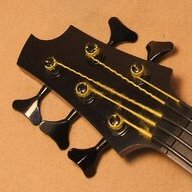
I'd put a lot of thought into the headstock design. The drawing would actually start at the nut. Then consider what factors matter to you. The tuners have to be at a distance to allow for the taper of the strings - so not too close. Next I'd decide on what I want the string path to look like. I'd prefer to not create too much break angle at the nut. With consideration that the tuners have to have adequate edge distance (3/4" ??) to structurally support the design. So that kinda determines where in space the tuners are. Now to draw in a outter contour for the head. I'm thinking shorter is better. I'm always worried about neck dive and any little thing I can do to prevent it is a consideration. Then what kind and where to put the string hold-down tree/buttons. Actually I hate buttons, I'd be looking for something else for that task.
Careful with symmetry and asymmetry both of which factor into a body shape. Smooth transitions between curves can also affect the overall visual aesthetic. Some general guidelines are body width 12-13” and width across upper body less the lower body. Most will specify upper strap location at the 12th fret but I have made it work at the 14th without issue. As has been mentioned do a full scale drawing marking the hard points and then work your design in.

Don't fear, OP, plenty seem willing and happy to help.Come on, now.....This is your project assignment. You're supposed to demonstrate the clever ideas, good engineering, and decent craftsmanship. We're not going to do that for you!

That's what a scarf joint and adequate break angle over the nut resulting from it are for. If you can step away from Fender-ish. Or you can drop the Fender-ish flat HS face down further with adequate planning of the whole neck. Since Fender-ish does not seem to be what Fish63 is going for, likely not a problem for them.Actually I hate buttons, I'd be looking for something else for that task.
You might consider building the bridge instead of buying one.
A bass bridge does not have to be elaborate. Accurately cut and drilled, and finely polished, and it would demonstrate your metalworking skills in addition to woodworking.
There are multiple examples in this forum.
Machine Shop Practice: Making Custom Metal Hardware For Basses
Handmade bass bridges/tailpieces, info and build thread
Metalwork: Building A Fender-Style Bridge From Scratch
Unfortunately neither I nor my school have the resources for metal work but this was an interesting idea, thanks
You're definitely right, I wasn't super set on this headstock shape but I think I want something similar, as for neck dive while I would very much like to avoid it, both my bass and my guitar are epiphone SG's so it's a pretty familiar feeling to me lol, thanks for the headstock adviceI'd put a lot of thought into the headstock design. The drawing would actually start at the nut. Then consider what factors matter to you. The tuners have to be at a distance to allow for the taper of the strings - so not too close. Next I'd decide on what I want the string path to look like. I'd prefer to not create too much break angle at the nut. With consideration that the tuners have to have adequate edge distance (3/4" ??) to structurally support the design. So that kinda determines where in space the tuners are. Now to draw in a outter contour for the head. I'm thinking shorter is better. I'm always worried about neck dive and any little thing I can do to prevent it is a consideration. Then what kind and where to put the string hold-down tree/buttons. Actually I hate buttons, I'd be looking for something else for that task.
Careful with symmetry and asymmetry both of which factor into a body shape. Smooth transitions between curves can also affect the overall visual aesthetic. Some general guidelines are body width 12-13” and width across upper body less the lower body. Most will specify upper strap location at the 12th fret but I have made it work at the 14th without issue. As has been mentioned do a full scale drawing marking the hard points and then work your design in.
Thank you for the size recommendations, I was planning to base the size vaguely off the bass I currently play but I will keep this in mind, and I'll be sure to make a detailed and scaled drawing/model, thanks
Hey everybody, thanks for all your help in this thread! I've posted a progress update, and a new set of questions. Come check it out if you feel inclined to help out, or if you're just curious about my project and wanna keep up to date with it, can't wait to post the final build!


