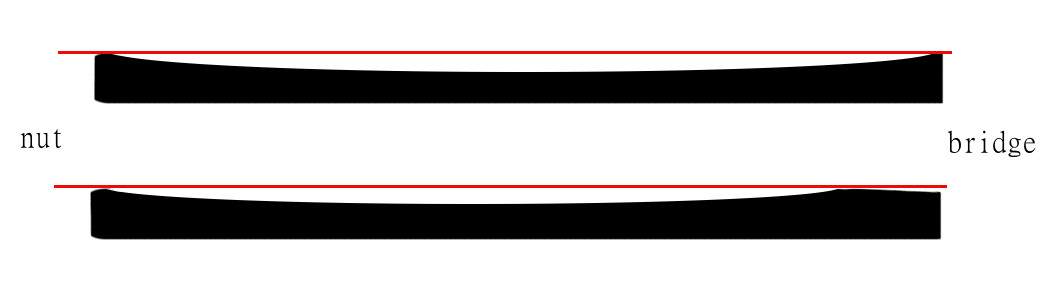
I recently noticed that scoop on the fingerboards of two basses I use have an interesting difference. On the first the scoop seems to extend from the nut to the end of the fingerboard, while on the second, the scoop seems to stop a little before the end. When checking with a 24" straightedge, this makes the second fingerboard appear to have a high point. It varies from about 1 to 2.5 inches from the end. If I press a string down at the end of the fingerboard with my right hand and pluck above there with my left, I get a buzzing/rattling sound on the second bass, but a clear tone on the first, as might be expected.
I have noticed that I have difficulty playing hard pizzicato on the A string of the second bass without getting a rattle or clacking sound (This string has the furthest back "high point" at around 2.5 inches), whereas on the first bass I can lower the strings way down and pull as hard as I want with no buzz. I pluck near the end of the board.
So, questions:
1. Are both of these camber shapes normal?
2. Could the shape be causing the rattling problem on the A string?
Here's a crude illustration of the relative shapes of the fingerboards. Both boards are the same length, going to the D harmonic on the G string.
I have noticed that I have difficulty playing hard pizzicato on the A string of the second bass without getting a rattle or clacking sound (This string has the furthest back "high point" at around 2.5 inches), whereas on the first bass I can lower the strings way down and pull as hard as I want with no buzz. I pluck near the end of the board.
So, questions:
1. Are both of these camber shapes normal?
2. Could the shape be causing the rattling problem on the A string?
Here's a crude illustration of the relative shapes of the fingerboards. Both boards are the same length, going to the D harmonic on the G string.