
Enjoy the benefits of a premium membership!
Upgrade Account
-
TalkBass has been independent since 1998. Add your voice.
Create a free account to reply to discussions, view embedded media, and browse with fewer display ads.
Join free Log in
Want zero display ads or expanded classifieds tools? Compare plans.
You are using an out of date browser. It may not display this or other websites correctly.
You should upgrade or use an alternative browser.
You should upgrade or use an alternative browser.
First Build - "Lucifer"
- Thread starter TerribleTim68
- Start date
More options
Who Replied?

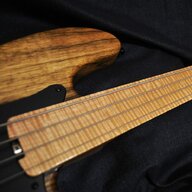
I also made a long beam out of tube steel with one side sanded "flat". Took a long time and lots of checking with my machinist's straight edge, but it's about as close as I can get it without actually having it machined. I just don't know if that's what I want to use or not.
I've got a few things I can do at this point. A proper fret job is first on the list. Then I still need to cut a nut, which means mounting tuners and bridges. The main issue there is that I don't have strings and Dingwall is out of stock on the long scale 5-string sets and hasn't answered when they would have them back in stock. Ideally I'd like to have the actual strings in hand to do all that, but I see guys mount bridges using string, so I guess there's that. There's always more sanding to do too, but I hate to get too far down that road without having everything else done for fear of scratching it along the way.
I would use your long beam for this. If your machinist's straight edge says it's flat it will be good for doing frets. Keep in mind you can go as slow as you need to and remove as little material as you want so there is really no risk in trying. Check along the string paths with your machinist's edge along the way to see how you are progressing.
Regarding strings, for my multiscale build I picked up some DR Hi-Beams LMR5-130 X-Long. I tend to like DRs, and they might be more readily available than the Dingwalls.
100% just mask off the fretboard when you're doing the frets. My early days of fretwork featured way too many hours spent fixing little nicks in the fretboard finish, or trying to find a way of sucking the tiny bits of metal dust out of the fretboard pores, or dealing with polish stains on the fretboard, and so on. The little fretboard protectors are nice when you're working on a single fret on a finished instrument, but when you're doing the whole job just mask it.
I first put a strip of blue tape down each side of the neck, aligned right at the edge of the fretboard. Then I put short strips across the face of the fretboard between the frets so they overlap onto the long side strips. This way, when the work is done, you can just grab the long side strips and pull them and the whole mess comes off at once, which saves from the tedious work of pulling off a lot of short strips of tape one by one.
I first put a strip of blue tape down each side of the neck, aligned right at the edge of the fretboard. Then I put short strips across the face of the fretboard between the frets so they overlap onto the long side strips. This way, when the work is done, you can just grab the long side strips and pull them and the whole mess comes off at once, which saves from the tedious work of pulling off a lot of short strips of tape one by one.
What grit sandpaper do you recommend? The leveling beam that my daughter bought me for Christmas has some sort of grit adhered to each side already.I would use your long beam for this. If your machinist's straight edge says it's flat it will be good for doing frets. Keep in mind you can go as slow as you need to and remove as little material as you want so there is really no risk in trying. Check along the string paths with your machinist's edge along the way to see how you are progressing....
I do like DRs, I run the neons on a couple of my swirl painted basses and the black beauties on my ABG. I was just mostly worried about proper length and since I built it based off a Dingwall Z I figured that was the safe method. But yeah, I'd love to have something I could easily grab from the Amazonians. I also see that the Dunlop long scales are available through Dingwall, so I could just look those up on the Amazonians too. It looks like Dingwall really likes nickel coated or nickel wound of some sort. Probably part of that "Dingwall sound"....Regarding strings, for my multiscale build I picked up some DR Hi-Beams LMR5-130 X-Long. I tend to like DRs, and they might be more readily available than the Dingwalls.
100% just mask off the fretboard when you're doing the frets. My early days of fretwork featured way too many hours spent fixing little nicks in the fretboard finish, or trying to find a way of sucking the tiny bits of metal dust out of the fretboard pores, or dealing with polish stains on the fretboard, and so on. The little fretboard protectors are nice when you're working on a single fret on a finished instrument, but when you're doing the whole job just mask it.
I first put a strip of blue tape down each side of the neck, aligned right at the edge of the fretboard. Then I put short strips across the face of the fretboard between the frets so they overlap onto the long side strips. This way, when the work is done, you can just grab the long side strips and pull them and the whole mess comes off at once, which saves from the tedious work of pulling off a lot of short strips of tape one by one.

What grit sandpaper do you recommend? The leveling beam that my daughter bought me for Christmas has some sort of grit adhered to each side already.
I do like DRs, I run the neons on a couple of my swirl painted basses and the black beauties on my ABG. I was just mostly worried about proper length and since I built it based off a Dingwall Z I figured that was the safe method. But yeah, I'd love to have something I could easily grab from the Amazonians. I also see that the Dunlop long scales are available through Dingwall, so I could just look those up on the Amazonians too. It looks like Dingwall really likes nickel coated or nickel wound of some sort. Probably part of that "Dingwall sound".
I used 80 grit on the last job I did, and that worked fine. It does leave some significant scratches so you may need to go over it with something finer after you get it level. 120 or 150 would probably be better.
Regarding strings, long scale are what go on typical 34" scale basses so I am surprised Dingwall says the Dunlops will work. Maybe they sell a special extra long version or something.
The DR X-long are for scales up to 40.5" which is actually an inch or two longer than the Dingwalls. Also, I don't know your gauge preference but I should also point out that DR also makes a LMR5-45 which is slightly lighter top/bottom version.
Oh, and Dingwall sells (or used to sell) three versions: nickle, nickle plated steel and stainless steel.
This link is useful to compare string lengths:
[Invalid or Expired Link Removed]
Maybe I'll go 150 just so it goes slower.I used 80 grit on the last job I did, and that worked fine. It does leave some significant scratches so you may need to go over it with something finer after you get it level. 120 or 150 would probably be better...
The Dunlops are shown with a part number of "DBSBFF45125", which by my understanding of decoding part numbers would be "Super Bright, Fan Fret, 45 to 125 gauge". So I'm guessing it may be a custom set Dingwall has made specifically for them since I can't find that part number anywhere else but the Dingwall site....Regarding strings, long scale are what go on typical 34" scale basses so I am surprised Dingwall says the Dunlops will work. Maybe they sell a special extra long version or something.
The DR X-long are for scales up to 40.5" which is actually an inch or two longer than the Dingwalls. Also, I don't know your gauge preference but I should also point out that DR also makes a LMR5-45 which is slightly lighter top/bottom version.
Oh, and Dingwall sells (or used to sell) three versions: nickle, nickle plated steel and stainless steel.
This link is useful to compare string lengths:
[Invalid or Expired Link Removed]
I did find the DR LMR5-45 set on the Amazonians, and honestly I don't know what gauge I prefer. I've never owned a 5-er, thus my reason for building this one, and I've always just used standard gauge strings, 45 to 100, on my 4 strings. So I would probably feel at home on a 45 to 125 set.


I suspect with this wenge neck and the Darkglass Tone Capsule, it's probably gonna sound pretty "bright", so the 125 may be too bright for the bottom end, I really don't know.
I've never owned a 5-er, thus my reason for building this one, and I've always just used standard gauge strings, 45 to 100, on my 4 strings. So I would probably feel at home on a 45 to 125 set.
I suspect with this wenge neck and the Darkglass Tone Capsule, it's probably gonna sound pretty "bright", so the 125 may be too bright for the bottom end, I really don't know.
Actually, it's probably the other way around. The 130 set will have higher tension on the B string so probably brighter. But really, it's more about feel, and even then it is subtle. I am sure you would be fine with either.
My experience with 5 and 6 string basses is more or less that the B string is a crapshoot. I think it's just so close to the limits of what works that the margin between a good string and one you hate is small.
On a 4 string bass, I can pick up any of half a dozen brands/styles of string that I've used before and confidently guess what they'll sound and feel like before putting them on a new bass. They're predictable.
But on basses with a low B, in my experience, that all goes out the window, and it becomes much more about finding the specific right low B for a specific bass, through trial and error. Neither of the two low-b-equipped basses I have right now ended up with the low b string I THOUGHT I'd like! And the string that sounds and feels good on one of them isn't good on the other.
So I guess what I'm saying is, don't get too hung up on trying to figure it out ahead of time, just get a string on there and see how you feel, then you can swap it later.
...but maybe I'm just bad at picking low b strings!
On a 4 string bass, I can pick up any of half a dozen brands/styles of string that I've used before and confidently guess what they'll sound and feel like before putting them on a new bass. They're predictable.
But on basses with a low B, in my experience, that all goes out the window, and it becomes much more about finding the specific right low B for a specific bass, through trial and error. Neither of the two low-b-equipped basses I have right now ended up with the low b string I THOUGHT I'd like! And the string that sounds and feels good on one of them isn't good on the other.
So I guess what I'm saying is, don't get too hung up on trying to figure it out ahead of time, just get a string on there and see how you feel, then you can swap it later.
...but maybe I'm just bad at picking low b strings!
Sounds like the 125 B string would be a good place to start, because at least then my nut slot would be the smallest.

Rôckhewer
Commercial User
- Feb 28, 2015
- 2,922
- 9,028
- Disclosures
- Owner/Builder- RockHewer Custom Guitars LLC
I use an OLD 1" x 4" x 48" square aluminoom tube that was part of my kit as a tile setter... (past life)Took a long time and lots of checking with my machinist's straight edge, but it's about as close as I can get it without actually having it machined. I just don't know if that's what I want to use or not.
It's function was a mortar screed.
I "machined" the edges on a huge granite machinist table with sandpaper stuck to it.
It's still straight after 5 years into It's new life.
It cost way less and is way longer than any "leveling beam " out there... I love it.
Rôckhewer
Commercial User
- Feb 28, 2015
- 2,922
- 9,028
- Disclosures
- Owner/Builder- RockHewer Custom Guitars LLC
Depending on the string... and the scale... and how much extra string length you lose "out the back "... like on a string-through body?.....Sounds like the 125 B string would be a good place to start, because at least then my nut slot would be the smallest.
...If your B string is tapered ... you could run into a situation where the nut slot for the B doesn't want to be a full .125" wide.
This happened to me... I consider it a mistake... or a miscalculation. Because different string manufacturers do their tapering different vs overall length.
The bottom arrow is where the string is at full thickness... about 3/8" into the first fret.
So the nut was cut at the first taper's thickness.
(Albeit sloppily... don't look too close)

Super sketchy situation.

Yeah, this is kind of why I wanted to have the string set in hand before I cut the nut.

https://www.paysonbass.com/store/p6/Payson_Fanned_Stainless_Steel_Bass_Strings.htmlI do have a fretboard protector, but I'm not sure if I'm gonna use it. I'll probably tape off the board, just to be safe. I also made a long beam out of tube steel with one side sanded "flat". Took a long time and lots of checking with my machinist's straight edge, but it's about as close as I can get it without actually having it machined. I just don't know if that's what I want to use or not.
I'm still pondering this whole procedure and sort of waiting until I can really get lost in it before I start. The last thing I want to do is get half way through it and be pulled away, then come back and not be in the same frame of mind. I'll probably wait until the weekend when work isn't bothering me, then I can "go at it" for several hours without interruption.
I've got a few things I can do at this point. A proper fret job is first on the list. Then I still need to cut a nut, which means mounting tuners and bridges. The main issue there is that I don't have strings and Dingwall is out of stock on the long scale 5-string sets and hasn't answered when they would have them back in stock. Ideally I'd like to have the actual strings in hand to do all that, but I see guys mount bridges using string, so I guess there's that. There's always more sanding to do too, but I hate to get too far down that road without having everything else done for fear of scratching it along the way.
That's an interesting choice.

I think that Payson makes the strings for Dingwall.That's an interesting choice.
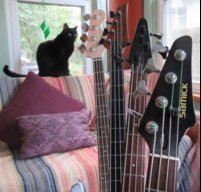
As you probably know, Stringjoy sells single strings, and I love how my Stringjoy balanced set sounds and feels on my 35" 5 string ESP. You may like that body shape...Sounds like the 125 B string would be a good place to start, because at least then my nut slot would be the smallest.

I DO like that body shape!!!As you probably know, Stringjoy sells single strings, and I love how my Stringjoy balanced set sounds and feels on my 35" 5 string ESP. You may like that body shape...
View attachment 4127068


We are men of discernment and taste.

And mullets. Mullets are important.We are men of discernment and taste.


