• TalkBass has been independent since 1998. Add your voice.
    Create a free account to reply to discussions, view embedded media, and browse with fewer display ads.
    Join freeLog in
    Want zero display ads or expanded classifieds tools? Compare plans.

First Build - "Lucifer"

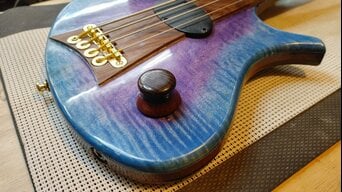
I did the filing thing on a bass recently and was able to drop it 2mm by filing a little off the bottoms of the saddles, the bottoms of the saddle string-inserts, and also deepening the string slots. I really didn't want the aesthetic change of dropping the whole bridge and didn't want to sand an angle into the neck heel as the fretboard was already close to the body top. :)
 
Oh, for those interested, those are the standard Dingwall long-scale 5-string stainless steel strings. Gauges shown on their website. I really wasn't sure what I wanted as far as gauges, so I just went kind of typical here. I doubt I'll be drop-tuning it so a .127" B should be just fine. Stainless because I wanted that Dingwall "clanky" mid (not sure how else to describe it), I like that tone. I think with these strings and the Darkglass TC it should capture that tone pretty well. :cool:

I've reached a point now where I can hear it, and I keep going "Man I wanna hear it through an amp!" :woot:
Hopefully it provides the push to get this thing done, but knowing I need to re-carve the neck has me reeling a bit. :eek:
 
Last edited:
I measure a lot of things, but a neck carve isn’t one of them. Well, that’s not strictly true - I shoot for a thickness just under an inch at the first and twelfth feet. But then I just wing it by feel.
Yeah, I mean the thing I wanna measure is truss rod depth. The last thing I want is to bust through at this point. :eek:

Also, "twelfth feet"?!?!?! What scale length are you using man?!?!?! :roflmao: :laugh: :roflmao:
 
Yeah, I mean the thing I wanna measure is truss rod depth. The last thing I want is to bust through at this point. :eek:

Yep. The LMII rods I use are 3/8” deep. Add 1/4” for the fretboard, and that still leaves plenty of meat for neck carving. Especially when you realize that the ends of the rod - which should be supported by a neck heel and a volute - are the only parts pushing towards the back of the neck, with most of the rod - the center, where the carve is - pushing up against the fretboard.
Also, "twelfth feet"?!?!?! What scale length are you using man?!?!?! :roflmao: :laugh: :roflmao:

Ugh!! Stupid phone…..
 
For the single-action rods I use, since they never push against the back of neck in the carved area, I feel that 1/16” is plenty.

However, I discovered that carving away the shoulders goes a long way towards making a neck more comfortable. That can give the tactical illusion of a slimmer neck, even if the very center is still thick.
 
So I just looked at the Ibanez SR series website, they list neck dimensions there and I love those necks! They show the SR neck as 19.5mm at 1st fret and 23mm at 24th. If my online converter is accurate, 19.5 mm is pretty much 3/4". It says .767", so a hair over 3/4".

That's almost certainly the total dimension, including the fretboard, right? So, probably a 1/4" fretboard and a neck that's barely over 1/2" thick. How thick are you at now?

In terms of just the neck (no fretboard), I generally aim for about 5/8" thick at the nut for the rough blank and probably end up somewhere around 1/16" or 3/32" thinner than that for the final neck.
 
I like super thin necks, so I'm usually around 18mm thick at the first fret and go back to about 25mm thick at the heel - that's basically 1" thick at the heel like Fender specs. I have two cardstock 'gauges' that I make for necks whose shape I like, one fits over the first fret area and the other is the 14th fret, and I remove everything between them.

I also totally agree that the shoulders of the back of neck profile contribute a LOT to the feel of the neck. I've done a few with a hard vee shape like Rick Toone has somehow patented (seriously? a neck shape was given a US patent? :rolleyes:) and they actually feel quite comfortable in the hand. When I carve a neck, I actually run the back of it in a router sled and firmly slab in the taper from heel to 1st fret, and then I carve. When I carve it, I don't touch the very centre of the neck except for the final sanding, and that way I can ensure it's the right thickness throughout the process. :thumbsup:
 
That's almost certainly the total dimension, including the fretboard, right? So, probably a 1/4" fretboard and a neck that's barely over 1/2" thick. How thick are you at now?

In terms of just the neck (no fretboard), I generally aim for about 5/8" thick at the nut for the rough blank and probably end up somewhere around 1/16" or 3/32" thinner than that for the final neck.
Honestly, I’m not sure. And I’m struggling to understand a solid way to measure it now. Because the fretboard face is radiused and so is the neck. So how would you measure that accurately?
 
That's looking great!

As @Beej pointed out, you might be able to file the saddles. I think on my bridge I will file down the string slots in the top of the saddles but you might be able to do either/both. And you probably still need to sink the bridges.

I am also planning an extra thick fretboard to get the strings high enough to allow for good action. It will probably end up about 9 mm (3/8") thick!
Be certain that the nut is cut low enough , and the neck is straight before you deem the action too high @TerribleTim68