The strings are going to go through the body? Otherwise I'm not sure if the back of that new bridge would be able to hold all the tension of those 5 strings.

Enjoy the benefits of a premium membership!
Upgrade Account
-
TalkBass has been independent since 1998. Add your voice.
Create a free account to reply to discussions, view embedded media, and browse with fewer display ads.
Join free Log in
Want zero display ads or expanded classifieds tools? Compare plans.
You are using an out of date browser. It may not display this or other websites correctly.
You should upgrade or use an alternative browser.
You should upgrade or use an alternative browser.
first build singlecut
- Thread starter stringplayer
- Start date
More options
Who Replied?


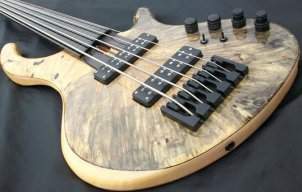

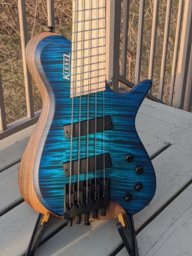
thats comming along very nicley, i was wondering what you used to make the contour where the neck attaches to the top part of the single cut sides horn?
thanks
thanks

Taylor Livingston
Commercial User
I'm intrigued by your 34.7" scale. What's your motivation for doing that? I converted it into centimeters and it doesn't seem to be a more even number in metric, so... just curious. I see people doing 34.5 and to me even that is splitting hairs. I really don't even notice the difference between my 32" bass and 34"s I've had. The jump to 42" is noticeable, though. 
I really don't even notice the difference between my 32" bass and 34"s I've had.
I notice a huge difference between 32, 34, 35 and 36 inches.
Taylor Livingston
Commercial User
Well, I certainly won't argue that some people seem to hear and feel a difference.
I don't, partially because my bass involves several other things that are way more distracting - 24 frets per octave and 8 strings chief among them. But those things aside, I don't feel any playability differences between 32" and 34" - 32" was a matter of convenience because it allows me to use guitar strings for the highest four strings. Obviously the tension is different with the same strings and same tuning, but slightly heavier strings or a slightly higher tuning (or both) make this moot. For me.
My point is this: I won't deny there's a difference between 34 and 35 for many. But splitting the difference to 34.5 seems rather trivial, and further splitting the difference between 34.5 and 35 to arrive at 34.7? To me, it sounds like when people laminate like a 1/4" layer of wenge between a bubinga top and an ovangkol back, so they can have X attribute of one wood, plus Y attribute of another, and temper that with Z attribute of the third. (Warwick, I'm looking at you.)
But anyway, I was just curious what his thoughts were that led him to make that choice.
I don't, partially because my bass involves several other things that are way more distracting - 24 frets per octave and 8 strings chief among them. But those things aside, I don't feel any playability differences between 32" and 34" - 32" was a matter of convenience because it allows me to use guitar strings for the highest four strings. Obviously the tension is different with the same strings and same tuning, but slightly heavier strings or a slightly higher tuning (or both) make this moot. For me.
My point is this: I won't deny there's a difference between 34 and 35 for many. But splitting the difference to 34.5 seems rather trivial, and further splitting the difference between 34.5 and 35 to arrive at 34.7? To me, it sounds like when people laminate like a 1/4" layer of wenge between a bubinga top and an ovangkol back, so they can have X attribute of one wood, plus Y attribute of another, and temper that with Z attribute of the third. (Warwick, I'm looking at you.)
But anyway, I was just curious what his thoughts were that led him to make that choice.


