• TalkBass has been independent since 1998. Add your voice.
    Create a free account to reply to discussions, view embedded media, and browse with fewer display ads.
    Join freeLog in
    Want zero display ads or expanded classifieds tools? Compare plans.

First or third fret.

You don't really need a visual hint to find the first fret.

3 5 7 9 12 and then repeat the cycle.

If you put one at the first fret, then that means you need one on the 13th fret, which would look odd right next to the 12th.
Heehee! Great answer and it should have ended the thread :D

However, some makers just like marking the first fret. Stylistic choice.
 
  • Like
Reactions: g-dude
Heehee! Great answer and it should have ended the thread :D

However, some makers just like marking the first fret. Stylistic choice.

What I think is really amazing is when stylistic choices end up actually making a difference in terms of function.

For example, the F-holes on archtop guitars don't function nearly as well as those on violins and other bowed instruments.

Apparently, the size of the hole isn't as important as the length of the perimeter of the hole.
 
What I think is really amazing is when stylistic choices end up actually making a difference in terms of function.

For example, the F-holes on archtop guitars don't function nearly as well as those on violins and other bowed instruments.

Apparently, the size of the hole isn't as important as the length of the perimeter of the hole.
I wonder if it's because most archtops made these days have a block going down the body making them semi-hollow, as opposed to those in the violin family, where you get a soundpost to support the body instead. Couldn't tell you for sure, but some of those semi-hollows I have a hard time differentiating from a solidbody in practical usage.
 
  • Like
Reactions: Volker Kirstein
I wonder if it's because most archtops made these days have a block going down the body making them semi-hollow, as opposed to those in the violin family, where you get a soundpost to support the body instead. Couldn't tell you for sure, but some of those semi-hollows I have a hard time differentiating from a solidbody in practical usage.

It has to do with the physics of the sound hole - apparently if you had a simplified f hole on a violin, it wouldn't have the same sound quality.

It's funny, because you'd thing it would be the size of the hole that matters most, but I guess having more edge exposed for the top makes a world of difference. If you look closely, bowed instruments have more of a curl at the ends of the hole than guitars do.
 
I'll just quote @iiipopes here:

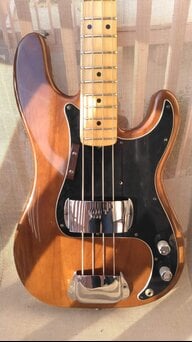
Also, it's just nice to have the visual cue there to break up that long, empty space, especially for unwashed slab players, like myself.
View attachment 4472841
I live in the 1/2 position, playing 5 strings with a high C. Between watching charts and watching the conductor, open strings are more important than marking the first 1/2 step for me.
 
  • Like
Reactions: g-dude
"Just curious why..."

There's no real reason, it's purely aesthetic. And look at the much longer history of guitars for background. For example, with Gibson guitars for inlays we're on lower priced guitars, and those blocks starting at 1st instead of 3rd was another indication of a more deluxe model.

Same reason Leo started with 20 frets. An acoustic guitar with 14 frets clear of the body means you can have 20 frets because of the layout of where the sound hole has to be. When he started the Broadcaster/Esquire he bought necks originally which did not work because they were not fretted well. So got 30 fret necks (which gives you a high C natural on guitars) so he put 20 on the bass in '51. Took him until 1976 to fix that :)
 
If you rarely look at Fender basses... :D
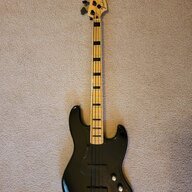
I never said I'm not a dummy. I got home from a weekend trip and looky there, my own newest bass, I wanted the pearly blocks but never gave much thought to the first one. Haha. Jokes on me. I have one with blocks starting on 3 and one starting on 1.
upload_2021-11-15_16-54-18.jpeg