
Enjoy the benefits of a premium membership!
Upgrade Account
-
TalkBass has been independent since 1998. Add your voice.
Create a free account to reply to discussions, view embedded media, and browse with fewer display ads.
Join free Log in
Want zero display ads or expanded classifieds tools? Compare plans.
You are using an out of date browser. It may not display this or other websites correctly.
You should upgrade or use an alternative browser.
You should upgrade or use an alternative browser.
Flatwound strings
- Thread starter Nicolas75
- Start date
More options
Who Replied?

You might want to forget about flatwounds, even though I've never heard of them dying like that, and try these.



Well, it has a lot to do with what you mean by "Dead" and "Alive". I don't know of any electric bass guitar strings that don't lose the... brightness... that they have when you first put them on. Most rounds are especially bright when new, but when that new sound goes away, that doesn't mean they're "dead". It means they're broken in; and the way they sound when they're broken in, is the way they're actually supposed to sound. People tend to change rounds very quickly because they don't want the broken in sound; they want that new brightness. Rounds will stay broken in for a while - how long a while, depends on your body chemistry; how long they're played; and who made them. But, they will die, sooner or later. How do you know when they're actually "Dead"? When they go out of tune quickly is a sign that they're moribund; when they won't intonate? They're well and truly dead. Breaking when you try to tune them, is also a clue...
All that applies to flats, as well, but there are some differences - mostly in degree. Flats also start out bright, but usually take longer than rounds to break in. Sometimes pretty quickly - compared to other flats - and sometimes, they'll take... seemingly forever. A lot of flats also exhibit the "Dull/Dead E string" phenomenon; the A,D, and G string are bright, and the E string sounds dull - or dead. But, as you play them, the E will brighten up, and the others will lose the new brightness. When they meet in the middle? They're broken in, and will sound like they're supposed to. And, if you take reasonable care of them? Depending on your body chemistry, and how much you play them, they can last for several years. But, when they do die? The symptoms are the same; they won't stay in tune, and won't intonate any more... And, yes; there are people who like the new flats sound. Steve Harris, for one. But, he gets his Roto Flats for free...
So... as for your Roto 77s? IME, Roto's Monel Flats are in the "break in quickly" family. And, they will stay broken in for... quite a while. I had a set on my Carvin LB-20 for... 7 or 8 years, if memory serves. That bass was strung BEAD, and if I hadn't decided to put it back to normal EADG tuning, the Rotos would still be on there. Honestly? I don't think your Roto flats actually "died". I'm thinking that they just broke in, and sounded like they were designed to sound...
All that applies to flats, as well, but there are some differences - mostly in degree. Flats also start out bright, but usually take longer than rounds to break in. Sometimes pretty quickly - compared to other flats - and sometimes, they'll take... seemingly forever. A lot of flats also exhibit the "Dull/Dead E string" phenomenon; the A,D, and G string are bright, and the E string sounds dull - or dead. But, as you play them, the E will brighten up, and the others will lose the new brightness. When they meet in the middle? They're broken in, and will sound like they're supposed to. And, if you take reasonable care of them? Depending on your body chemistry, and how much you play them, they can last for several years. But, when they do die? The symptoms are the same; they won't stay in tune, and won't intonate any more... And, yes; there are people who like the new flats sound. Steve Harris, for one. But, he gets his Roto Flats for free...
So... as for your Roto 77s? IME, Roto's Monel Flats are in the "break in quickly" family. And, they will stay broken in for... quite a while. I had a set on my Carvin LB-20 for... 7 or 8 years, if memory serves. That bass was strung BEAD, and if I hadn't decided to put it back to normal EADG tuning, the Rotos would still be on there. Honestly? I don't think your Roto flats actually "died". I'm thinking that they just broke in, and sounded like they were designed to sound...
Last edited:


I've used D'Addario Chromes and they actually take a long time to get to the 'broken in' stage. They are quite bright for a flat wound string. On the other hand the Pyramid Gold flats on my Hofner, the E string has that broken in sound, the rest are brighter but they are somewhat now starting to meet in the middle as GIBrat51 mentioned in his post.
Unfortunately to find exactly what you want you have to experiment and see what suits your sound and your body chemistry and then you can just stick with that. I mainly use rounds and I went through the same process of trying different strings until I settled on DR Hi Beams as my go to.
Unfortunately to find exactly what you want you have to experiment and see what suits your sound and your body chemistry and then you can just stick with that. I mainly use rounds and I went through the same process of trying different strings until I settled on DR Hi Beams as my go to.
Well, it has a lot to do with what you mean by "Dead" and "Alive". I don't know of any electric bass guitar strings that don't lose the... brightness... that they have when you first put them on. Most rounds are especially bright when new, but when that new sound goes away, that doesn't mean they're "dead". It means they're broken in; and the way they sound when they're broken in, is the way they're actually supposed to sound. People tend to change rounds very quickly because they don't want the broken in sound; they want that new brightness. Rounds will stay broken in for a while - how long a while, depends on your body chemistry; how long they're played; and who made them. But, they will die, sooner or later. How do you know when they're actually "Dead"? When they go out of tune quickly is a sign that they're moribund; when they won't intonate? They're well and truly dead. Breaking when you try to tune them, is also a clue...
All that applies to flats, as well, but there are some differences - mostly in degree. Flats also start out bright, but usually take longer than rounds to break in. Sometimes pretty quickly - compared to other flats - and sometimes, they'll take... seemingly forever. A lot of flats also exhibit the "Dull/Dead E string" phenomenon; the A,D, and G string are bright, and the E string sounds dull - or dead. But, as you play them, the E will brighten up, and the others will lose the new brightness. When they meet in the middle? They're broken in, and will sound like they're supposed to. And, if you take reasonable care of them? Depending on your body chemistry, and how much you play them, they can last for several years. But, when they do die? The symptoms are the same; they won't stay in tune, and won't intonate any more... And, yes; there are people who like the new flats sound. Steve Harris, for one. But, he gets his Roto Flats for free...
So... as for your Roto 77s? IME, Roto's Monel Flats are in the "break in quickly" family. And, they will stay broken in for... quite a while. I had a set on my Carvin LB-20 for... 7 or 8 years, if memory serves. That bass was strung BEAD, and if I hadn't decided to put it back to normal EADG tuning, the Rotos would still be on there. Honestly? I don't think your Roto flats actually "died". I'm thinking that they just broke in, and sounded like they were designed to sound...
That's it! I play a lot of Maiden and the SH77's break very quickly and at the price these strings cost I should have a job just for that! Maybe I should play with old roundwound strings but I find that Harris' sound comes from his unique technique and fresh flat... All in all thanks for the great info!


Which Rotosound flats are you using? I use the Jazz 77 and found the total opposite. My main gigging bass I got the current set for at least two months and they still sound great. And I gig 2-3 times a week.
Which Rotosound flats are you using? I use the Jazz 77 and found the total opposite. My main gigging bass I got the current set for at least two months and they still sound great. And I gig 2-3 times a week.
I use these. Just bigger size than jazz77
Attachments

After reading this thread, I’d suggest Chromes for you. Even when they’re broken in, they still have brightness in the upper- midrange, and my first set on my main P lasted 10 years without intonation problems.
Thanks, I'll these.

I don't understand this. I have LaBella 760s on my P bass since 2008 and they sound exactly the same. My other flats basses have TI Jazz Flats for years and I never even consider taking them off.
Just BTW - I never liked Chromes. To my year they have a 'honk" that I don't care for.
Just BTW - I never liked Chromes. To my year they have a 'honk" that I don't care for.

I’m all in on Ernie Ball Cobalt Flats. They are very bright and seem to remain that wayErnie Ball cobalt flats

I like flatwound from Rotosound but they become dead very fast! Does anyone know flat that stay alive longer ?
Ernie ball cobalt bro. Best flat strings out.

Ernie Ball Slinky Cobalt Flat wounds. They will go for around 2 years with care wiping them down after performances. Labella Low Tension Flat wounds are also great.


OK, this is 46 years of experience talking:
1) The most underrated stainless flats are Ernie Ball Stainless Flats (not cobalt). They have a subtle growl and last forever, mellowing to a great classic flat tone.
2) For modern flats, the Fender 9050L set starts out growly and mellows to a great tone that slots a mix well, and also lasts forever. I heavily gigged a set for two years, then replaced the E string with an Ernie Ball of the same gauge because I thought it was a little thumpy, (Fender doesn't sell singles) and gigged the set another year. The only reason I changed them was because that band ended and the next band had a different repertoire that rounds suited the repertoire better. They would have lasted indefinitely otherwise, and I keep a couple of used sets on hand so I am prepared for any gig that requires that tone.
3) La Bella flats last for more than a decade. Period. I don't have a gig right now where the 760FL set 43-104 is the appropriate set, but if I had such a gig, and bought a new set tomorrow, it would last me the rest of my playing days.
4) And now for something completely different: GHS Balance Pure Nickel rounds. Yes, they are rounds. But the winding is pure nickel. After settling in after the new string zing, and after about a year or so of gigging, they have started taking on some of that woody quality that we all miss about "golden era" Fender Flats made by the V. C. Squier company. I have a set on a travel bass. They have encountered the vagaries of travel, salt sea air from gigging at a Mexico resort, and in spite of a little discoloration, rock on. Again, I tend to kill E strings (probably because I prefer a slightly larger gauge, so the core is thicker, and by definition has less overtones to match the rest of the set after settling in), so in two years and two trips to Mexico, I did finally replace the E string. I don't anticipate changing this set in the foreseeable future.
5) With due respect, I completely disagree with those who use EB Cobalt flats. In my experience, they were lively, grindy, clanky, modern, trendy, etc., until one day about a year and a half in, they all just went thud all of a sudden, losing tone, sustain, intonation: they just died a horrible death unexpectedly.
6) With due respect, I also completely disagree with D'A Chromes. In my experience, they start out with new string zing that is actually annoying, despite rolling down the tone knob, and they have a short settled in period before they die to worthless thud. Not mellow or dark tone that flats are known for, just worthless thud devoid of tone and sustain.
7) Some folks have had good experiences with the dark chocolate tone of GHS flats having good longetivity. I defer, because I don't use them or gig with them.
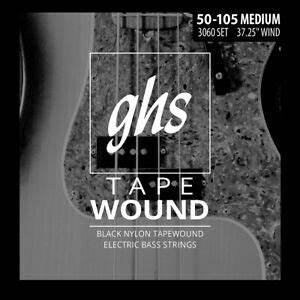
8) Some have commented on using tapewounds instead. That is a whole 'nutha kettle of fish. Yes, they are mellow, but to get a similar feel, you must use the 60-115 regular gauge instead of the light 50-105 light set. You must re-cut a new nut to accommodate the larger diameters without pinching and losing tuning stability. The nylon is a disconnect from the bridge ground so you must use EMG actives that don't use a bridge ground to fully eliminate noise and hum. Don't listen to those who claim good shielding will suffice. I had them on a bass that despite doing everything that everyone else will claim kills noise, shielding, care in soldering the grounds, etc., I had to anchor my thumb on the metal pickup cover which was grounded passively to kill all the noise and hum on the passive bass with humbucking pickups (Rickenbacker HB-1 and DiMarzio Ultra Jazz) that I had nylon tapes on for awhile. The nylon tape is @ 15 thou thick, but adds no appreciable mass, so the 60-115 set is roughly equivalent tension-wise to a 45-100 set of rounds with the tone rolled off. For some folks that is a good option. I gigged a set for about two years until the frets wore divots into the nylon tape and the strings lost intonation stability and sustain.
1) The most underrated stainless flats are Ernie Ball Stainless Flats (not cobalt). They have a subtle growl and last forever, mellowing to a great classic flat tone.
2) For modern flats, the Fender 9050L set starts out growly and mellows to a great tone that slots a mix well, and also lasts forever. I heavily gigged a set for two years, then replaced the E string with an Ernie Ball of the same gauge because I thought it was a little thumpy, (Fender doesn't sell singles) and gigged the set another year. The only reason I changed them was because that band ended and the next band had a different repertoire that rounds suited the repertoire better. They would have lasted indefinitely otherwise, and I keep a couple of used sets on hand so I am prepared for any gig that requires that tone.
3) La Bella flats last for more than a decade. Period. I don't have a gig right now where the 760FL set 43-104 is the appropriate set, but if I had such a gig, and bought a new set tomorrow, it would last me the rest of my playing days.
4) And now for something completely different: GHS Balance Pure Nickel rounds. Yes, they are rounds. But the winding is pure nickel. After settling in after the new string zing, and after about a year or so of gigging, they have started taking on some of that woody quality that we all miss about "golden era" Fender Flats made by the V. C. Squier company. I have a set on a travel bass. They have encountered the vagaries of travel, salt sea air from gigging at a Mexico resort, and in spite of a little discoloration, rock on. Again, I tend to kill E strings (probably because I prefer a slightly larger gauge, so the core is thicker, and by definition has less overtones to match the rest of the set after settling in), so in two years and two trips to Mexico, I did finally replace the E string. I don't anticipate changing this set in the foreseeable future.
5) With due respect, I completely disagree with those who use EB Cobalt flats. In my experience, they were lively, grindy, clanky, modern, trendy, etc., until one day about a year and a half in, they all just went thud all of a sudden, losing tone, sustain, intonation: they just died a horrible death unexpectedly.
6) With due respect, I also completely disagree with D'A Chromes. In my experience, they start out with new string zing that is actually annoying, despite rolling down the tone knob, and they have a short settled in period before they die to worthless thud. Not mellow or dark tone that flats are known for, just worthless thud devoid of tone and sustain.
7) Some folks have had good experiences with the dark chocolate tone of GHS flats having good longetivity. I defer, because I don't use them or gig with them.
8) Some have commented on using tapewounds instead. That is a whole 'nutha kettle of fish. Yes, they are mellow, but to get a similar feel, you must use the 60-115 regular gauge instead of the light 50-105 light set. You must re-cut a new nut to accommodate the larger diameters without pinching and losing tuning stability. The nylon is a disconnect from the bridge ground so you must use EMG actives that don't use a bridge ground to fully eliminate noise and hum. Don't listen to those who claim good shielding will suffice. I had them on a bass that despite doing everything that everyone else will claim kills noise, shielding, care in soldering the grounds, etc., I had to anchor my thumb on the metal pickup cover which was grounded passively to kill all the noise and hum on the passive bass with humbucking pickups (Rickenbacker HB-1 and DiMarzio Ultra Jazz) that I had nylon tapes on for awhile. The nylon tape is @ 15 thou thick, but adds no appreciable mass, so the 60-115 set is roughly equivalent tension-wise to a 45-100 set of rounds with the tone rolled off. For some folks that is a good option. I gigged a set for about two years until the frets wore divots into the nylon tape and the strings lost intonation stability and sustain.
Last edited:

Might wanna consider half wounds or even rounds. I’d also get use to replacing them often. Strings don’t retain that new zing regardless of brand. Flats are generally strings we bassists want to be dead.

JeezyMcNuggles
Inactive
- Feb 23, 2018
- 14,723
- 20,970
- Disclosures
- I suck, but nobody really notices
?I like flatwound from Rotosound but they become dead very fast! Does anyone know flat that stay alive longer ?
You mean they only last 8 years instead of 10 - 20?
Hmm, any other flatwound on the market?
Strange, strings made from Monel has the best corrosion resistance of any flats, which is why I find them long lasting. But as others said, people buy flats not for brightness. They want the tone after they have been broken in for awhile and loss that high end zing.
If you want something in between flats and rounds, try GHS Pressure Wound strings. Awesome sounding strings, have them on my P-Bass.
Personally I stay away from half rounds or ground wound strings. I hate how they feel and sound. Haven’t tried a set yet I liked.


