Michael Fournelle in Montreal. I believe he personally retired but his shop still builds by commission.Who built it?

TalkBass has been independent since 1998. Add your voice.
Create a free account to reply to discussions, view embedded media, and browse with fewer display ads.
Join free Log in
Want zero display ads or expanded classifieds tools? Compare plans.
Michael Fournelle in Montreal. I believe he personally retired but his shop still builds by commission.Who built it?

In his case it won’t matter at all since he’s using a piezo pickup.This is why tapewounds should always be top-loaded (vs. thru-body) so the ball ends would have direct contact with the bridge.

Yes, I get that. I wasn't necessarily commenting on the OP's specific case; it was a general comment regarding the grounding issue with tapewounds.In his case it won’t matter at all since he’s using a piezo pickup.
It is bass specific though. I’ve got mine thru-body. However I did a stellar job shielding it, and I’m using Barts, which are also quiet as a mouse. It can be done, but yes it is easy to get that ground by top loading. I’ve read some hilarious methods people have grounded themselves to get a tape wound bass quiet in the studio. I believe I read that in the tapewound club.Yes, I get that. I wasn't necessarily commenting on the OP's specific case; it was a general comment regarding the grounding issue with tapewounds.

Agreed, and that IMO is one more reason for preferring "regular" tapes ( = E string gauge between 110 and 115, or the internally flatwound, ergo heavier, GHS tapes) over the thinner sets, which can only be played with a moderate to featherlight touch. Nothing wrong with that, but if the specific goal is mimicking upright tones, playing with the side of the index, over the last frets or just past them, with some force, are each important ingredients.Tapes will probably sound the closest, but what will probably make a bigger difference is raising the action, turning down the amp, and plucking harder (which is the opposite of what you should do for general BG playing). The pizzicato double bass sound’s defining characteristic isn’t how bright or dark the tone is, it’s the thump from pulling the strings hard and the sharp attack and fast decay that comes from it. Some double bassists rely on an amp more than others (and thereby play more lightly), but the average jazz double bassist will still be plucking the strings much harder than the average bass guitarist.
I'd probably still pluck around the neck pickup (or where it would be): the fingerboard of a double bass tends to end around the B4–D5 area (which if we had a fretboard that long it would be frets 28–31) and jazz double bassists tend to pluck near the end of the fingerboard, which coincidentally is also roughly where a P bass pickup or the neck pickup of a J bass lies.Agreed, and that IMO is one more reason for preferring "regular" tapes ( = E string gauge between 110 and 115, or the internally flatwound, ergo heavier, GHS tapes) over the thinner sets, which can only be played with a moderate to featherlight touch. Nothing wrong with that, but if the specific goal is mimicking upright tones, playing with the side of the index, over the last frets or just past them, with some force, are each important ingredients.


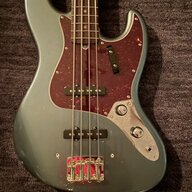
You’ll get the best mimic of an upright from Rotosound 88s.Hello. Im a bit confused about strings for an upright bass sound (See my earlier thread) I know I want flatwounds or nylon tapewounds, but I don't know the difference between them sound wise. What is usually preferred for upright sound? Will be played on a (semi) hollow fretless Ibanez. Do flatwounds with nylon exist? Feel free to recommend specific strings aswell!

Well...Hello. Im a bit confused about strings for an upright bass sound (See my earlier thread) I know I want flatwounds or nylon tapewounds, but I don't know the difference between them sound wise. What is usually preferred for upright sound? Will be played on a (semi) hollow fretless Ibanez. Do flatwounds with nylon exist? Feel free to recommend specific strings aswell!

It is bass specific though. I’ve got mine thru-body. However I did a stellar job shielding it, and I’m using Barts, which are also quiet as a mouse. It can be done, but yes it is easy to get that ground by top loading.