• TalkBass has been independent since 1998. Add your voice.
    Create a free account to reply to discussions, view embedded media, and browse with fewer display ads.
    Join freeLog in
    Want zero display ads or expanded classifieds tools? Compare plans.
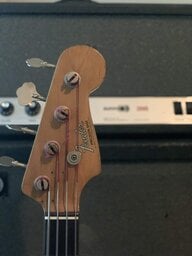
Flatwounds on a J Bass - overall thoughts and experiences?

One of my favorite sounds ever.
IMG_8282.jpeg
 
I put some Ernie Ball cobalt flats on my AVii Jazz to great results, only took the off because i want to put them on a AVii P i just got, and I had gotten a crap ton of markbass string sets during a blow out sale.
 
I've played bass for what seems like a hundred years (and I'm going to keep doing it until I get it right!) In the late sixties, I played flats because it was what was readily available. In about 1974, a preacher named Boatright--the "rite" of Mosrite--gave me three sets of Mosrite bass strings because he saw me playing a Mosrite Celebrity bass. They were roundwounds., and I loved them. After that, I played nothing but roundwounds on all my basses for about 45 years, but now I find myself switching back to flats on some of my basses. To get the comfort of flatwounds with some of the tonal characteristics of roundwounds, I use either Rotosound 77 Monel flats or Ernie Ball Slinky Cobalt flats. I've tried the new Fender flats (too thin for my taste) and the LaBella Deep Talkin' flats (too thumpy for my taste). Hope you find this helpful.
 
The use of flats on a Rickenbacker 4001 may not have been Paul's "choice". Rounds were really new at that point, and Ric's shipped with their flatwound strings (and warnings not to use other strings) - Paul probably played the thing, thought it sounded OK (way more sustain than a Hofner!) and continued on. He probably hadn't played rounds, and flats lasted long enough that changing strings on a bass wasn't something you thought of doing often (if at all) back then.
I recall an anecdote (don't know how true it is) that John Entwistle loved roundwounds but at the time the only sets available in England were the ones that Danelectro installed on their basses in the factory, so for a while he was buying a new Dano bass every time he needed a fresh set of strings

 
  • Like
Reactions: jglunt
I recall an anecdote (don't know how true it is) that John Entwistle loved roundwounds but at the time the only sets available in England were the ones that Danelectro installed on their basses in the factory, so for a while he was buying a new Dano bass every time he needed a fresh set of strings
Rotosound introduced round wounds in 1962. The WHO's first hit was 3 years after that. He may have done that a couple times, but he didn't have to do it for too long. Entwistle was involved with Rotosound early on; he ay have had prototype round wound strings before they were introduced.
 
  • Like
Reactions: MrAB4003
I've always been a roundwound player, mostly because 1: that's what all the basses I've ever bought have shipped with, and 2: because I like plenty of treble in my sound, whatever the bass.

With that said, one bass tone I've always loved and craved is Paul McCartney's late-years Beatles tone (from '66 onwards) - think "With A Little Help From My Friends", or "Something", that really full and rounded tone that sounds so beautiful and punches through the mix. I know there were a lot of factors behind that tone, including his switch to a Rickenbacker 4001 (at first), and, perhaps more significantly, changes to the recording techniques used as he chased a more Motown sound. I'm also aware that he probably used flats on his Rick. I know he also used a Jazz Bass in the later Beatles years, but I'm not sure what sort of strings he used on it, or which songs exactly he used it on, and searches have thrown up conflicting answers.

Anyway, I have a Squier Paranormal Jazz '54, which currently serves me primarily as a back-up gig bass, but also as a live bass on a single song my band plays that needs a really trebly tone that my Squier Rascal can't quite reach. I play with a pick, and achieve this tone by using the bridge pickup, tone at 100%, and EQing to cut the mids and boost the treble and bass. I do also sometimes use it for funky pick-played basslines too, in an Andy Rourke (The Smiths) vein, with a balanced EQ and both pickups at 100% tone.

I've thought about experimenting with flats, and this seems to me the ideal bass in my line-up to try them on, but there are two main questions I have before taking the plunge (and spending money on potentially two sets of strings if I don't like the results):

1: Would flats on a Jazz help me get close(r) to that post-'66 McCartney tone?

2: Would flats completely get rid of that absolute maximum J Bass treble, or just alter it a little?

Any tips or experiences from any J Bass flats users would be hugely appreciated!
I think what you will find what you are looking is not necessarily a bass/string issue. It’s more of a EQ issue.

One, do not cut low mids (ever lol), use a slight boost about 125-150 this where you will get that oomph . Start with the bass and treble set to flat, boost low mids, and use 750-800 hz for treble regulation. An HPF and a touch of compression might help.

With regards to theJB, I bought an AM JB pro 5 last summer that came with flats (the first bass I’ve owned since 1974 with flats on it). I’ve done a fair amount of recording with it and a few gigs. My observation, while it records extremely well with flats, providing the plain Jane typical Fender sound. It’s spot on for that. Live performance, give me rounds any day of the week, in particular DR Lo Riders.

I don’t want to be discouraging here. I get the fun in trying to duplicate a certain tone, and hopefully you come up with some useful tone settings along the way. But you have to understand what goes into the manufacture of the sound goes well beyond the choice of strings and bass. Most of us don’t have the type of gear you may find in a studio for sound production or the engineering talent to design it. I know for a fact I sure don’t.

Best wishes and I hope you find this useful.
 
I have spent years fighting against the flat wound thing for lots of reasons, but mainly because getting a reasonable tone that is able to cut through a live mix is difficult with traditional flats. I love the way TIJF's sound when they are new, the first few months, but once they get broken in they are too thumpy with too much midrange. I tried Labella LTF's, they get lost sound wise in my livingroom, forget about in a live mix. EB Cobalt flats though are a whole different animal, they don't sound like rounds as way too many people claim, but they have enough treble content to satisfy me. I currently have them on a Fender J that has Dimarzio Area J pickups in it and I have them in a Nash PJ with Lollars, both basses sound really good with them. I am not going away from rounds in total, but it is nice to have a little variety string wise.
 
  • Like
Reactions: Swerve
Would flats on a Jazz help me get close(r) to that post-'66 McCartney tone?

Yes, but not necessarily. It will depend very much on what type of flats you install. Different types of flats can vary a LOT more in tone than different types of rounds.

I won't pretend to be an expert on what type of flats Paul McCartney used (I'm not) but if you want to nail the McCartney tone I would like to mention a couple of things:

Most of the flats recommended in this thread didn't even exist back then, and many of them sound VERY different from the flats that DID exist back then.

If I had to make a guess on what type of flats McCartney used on his Rick, I would have to go with the flats that were factory installed on Ricks back then, which were Maxima flats. These have been "reissued" as Optima RB flats. These are round core, only available in relatively light gauges, very supple. They have a lovely tone but they are too light/supple for MY playing style (fret buzz).

I'm pretty sure McCartney used Pyramid Gold flats on his Höfners. These strings have (to my knowledge) always been the factory installed strings on German made Höfners, even today. Pyramid Golds are my favorite flats for short scale basses, but I've never liked them much on long scale basses. The Golds have a rather "dead" sounding E-string that gets a bit TOO "dead" for my taste with the long scale sets.

I'm also pretty sure that during the latter years of The Beatles, McCartney used tapewounds rather than flats (probably Rotosound 88s).

I have no idea what kind of flats McCartney used on his Jazz Bass, but if I had to guess I would have to go with the factory installed Fender flats. There were very different from current Fender flats. The closest flats available today are probably GHS Precision Flats (there's a historical connection between GHS and the V.C. Squier Company that made Fender strings back then). But then again, he might have used completely different flats, like LaBellas which were definitely available at the time. LaBellas would have been the obvious choice if he was deliberately aiming for "the Motown tone".

Would flats completely get rid of that absolute maximum J Bass treble, or just alter it a little?

Flats can start out pretty bright, but once they mellow out (which is what most people want from flats), yes they will completely get rid of "that maximum J bass treble". At least with the types of flats that existed back then (except possibly Roto 77 flats which are quite bright, but I have never heard anything about McCartney using Roto 77s).
 
I could be wrong, but I was under the impression (based on what my ears tell me) that onWith A Little Help From My Friends
Paul is playing the Hofner. Regardless, I use Ernie Ball Slinky Cobalt Flats on both of my Lakland 55-94’s. I used Thomastick Jazz flats on my 65 Fender Jazz for years until the price jumped to ridiculous.
 
Last edited:
I've always been a roundwound player, mostly because 1: that's what all the basses I've ever bought have shipped with, and 2: because I like plenty of treble in my sound, whatever the bass.

With that said, one bass tone I've always loved and craved is Paul McCartney's late-years Beatles tone (from '66 onwards) - think "With A Little Help From My Friends", or "Something", that really full and rounded tone that sounds so beautiful and punches through the mix. I know there were a lot of factors behind that tone, including his switch to a Rickenbacker 4001 (at first), and, perhaps more significantly, changes to the recording techniques used as he chased a more Motown sound. I'm also aware that he probably used flats on his Rick. I know he also used a Jazz Bass in the later Beatles years, but I'm not sure what sort of strings he used on it, or which songs exactly he used it on, and searches have thrown up conflicting answers.

Anyway, I have a Squier Paranormal Jazz '54, which currently serves me primarily as a back-up gig bass, but also as a live bass on a single song my band plays that needs a really trebly tone that my Squier Rascal can't quite reach. I play with a pick, and achieve this tone by using the bridge pickup, tone at 100%, and EQing to cut the mids and boost the treble and bass. I do also sometimes use it for funky pick-played basslines too, in an Andy Rourke (The Smiths) vein, with a balanced EQ and both pickups at 100% tone.

I've thought about experimenting with flats, and this seems to me the ideal bass in my line-up to try them on, but there are two main questions I have before taking the plunge (and spending money on potentially two sets of strings if I don't like the results):

1: Would flats on a Jazz help me get close(r) to that post-'66 McCartney tone?

2: Would flats completely get rid of that absolute maximum J Bass treble, or just alter it a little?

Any tips or experiences from any J Bass flats users would be hugely appreciated!
1. Surely closer than roundwounds.
2. Flatwounds tremendously reduces the maximum treble, but neither COMPLETELY nor minimally alters it.

Use your tone control. Use the volume control on your bass. Turn the amp up and the volume down. You WILL loose treble. You can get into some VERY muddy tones without the need to resort to flatwounds. I've had a couple of sets of flatwounds for 30+ years. I keep trying them. I never like the feel/resonance/tonal compromise required to use them when I can do so much with roundwounds and other tone shaping possibilities available in every bass I own. The setlists of music I play in 2 out of 3 bands requires in a LIVE, gigging setting for me to emulate Motown, Upright bass and very zingy funk slap tones- Flatwounds willl never work for me in the tremendous diversity of songs, genres and tones I need to emulate. They might work for you, though.
 
I've never put flats on my '90 Jazz Plus but have had GHS pressure wounds on it for about a year. After the initial brightness wore off (about 2 months), they have really solid low end and mid-range, and a good deal of punch, without the annoying brightness and string noise of rounds. The pressure wounds show no signs of wearing out. My '72 Rick came with flats but I did not get the warning about not changing to other strings, perhaps it wasn't a 4001? I had all kinds of strings on that thing over the 12 years I owned it, but I never put flats back on after the initial change-out. Seemed like it preferred rounds. It did not sound good with tapes. I had heard that the Rick was made for flats, to emulate the sound of a stand-up bass? I just wanted to sound like Squier (who said in interview he used to change strings before every concert, to get max zing).
 
I have come full circle regarding flats on a Jazz bass.
When I first tried them, they sounded tubby and dead to me so I quickly went back to rounds.

Nowadays, I used brighter flats like Chromes or EB Cobalt Flats, and I leave the tone control up and let the strings' clack come through.
It sounds a little rough soloed, but in the mix, the extra high end sonic content adds a lot to the perceived articulation of each note and helps with clarity.

I also find that with Cobalt flats, I can get a nice, burpy, growl from the bridge pickup on a Jazz bass.
 
It always depends on the amp , cab , bass and player . I just bought the Ernie Ball Pino Palladino flats and I put them on my Tokai 62 JB and while sounding good , not what I wanted . Ended up putting strings on Fender Mustang and it was perfect . By the way , those strings are fantastic (feel/tone) .
 
  • Like
Reactions: Swerve and kevk