I've always been a roundwound player, mostly because 1: that's what all the basses I've ever bought have shipped with, and 2: because I like plenty of treble in my sound, whatever the bass.
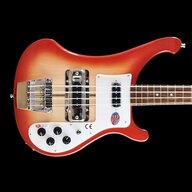
With that said, one bass tone I've always loved and craved is Paul McCartney's late-years Beatles tone (from '66 onwards) - think "With A Little Help From My Friends", or "Something", that really full and rounded tone that sounds so beautiful and punches through the mix. I know there were a lot of factors behind that tone, including his switch to a Rickenbacker 4001 (at first), and, perhaps more significantly, changes to the recording techniques used as he chased a more Motown sound. I'm also aware that he probably used flats on his Rick. I know he also used a Jazz Bass in the later Beatles years, but I'm not sure what sort of strings he used on it, or which songs exactly he used it on, and searches have thrown up conflicting answers.
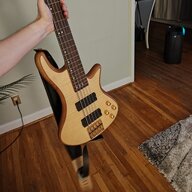
Anyway, I have a Squier Paranormal Jazz '54, which currently serves me primarily as a back-up gig bass, but also as a live bass on a single song my band plays that needs a really trebly tone that my Squier Rascal can't quite reach. I play with a pick, and achieve this tone by using the bridge pickup, tone at 100%, and EQing to cut the mids and boost the treble and bass. I do also sometimes use it for funky pick-played basslines too, in an Andy Rourke (The Smiths) vein, with a balanced EQ and both pickups at 100% tone.
I've thought about experimenting with flats, and this seems to me the ideal bass in my line-up to try them on, but there are two main questions I have before taking the plunge (and spending money on potentially two sets of strings if I don't like the results):
1: Would flats on a Jazz help me get close(r) to that post-'66 McCartney tone?
2: Would flats completely get rid of that absolute maximum J Bass treble, or just alter it a little?
Any tips or experiences from any J Bass flats users would be hugely appreciated!
With that said, one bass tone I've always loved and craved is Paul McCartney's late-years Beatles tone (from '66 onwards) - think "With A Little Help From My Friends", or "Something", that really full and rounded tone that sounds so beautiful and punches through the mix. I know there were a lot of factors behind that tone, including his switch to a Rickenbacker 4001 (at first), and, perhaps more significantly, changes to the recording techniques used as he chased a more Motown sound. I'm also aware that he probably used flats on his Rick. I know he also used a Jazz Bass in the later Beatles years, but I'm not sure what sort of strings he used on it, or which songs exactly he used it on, and searches have thrown up conflicting answers.
Anyway, I have a Squier Paranormal Jazz '54, which currently serves me primarily as a back-up gig bass, but also as a live bass on a single song my band plays that needs a really trebly tone that my Squier Rascal can't quite reach. I play with a pick, and achieve this tone by using the bridge pickup, tone at 100%, and EQing to cut the mids and boost the treble and bass. I do also sometimes use it for funky pick-played basslines too, in an Andy Rourke (The Smiths) vein, with a balanced EQ and both pickups at 100% tone.
I've thought about experimenting with flats, and this seems to me the ideal bass in my line-up to try them on, but there are two main questions I have before taking the plunge (and spending money on potentially two sets of strings if I don't like the results):
1: Would flats on a Jazz help me get close(r) to that post-'66 McCartney tone?
2: Would flats completely get rid of that absolute maximum J Bass treble, or just alter it a little?
Any tips or experiences from any J Bass flats users would be hugely appreciated!